Short answer: PVARA vs Pakistan Crypto Council in one line: PVARA is the regulator created by law, with the power to license, inspect and penalise crypto companies. The Pakistan Crypto Council (PCC) is a policy body set up under the Ministry of Finance in March 2025. The Council advises and promotes. Only PVARA can authorise a platform.
Key takeaways
- PCC came first: the Ministry of Finance launched the Pakistan Crypto Council on 14 March 2025, chaired by the Finance Minister.
- PVARA has the legal power: it was created by the Virtual Assets Ordinance in July 2025 and now works under the Virtual Assets Act, 2026, which Parliament passed on 6 March 2026.
- Only PVARA licenses. The PCC cannot issue a licence, an NOC or a fine. A platform that says it is “approved by the Crypto Council” has shown you nothing.
- Penalty for unlicensed service: up to 5 years in prison, a fine up to PKR 50 million, or both, under section 54 of the Act.
- Complaints go to PVARA, through its online portal. The Council has no public complaint desk that we could find.
- No full licence found yet: as of 15 November 2026, we found no public register of licensees on PVARA’s website and no report of a full licence.
On this page
- PVARA vs Pakistan Crypto Council at a glance
- What is the Pakistan Crypto Council?
- What is PVARA?
- What can PVARA do that the Council cannot?
- Who leads PVARA and the PCC in November 2026?
- Where do SBP, SECP and FBR fit?
- Timeline: Pakistan’s crypto bodies from 2025 to November 2026
- What does this mean for an ordinary user?
- Common mistakes people make
- FAQ
- Your next step
The two names get mixed up because, for most of 2025, the same person was the public face of both. They are not one thing. One is a table where policy is discussed. The other is an authority with a law behind it.
Want to check a platform right now? Use the free PVARA checker tool or follow the steps in the guide on how to check a crypto exchange licence in Pakistan.
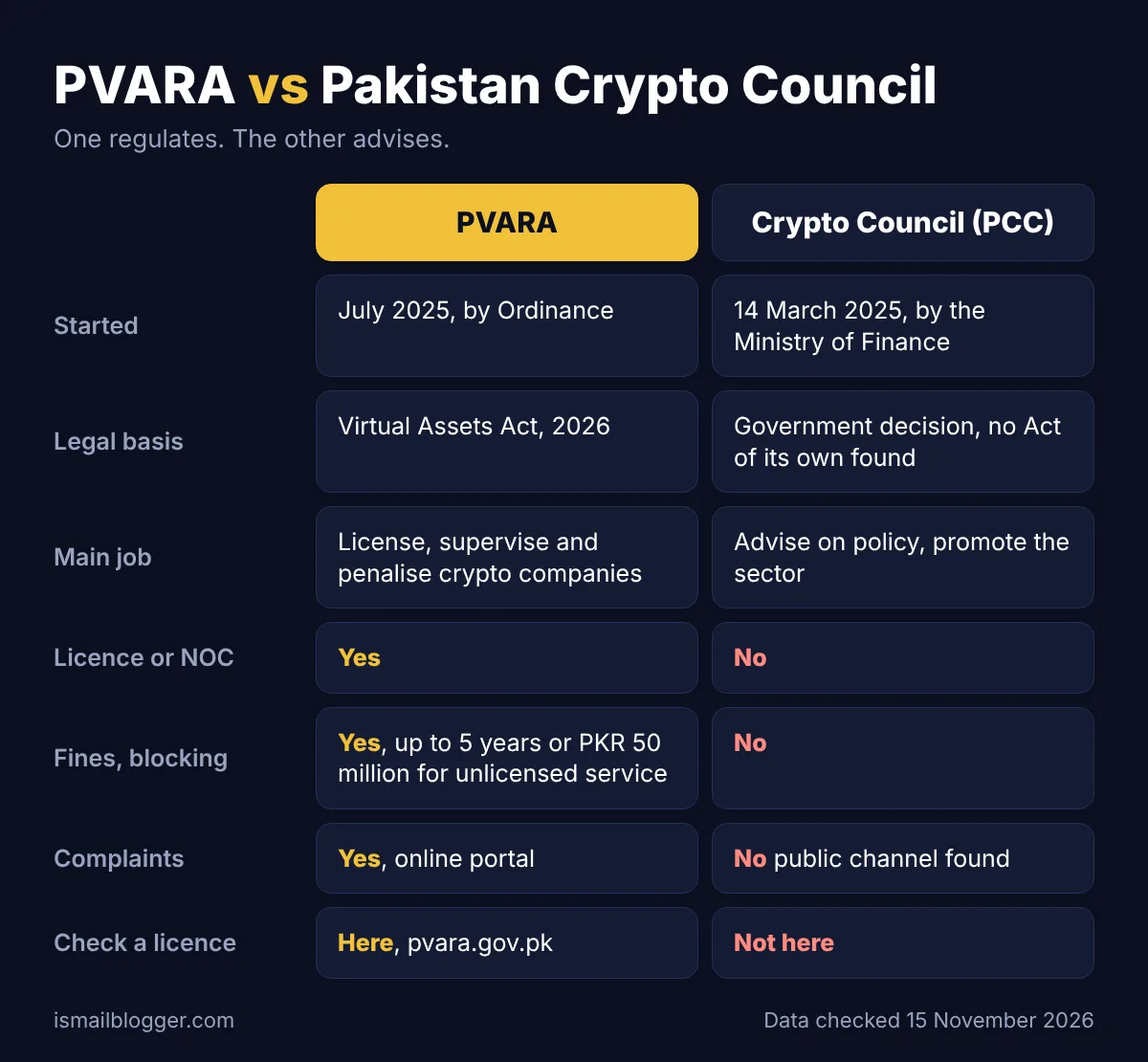
PVARA vs Pakistan Crypto Council at a glance
| Point | PVARA | Pakistan Crypto Council (PCC) |
|---|---|---|
| Full name | Pakistan Virtual Assets Regulatory Authority | Pakistan Crypto Council |
| Started | July 2025, by Ordinance | 14 March 2025, by the Ministry of Finance |
| Legal basis | Virtual Assets Act, 2026 | Government decision, no Act of its own that we could find |
| Main job | License, supervise and penalise crypto companies | Advise on policy, promote the sector, engage internationally |
| Can issue a licence or NOC | Yes | No |
| Can fine or block a platform | Yes | No |
| Takes public complaints | Yes, online portal | No public complaint channel found |
| Headed by | Chairman Bilal bin Saqib (press, 6 November 2026) | Chaired by Finance Minister Muhammad Aurangzeb (at launch) |
Facts in this table were checked on 15 November 2026.
What is the Pakistan Crypto Council?
The Pakistan Crypto Council is a government backed policy body. The Ministry of Finance announced its launch on 14 March 2025, and Profit carried the official press release the same day.
According to that release, the Council’s job is to help form policy, set a direction for regulation, talk to international crypto and blockchain organisations, and work with fintech startups and developers. Notice the verbs: form, engage, work with. None of them is “license” or “penalise”.
Who sits on the Council?
At launch, the Council was chaired by Finance Minister Muhammad Aurangzeb, with Bilal bin Saqib as its chief executive. The first board members were the Governor of the State Bank, the Chairman of SECP, the Federal Law Secretary and the Federal IT Secretary.
In April 2025, Binance founder Changpeng Zhao was named a strategic adviser to the Council, as Al Jazeera reported. An adviser to a policy body is not a licence for any exchange, and it should not be read as one.
What has the Council actually done?
Its most important act was to help create the regulator. On 2 June 2025, a Council meeting chaired by the Finance Minister agreed to form a technical committee, with people from SBP, SECP, the Law Division and the IT Division, to draft a framework and review a proposal for an autonomous regulator. The Express Tribune reported it the next day.
About five weeks later, that autonomous regulator existed. Its name was PVARA.
What is PVARA?
PVARA stands for the Pakistan Virtual Assets Regulatory Authority. On its own website it describes itself as Pakistan’s independent federal regulator for virtual assets, established under the Virtual Assets Act, 2026.
It began under the Virtual Assets Ordinance, 2025, promulgated in July 2025. An ordinance is temporary, so Parliament later passed the Virtual Assets Act 2026 on 6 March 2026, as Arab News reported. That Act is what gives PVARA permanent legal standing.
PVARA’s About page lists its work as licensing and supervision, anti money laundering compliance and market integrity, and it says the Authority can impose penalties, suspend licences and take legal action against unauthorised operators.
The licence categories, capital and application steps are in the full PVARA guide, so they are not repeated here.
The Crypto Council can recommend a rule. Only PVARA can enforce one.
What can PVARA do that the Council cannot?
This is the part that matters when a platform, a Telegram admin or a YouTube ad throws official sounding names at you.
| Power | PVARA | PCC |
|---|---|---|
| Grant an NOC or a licence | Yes | No |
| Make binding regulations | Yes, two sets notified on 21 August 2026 | No |
| Order online material of an unlicensed service blocked | Yes, section 61 of the Act | No |
| Act against unlicensed service | Yes, section 54: up to 5 years, up to PKR 50 million, or both | No |
| Keep a public register of licensees | Required, per PVARA’s FAQ | No |
To put the penalty in rupees: PKR 50 million is Rs 5 crore. That is the maximum fine in the Act for wilfully providing an unlicensed virtual asset service. It applies to businesses offering the service, and it is a ceiling, not a fixed amount.
“Registered with the Pakistan Crypto Council” is not a real status. The Council does not register, approve or license platforms. If an app or group uses that line to win your trust, treat it as a red flag and read the guide on crypto scams in Pakistan.
Who leads PVARA and the PCC in November 2026?
People change, so each name here carries a date.
PVARA: Bilal bin Saqib is the chairman. The Tribune described him on 6 November 2026 as Minister of State and Chairman PVARA. Dawn reported in December 2025 that he was appointed for three years, with the status of a minister of state, on a pro bono basis.
PCC: The Finance Minister chaired the Council at launch, and Bilal bin Saqib was its CEO. Dawn still described him as the Council’s CEO in December 2025. We could not find a 2026 official statement that confirms the Council’s current office holders, so treat the PCC line up as “last confirmed December 2025”.
There is one more detail that explains a lot of the confusion. In May 2025 he was also made Special Assistant to the Prime Minister on blockchain and crypto. He later resigned from that post, and the Tribune reported the reason: under the Rules of Business, a special assistant cannot also chair a statutory regulator.
PVARA’s website does not name its chairman or board members on the pages we opened on 15 November 2026. The names above come from press reports, with the dates shown.
Where do SBP, SECP and FBR fit?
PVARA is not the only office with a say. Here is how the others connect, in plain words.
- State Bank of Pakistan (SBP): controls banks and payment companies. Its circular of 14 April 2026 let banks open accounts for PVARA licensed companies after checking the licence with PVARA, according to press reports. The same circular still bars banks themselves from investing in or holding virtual assets.
- SECP: registers companies and regulates securities and investment schemes. A company certificate from SECP is not permission to offer crypto services or take deposits.
- FBR: handles tax. The Virtual Assets Act is about licensing, not tax. An FBR official told Arab News in June 2026 that crypto income is already taxable under existing law, and press reports said the 2026 to 27 budget added no new crypto tax.
- FMU: the Financial Monitoring Unit receives suspicious transaction reports from banks and from licensed crypto companies.
The Governor of SBP and the Chairman of SECP sat on the Crypto Council from day one. The Act also gives both a seat on PVARA’s board. So the same institutions sit at both tables, but they sit there in different roles: advising in one, governing a regulator in the other.
Under the Act, virtual assets are not legal tender in Pakistan. A licence for a company to offer services does not turn any coin into money you can legally settle debts with. More on this in is crypto legal in Pakistan.
Timeline: Pakistan’s crypto bodies from 2025 to November 2026
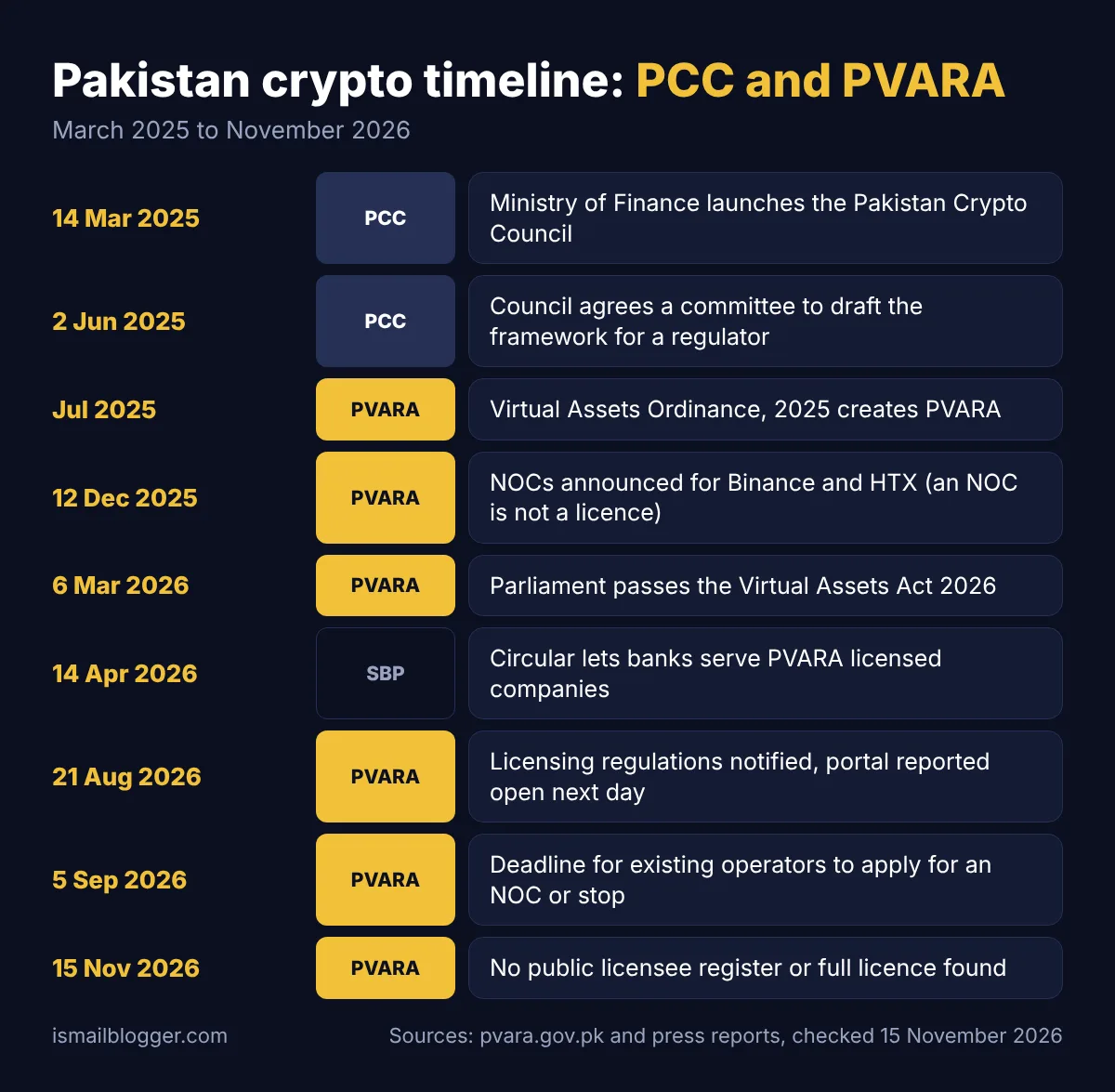
- 14 March 2025: the Ministry of Finance launches the Pakistan Crypto Council.
- 26 May 2025: Bilal bin Saqib is appointed Special Assistant to the Prime Minister on blockchain and crypto.
- 2 June 2025: the Council agrees to a technical committee to draft the framework for a regulator.
- July 2025: the Virtual Assets Ordinance, 2025 creates PVARA.
- 12 December 2025: PVARA announces NOCs for Binance and HTX. An NOC is not a licence.
- 6 March 2026: Parliament passes the Virtual Assets Act 2026.
- 14 April 2026: SBP’s circular opens bank accounts to licensed companies.
- 21 August 2026: PVARA’s two sets of regulations are notified, and the licensing portal is reported open the next day.
- 5 September 2026: deadline for companies already operating to apply for an NOC or stop.
- 15 November 2026: no public licensee register and no report of a full licence found.
What does this mean for an ordinary user?
Three practical things.
1. Check a licence with PVARA, never with the Council
PVARA’s FAQ says the Authority maintains a public register of licensees, and that every licensee must show its legal name, Pakistan office, licence number and licence categories on its own website. On 15 November 2026 we could not find that register on pvara.gov.pk, so for now the honest answer for any platform is “not confirmed as licensed”.
2. Complain to PVARA, and to the police side if money is lost
- Open PVARA’s complaints page and choose the type: suspected fraud, unlicensed provider, misconduct by a provider, or other.
- Submit it through the online portal and save the reference number.
- Expect an acknowledgement within 2 business days. PVARA says a full investigation can take 30 to 60 days.
- If you have lost money to fraud, also report it to the cyber crime agency and your bank. A regulator complaint is not a police case.
3. Do not treat any body’s name as an investment signal
Neither PVARA nor the Council tells you what to buy. A regulator’s existence does not make a coin safe, and it does not make trading risk free. Nothing on this page is investment advice. VAAP, which you may also see mentioned, is an industry alliance and not a regulator, as explained in the VAAP guide.
Roman Urdu mein: Pakistan Crypto Council sirf policy aur mashwaray ka idara hai, jo March 2025 mein Ministry of Finance ne banaya. PVARA qanoon ke tehat bana hua regulator hai, licence dena aur jurmana karna sirf isi ka kaam hai. Kisi platform ka licence check karna ho ya shikayat karni ho, to PVARA ke paas jayen, Council ke paas nahi.
Common mistakes people make
- Calling the Council “the regulator”. Even some international news reports did this in 2025. The regulator is PVARA.
- Reading an NOC as a licence. PVARA’s own FAQ says an NOC does not constitute a licence to carry on any virtual asset service.
- Assuming SECP registration covers crypto. It does not. Company registration and a virtual asset licence are two different things.
- Thinking users need a licence. The licensing rule in PVARA’s FAQ is aimed at persons providing a virtual asset service “by way of business”, which means the companies, not their customers.
FAQ
Is PVARA the same as the Pakistan Crypto Council?
No. The Pakistan Crypto Council is a policy body launched by the Ministry of Finance on 14 March 2025. PVARA is the regulator created by the Virtual Assets Ordinance in July 2025 and continued under the Virtual Assets Act, 2026. The Council advises, and PVARA licenses and enforces.
Who regulates crypto in Pakistan?
The Pakistan Virtual Assets Regulatory Authority (PVARA) regulates virtual asset service providers under the Virtual Assets Act, 2026. The State Bank regulates the banks that serve those companies, SECP regulates companies and securities, and FBR handles tax. The Pakistan Crypto Council is advisory and does not regulate.
Who is the chairman of PVARA?
Bilal bin Saqib is the chairman of PVARA. The Express Tribune described him as Minister of State and Chairman PVARA on 6 November 2026, and Dawn reported in December 2025 that the appointment is for three years on a pro bono basis.
Who is the head of the Pakistan Crypto Council?
The Council was launched with Finance Minister Muhammad Aurangzeb as chairman and Bilal bin Saqib as chief executive. Dawn still described Bilal bin Saqib as the Council’s CEO in December 2025. No official 2026 statement on its current office holders was found as of 15 November 2026.
Can the Pakistan Crypto Council give a licence to an exchange?
No. The Council has no licensing power. Under the Virtual Assets Act, 2026, only PVARA can grant a licence, and PVARA says all virtual asset service providers must obtain a formal licence before offering services in Pakistan.
Does the Pakistan Crypto Council still exist after PVARA?
The Express Tribune reported in December 2025 that the Council continues to operate on crypto policy, innovation and international engagement. No report of it being dissolved was found as of 15 November 2026, but its recent activity is far less visible than PVARA’s.
Your next step
If someone is pushing you towards a platform, do one thing before anything else: run its name through the PVARA checker and look for a licence number on the platform’s own website. If there is no number, the names of councils, ministers and advisers do not change the answer.
Keep reading