
To build an online community that actually grows, start with one clear purpose and show up consistently, give value long before you ask for anything, choose one home base (a WhatsApp channel or Telegram channel for updates, a group or Discord server for discussion), design ways for members to help each other, and bring people together in real rooms. Growth is slow at the start and then suddenly fast.
I have organized 200+ tech and creator events in Pakistan since 2016, from a 30 person meetup in Swabi to CreatorsCon chapters in Islamabad, Peshawar and Swabi. CreatorsCon has since grown into a network of more than 120 creators. I have also watched dozens of WhatsApp groups and Facebook communities die within months. The difference is never luck. Below are the principles that held up, a platform comparison with current limits, a first 100 members checklist and a rules message you can copy.
Key takeaways
- A community is people talking to each other. If every conversation goes through you, you have an audience, not a community.
- Use a ten to one ratio: ten pieces of free value for every one ask.
- WhatsApp channels and Telegram channels are for broadcasting. Groups, WhatsApp Communities and Discord servers are for conversation. Most growing communities use one of each.
- One physical event does more for trust than a year of posts.
- Own your list. Platforms change rules; your members’ contact and email list stays yours.
What is an online community, and how is it different from an audience?
An online community is a group of people with a shared goal who interact with each other, not only with the creator, in a space they return to regularly. An audience watches you. A community talks, helps and shows up even when you are quiet.
That difference shapes every decision below. My YouTube channel has an audience. CreatorsCon is a community, because the creators in it collaborate, refer clients and meet each other without me in the middle.
Why building a community in Pakistan makes sense in 2026
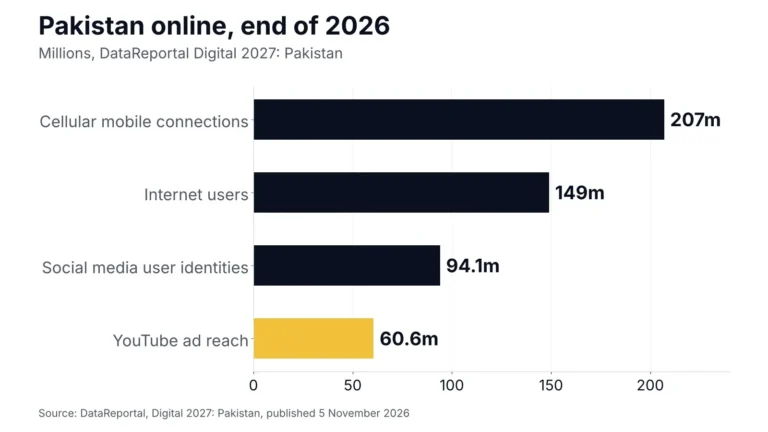
The people are already on their phones. According to DataReportal’s Digital 2027: Pakistan report, there were 149 million internet users in Pakistan in October 2026 and 94.1 million active social media user identities, with 207 million cellular mobile connections in late 2026.

Most of those people already use WhatsApp every day for family and work. That makes a Pakistani community unusually easy to start and unusually easy to kill with spam. The rest of this guide is about staying on the right side of that line.
The principles that held up across 200+ events
Start with a person, not a platform
Communities grow around someone who shows up. Before I had a logo or a group name, I answered every question people sent me about blogging. That consistency is the seed. A platform is a container; it is not the community.
Give before you ask
Every community I have seen fail started with a sales pitch. Every one that lasted started with free value: a workshop, a resource, an introduction. The ratio I use is ten pieces of value for every one ask. People forgive promotion from someone who has helped them ten times.
Design for members talking to each other
If every conversation goes through you, you have an audience, not a community. Create structures where members help members: introductions, accountability partners, member spotlights, city chapters. The leader’s job is to build the system, then step back.
Which platform should you build your community on?
Pick the platform last, after the purpose. Then pick two layers: a broadcast layer for updates and a conversation layer for members. I checked every limit below on each platform’s own help pages on 10 November 2026. Limits change, so open the linked page before you plan around a number.
| Option | Best for | Size limit | Phone number privacy | Watch out for |
|---|---|---|---|---|
| WhatsApp Channel | Broadcast updates to a large following | WhatsApp describes the audience as unlimited; the owner can invite up to 16 more admins | Followers cannot see your number or each other’s, and admins cannot see a follower’s full number unless it is saved in their contacts (WhatsApp privacy guide) | One way only: followers can react and vote in polls but cannot reply, and notifications are muted by default |
| WhatsApp Group | One focused discussion among people who mostly know each other | 2 to 1,025 participants, including the creator | Every member can see every other member | Spam spreads fast, and anyone in the group can save members’ numbers |
| WhatsApp Community | Several topic or city groups under one roof, with admin announcements to everyone | Up to 2,000 members across up to 100 groups | Members only see the numbers of people in the same sub group; admins can see all members | The 2,000 total fills quickly if the community is open to the public |
| Telegram group | Large, open discussion | Up to 200,000 members, with topics and detailed admin rights | By default your number is only visible to people you have saved as contacts | Many members will need to install it first |
| Telegram channel | Broadcasting with no ceiling | Unlimited subscribers | Posts are signed with the channel’s name and photo, not yours | Broadcast, not conversation; pair it with a group |
| Discord server | Deep, ongoing communities such as gaming, coding, crypto and creators | Up to 25 million members and 500 channels per server | Members appear by username, not phone number | Learning curve for non technical members. Community tools (announcement channels, Server Insights, onboarding) need a rules channel and safety settings switched on first |
The setup I recommend for most Pakistani creators
- A WhatsApp channel for updates, because almost everyone already has WhatsApp.
- One WhatsApp Community or Telegram group for discussion, split into small topic or city groups. If you expect more than 2,000 members, start the discussion on Telegram.
- A Discord server only if your members are technical or need many organised channels.
- An email list you own, because any platform can change its rules or ban an account.
How to build an online community step by step: your first 90 days
- Write your purpose in one sentence. “Helping Peshawar students get their first freelance client in 90 days” is a purpose. “Tech community” is not.
- Invite your first 20 to 50 members personally. Message them one by one. Founding members set the culture for everyone who comes later. The checklist below takes you to 100.
- Post rules and a welcome message on day one. WhatsApp’s own community guide advises admins to welcome all newcomers and share the community’s purpose and rules.
- Set a rhythm. A weekly session, a monthly meetup and a quarterly big event. Members return to habits, not to random posts.
- Start conversations, then step back. Ask easy, open questions. Reply to every early answer so people know their voice matters.
- Recruit moderators from your most active members. Discord’s community guide recommends the same. It also spreads the work so you do not burn out.
- Ask for feedback every month. What do members want more of? If participation drops, find out why before adding new features.
Checklist: your first 100 members
The first 100 people decide how the next 1,000 behave, so get them by hand, not by bulk adding.
- Before anyone joins: put the one sentence purpose in the description, pin the rules and write your welcome message.
- Members 1 to 20: message people you already know who have the problem your community solves. Ask first, then add them.
- Members 20 to 50: ask each founding member to bring one person they can vouch for. Welcome every newcomer by name and ask them to introduce themselves.
- Members 50 to 100: tell your existing audience on YouTube, Instagram or WhatsApp Status, but send them to your channel or a short signup form, not straight into the group. WhatsApp itself says to share community invite links only with people you know and not to post them on public sites.
- Every week: one fixed session or question thread, so new members arrive to activity and not to silence.
- Inside the first month: one live call or small meetup, so names become faces.
- At 100: pick one or two moderators from your most active members and ask everyone what they want more of.
Real rooms beat screens: using events to grow
Online communities become real when members meet in person. One physical event does more for trust than a year of posts. This is why CreatorsCon exists. People who sat in the same room in Islamabad still collaborate two years later.

You do not need a hotel ballroom. My first meetups were small rooms, a projector and chai. What matters is that people leave knowing three new names.
How to turn online members into attendees
- Ask before you book. Run a poll in the group or channel on city, day and topic, so members have a say before you commit to a venue.
- Announce it in your broadcast layer. One message with date, time, venue pin and the one takeaway, pinned until the day.
- Put registered people in a small event group. Use it for directions and timing, send a reminder the day before and on the morning, then close it afterwards.
- Ask every member to bring one person who is not in the community yet. A meetup is the easiest way for a newcomer to join.
A simple checklist for your first meetup
- A clear topic and one useful takeaway, for example “set up your first Fiverr gig together”.
- A free or low cost venue: a university hall, a coworking space or a café that wants footfall.
- Registration through a simple form so you know numbers and have contacts.
- A backup plan for load shedding: charged laptops, a power bank and a printed agenda.
- A group photo and a follow up message in the community the same night.
- Ask attendees to introduce one person they met. That is how the community knits together.

If you want to see the kind of events I run, they are listed on my events page.
Community rules: the five I enforce, and a template you can copy
These five are not negotiable in any community I run:
- Clear purpose in one sentence. If you cannot say it, nobody can repeat it.
- Moderation from day one. Spam and disrespect kill groups faster than silence.
- A rhythm: weekly session, monthly meetup, quarterly big event.
- Recognition. Celebrate member wins publicly. People stay where they are seen.
- Own the list. WhatsApp and email, not just a platform’s follower count.
A rules message you can copy
Paste this into your group description or pinned message and edit the brackets. Keep it short enough to read on one phone screen, and translate it into Urdu or Pashto if that is how your members talk.
Welcome to [community name]. We are here to [one sentence purpose].
- Stay on topic. Off topic posts will be deleted.
- Respect everyone. No abuse, personal attacks, or religious and political fights.
- No spam: no forwarded chains, unrelated links or ads. Promote your own work only in the [weekly promo thread].
- No money schemes. Investment offers, signal groups, referral links and “double your money” posts mean instant removal.
- Do not message members privately without their permission.
- Keep it private. Do not share members’ numbers, messages or screenshots outside this group.
- Ask clear questions and search the chat before you ask.
- First problem: a warning. Second: removal. Scams and harassment: removal without warning.
Admins: [names]. To report a problem, message an admin privately.
Rules only work if they are applied the same way to everyone, including your friends. WhatsApp’s admin guidance is to act promptly and strictly on inappropriate content, and community admins can delete unwanted messages or remove members. On Discord, a posted rules channel is required before you can switch on Community features. Add a second admin early, so moderation does not stop when you are offline.
How to keep members active (and know if it is working)
Follower counts lie. These are the numbers I actually watch:
- Active members: how many people posted or reacted in the last 30 days.
- Member to member replies: how often someone other than the admin answers a question.
- Event return rate: how many people come to a second event.
- Member wins: jobs, clients or projects that came from the community.
You do not need software for this. Once a month, scroll back through the last 30 days and count how many different names posted, and how many questions were answered by someone other than you. Discord shows activity and retention in Server Insights; in a WhatsApp group you count by hand. If most answers still come from you, it is still an audience.
To keep those numbers healthy, mix formats. Voice notes and short videos work well in Pakistan, where many members read less and listen more. Spotlight one member each week. Run small challenges, such as a seven day posting challenge, and celebrate everyone who finishes.
Can you make money from a community?
Yes, but only after trust. Sponsorships, paid workshops, job boards and affiliate recommendations all work once members feel helped. A community is one of the most durable assets in my guide to online earning in Pakistan, because it keeps paying long after a single video or post stops. I explain the affiliate side, including honest disclosure, in my Hostinger affiliate marketing guide.
Communities also feed careers. Many members find freelance clients through each other, which pairs well with learning one of the high paying freelancing skills. And if your community lives around a YouTube channel, my YouTube automation guide shows how creators grow the top of that funnel, and my free playbooks include a YouTube growth guide.
Never turn a community into a pitch for “double your money” schemes, binary options or anything that pays for recruiting members. One bad promotion can destroy years of trust.
Common mistakes that kill communities
- Starting with a sales pitch instead of value.
- Adding thousands of people to a group without their permission.
- No moderation in the first weeks, so spam sets the culture.
- Creating ten groups on day one. Start with one and split when it gets busy.
- The founder disappearing after launch. Your presence matters most in the first 90 days.
- Measuring success by member count instead of conversations.
- Leaving an investment offer, signal group or referral link up “just this once”.
- Running everything from one admin account with no backup admin.
Frequently asked questions
How long does it take to build an online community?
Expect three to six months before members start helping each other without you. A community is slow at the start and then suddenly fast.
What should I do when my WhatsApp group is full?
A WhatsApp group holds up to 1,025 participants and a WhatsApp Community up to 2,000 members in total. Past that, keep WhatsApp for broadcasting through a channel and move the discussion to a Telegram group or a Discord server. Announce the move for a few weeks and pin the new link before you close the old group.
Can followers of my WhatsApp channel see my phone number?
No. WhatsApp says followers will not see your profile name, picture or phone number. Channel admins are visible to each other, so only invite admins you trust.
The bottom line
A community that actually grows is slow at the start and then suddenly fast. Stay through the slow part. That is the whole secret. If you want me to speak at or collaborate on your community event, you can send me an invite.
Written by Muhammad Ismail (Ismail Blogger), founder of Ismailblogger in Islamabad, organizer of 200+ events, founder of the CreatorsCon creator network and TEDxFAST Peshawar speaker. Updated November 2026.
Free playbook
The YouTube Growth Playbook 2026
Niche, outlier research, packaging, Shorts and getting paid in Pakistan. Free PDF, opens instantly.
Get it free →Keep reading
Related articles
 YouTube & AI · 27 min readYouTube Automation in Pakistan: How to Build a Faceless Channel with AI in 2026Read article →
 Marketing · 13 min readReal Earning Apps in Pakistan 2026: 9 Checked Apps and How to Spot Fake OnesRead article →
 Marketing · 14 min readOnline Earning in Pakistan Without Investment: 15 Real Ways for 2026Read article →