YouTube automation in Pakistan means building a YouTube channel as a small production system: you pick a niche, research what already works, write scripts with AI help, add a voiceover and visuals, and publish on a schedule without ever showing your face. It is real and it can pay, but only if every video adds original value, because YouTube refuses to monetize mass produced, templated or reuploaded content. Done properly, it is a business you run, not passive income that runs itself.
Every week someone messages me on Instagram: “Bhai, I don’t want to show my face. Can I still earn from YouTube?” Yes, you can. I have been earning online since 2010 and my own channel has 377K subscribers and 700+ videos, so this guide is the honest version: what works, what YouTube’s current rules say, how money actually reaches a Pakistani bank account, and the scams that eat beginners alive.
Key takeaways
- A faceless YouTube channel earns from information, story and consistency. AI speeds up the work, but YouTube’s monetization policies require original value in every video.
- YouTube’s monetization policies now cover four areas: generic or repetitive content, reused content, unsatisfying or off-putting content, and AI personas on sensitive topics. Templated, mass produced AI videos are not eligible to earn.
- In Pakistan you need 1,000 subscribers plus 4,000 watch hours in 12 months, or 10 million Shorts views in 90 days. The lower 500 subscriber tier is not available in Pakistan as of November 2026. YouTube has announced that from February 1, 2027 new creators will need 8,000 qualified watch hours in the last 365 days, or 20 million qualified Shorts views in the last 90 days, along with 1,000 subscribers.
- Choose your niche with RPM logic: who your viewers are and what advertisers want to sell them matters more than raw views.
- AdSense pays Pakistani creators by wire transfer once your balance reaches the US$100 payment threshold by the 20th of the month. Submit US tax info, and keep records for FBR.
- Skip paid “automation courses” that promise income and never buy a monetized channel. Both are the most common ways Pakistanis lose money in this space.
What is YouTube automation, really?
YouTube automation is a way of running a channel where the owner manages a repeatable production process (research, script, voice, edit, thumbnail, upload) and uses AI tools or freelancers for some or all of those steps, instead of personally filming every video.
A faceless YouTube channel is any channel where the creator never appears on camera. Viewers come for the information, the story or the visuals: explainers, tutorials, history, finance basics, software walkthroughs, documentaries, top lists done well.
The word “automation” misleads people. Nothing on a good channel is automatic. The software does not decide what your audience needs, it does not fact check, and it does not care whether the video is boring. You do.
The three ways people run faceless channels
| Model | Who does the work | Best for | Main risk |
|---|---|---|---|
| Solo faceless creator | You do research, script, voice and edit, with AI as an assistant | Students and beginners with time but little money | Burnout and slow output |
| Small team | You own the niche and scripts, a freelance editor and thumbnail designer help | People with some budget and a proven format | Quality drops if you stop reviewing |
| Agency style (cash cow) | Writers, voice artists and editors produce almost everything | Experienced operators with cash flow | High cost, and templated output that YouTube will not monetize |
My honest advice: start solo. When you have done every step yourself 20 or 30 times, you will know exactly what to hire for and how to judge the work.
Is YouTube automation still worth it in Pakistan in 2026?
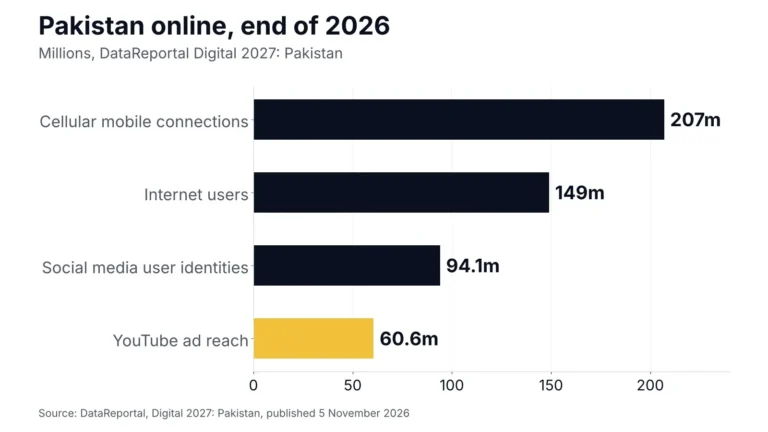
The audience is there. According to DataReportal’s Digital 2027: Pakistan report, Pakistan had 149 million internet users in October 2026 (57.3 percent of the population), and YouTube’s advertising tools reached 60.6 million users in Pakistan in late 2026, about 23.3 percent of the total population.

But a big local audience does not automatically mean big local income. Advertisers pay according to the buying power of the viewer, which is why so many Pakistani faceless channels make English content for the US, UK, Canada and Australia. The choice is not only about money, so compare both honestly:
| Urdu for Pakistan | English for a global audience | |
|---|---|---|
| Who you compete with | Mostly local creators, and you understand the audience better than any outsider | Creators from every country, so the quality bar for research and editing is higher |
| Advertiser demand | Generally lower for the same topic, because advertisers pay by viewer buying power | Generally higher for the same topic, but nothing is guaranteed |
| Voice | Your own voice works best. Urdu AI voices have improved but still miss natural rhythm | Wide choice of natural AI voices, or your own voice if your English is clear |
| Income beyond ads | Local sponsors, your own services and digital products | International affiliate programs (software, hosting), sponsors and digital products |
| Good fit if | You know a local problem deeply and can explain it simply | You can research and write in English at the level your competitors do |
I am not giving income ranges for either side, because YouTube does not publish them and the numbers you see online are guesses. Pick the language you can make the best video in.
It is worth it if you treat it like a small media business: 6 to 12 months of steady work before results, a willingness to learn editing and storytelling, and patience with slow early growth. It is not worth it if you want quick money next month. For faster first income, read my guide on ways to earn online in Pakistan without investment or the full online earning in Pakistan beginner guide.
What YouTube’s rules say about AI and faceless channels
This is the section most Pakistani guides skip, and it is the reason most automation channels get rejected from monetization. Everything below is from YouTube’s own Help Center, checked in November 2026.
The YouTube channel monetization policies page says content that earns money should be original and authentic: it should be your own creation (anything borrowed must be changed significantly), and it should not be “mass-produced, generic, repetitive, or manipulative”. A notice on that page dated July 15, 2025 renamed the old “repetitious content” policy to “inauthentic content”. Today the page sets out the rules for faceless and AI channels under four headings:
The four policies that decide if a faceless channel can earn
| Policy | What YouTube means | Allowed (examples from YouTube Help) | Not allowed (examples from YouTube Help) |
|---|---|---|---|
| Generic or repetitive content | Content that looks made from a template, or feels repetitive after a few videos from the same channel | The same intro and outro with different content in between. A series or review channel where each video has a distinct storyline, focus or concept | Image slideshows, templated storylines or scrolling text with little or no narrative, commentary or educational value. AI generated content from generic templates that gives the impression of mass production |
| Reused content | Repurposing content already on YouTube or elsewhere without significant original commentary, substantive changes, or educational or entertainment value | Clips used for a critical review. Reaction videos where you comment on the original. Edited footage where you add a storyline and commentary | Clips from a show edited together with little or no narrative. Short videos compiled from other social media sites. Content that only reads out text you did not write, such as websites or news feeds |
| Unsatisfying or off-putting content | Content that leans on emotionally manipulative formulas, copies existing formats until videos feel interchangeable, or exists only to shock | A cohesive storyline. Your own spin on a popular format. Using AI to edit your scripts or to generate a unique background visual | Unrelated or inconsistent AI clips stitched together to surprise or shock. Realistic visuals that trick viewers into believing a fake celebrity death or natural disaster. Repeated disturbing themes with no real narrative |
| AI personas related to sensitive topics | AI generated personas presented as human experts giving advice on health, legal issues, finances or politics | None listed. Channels uploading this content are not allowed to monetize | An AI “doctor” giving health advice. AI podcast hosts offering investment tips. AI personas giving legal advice |
Three details from the same page that beginners miss. First, the reused content policy applies to your channel as a whole and applies even if the original creator gave you permission, because it is separate from copyright. Second, templates and automated tools are allowed, but YouTube says the final product must still demonstrate your creative vision and provide educational or entertainment value. Third, if you run a finance channel, never present an AI character as a human expert. Speak as yourself and explain your sources.
Why faceless channels get rejected
- Unedited AI scripts read by an AI voice over stock clips, repeated across dozens of near identical videos.
- Movie, drama or sports clips stitched together without real commentary. This can bring copyright claims as well as a reused content rejection.
- Slideshows or scrolling text with no narration, analysis or teaching.
- Copying a successful channel’s format so closely that the videos feel interchangeable.
- Shock or fake news style AI Shorts made only to collect views.
The fix is the same every time: your own research, your own angle, and editing that shows a person made decisions.
AI disclosure
YouTube’s GenAI disclosure policy requires creators to disclose realistic AI generated or altered content, for example making a real person appear to say something they did not, or generating a realistic scene that never happened. Using AI to help write a script, title or thumbnail does not need disclosure, and neither do clearly animated or fantastical visuals. YouTube also says disclosure alone does not limit reach or earning eligibility. You tick the box under “AI use” in YouTube Studio during upload.
Fake engagement
Buying views, subscribers or comments breaks YouTube’s Fake engagement policy, and so does sub4sub. YouTube says channels that break it may be terminated, and three strikes within 90 days can end the channel.
Step 1: Choose a niche with RPM logic
Your niche decides your income more than your view count. Two terms you need, straight from YouTube’s ad revenue analytics help page: RPM (revenue per mille) is how much you earned per 1,000 video views after YouTube’s share, counting all views including ones with no ads. CPM is what advertisers pay per 1,000 ad impressions before the revenue share.
RPM depends on three things you can control: the topic (what advertisers want to sell next to it), the audience country, and the video length and format (long videos can carry more ads than Shorts). How low can a Pakistani audience go? When FBR set its tax benchmark of Rs195 per 1,000 views in 2026, an FBR official told Arab News this was below the average that normal Pakistani content earns per 1,000 views. Treat that as a floor indicator, not a promise.
Faceless niches that suit automation
| Niche | Why advertisers care | Faceless format | Watch out for |
|---|---|---|---|
| AI tools and software tutorials | Software companies buy ads and pay affiliates | Screen recordings with voiceover | Tools change fast, update videos |
| Personal finance basics | Banks, apps and finance brands | Explainers with charts and B roll | Never give investment promises or promote binary options apps |
| Business and case studies | B2B and education advertisers | Story documentaries | Needs strong research |
| History and true stories | Broad audience, long watch time | Narrated documentaries with maps and archives | Copyright on archive footage |
| Education and how to | Courses and edtech | Whiteboard or animated explainers | Accuracy, cite your sources |
Before you commit, run this check:
- Audience: who exactly is watching, which country, which language?
- Money: are there products, apps or services advertisers sell to this audience?
- Supply: can you list 100 video ideas right now without repeating yourself?
- Proof: are small channels (under 10,000 subscribers) getting big views in this niche? That means demand is open.
- Fit: can you personally add analysis, not just reword Wikipedia?
Step 2: Research what is already working
An outlier video is a video that got far more views than the channel usually gets. Outliers show you what the audience wants right now, independent of channel size, and they are the best signal for a faceless channel.
I built TubeMind for exactly this: it finds breakout YouTube videos, lets you research channels and niches in your own language, and suggests data backed title ideas and hook drafts. It is my own product, so judge it for yourself: it is free to start, and the routine below works with any tool that shows outliers, or with patient manual searching on YouTube.
- Start with a seed topic you are curious about, for example personal finance, AI tools or history stories, and pick the language you will publish in.
- Find the outliers from small and mid sized channels. Small channels with breakout videos tell you the niche still has room for a new creator.
- Save 20 to 30 outliers and note the pattern: topic, angle, title format and thumbnail style.
- Group them into 3 to 5 content pillars, for example “AI tool reviews”, “how to” tutorials and “tools compared”.
- Plan your own angle for every pillar: newer data, a Pakistan example, a clearer structure or a stronger story. Then draft titles and hooks in your own words.
- Check again every month, because what breaks out changes.
Built by Muhammad Ismail
TubeMind: find breakout YouTube videos before you script a single line
Outlier videos, channel and niche research in your language, and data backed title and hook ideas. Free to start, no card.
Try TubeMind free →Shorts are a good testing ground for topics before you invest in a 10 minute video. You can also find free helpers on my free YouTube tools page.
Step 3: Write scripts with AI, then edit like a human
AI can draft a script in minutes, and that is exactly the problem: raw AI scripts sound the same on every channel, and viewers leave. Here is the workflow I recommend:
- Research brief first: collect facts, numbers and sources yourself. Paste them into ChatGPT, Claude or Gemini and ask for an outline, not a full script.
- Write the hook yourself: the first 30 seconds decide if the video gets pushed. State the promise, the stakes and why the viewer should trust you.
- Draft section by section with AI, giving it your tone and examples.
- Rewrite out loud: read it, cut every generic line, and add your opinion, a local example or a mistake you made.
- Fact check every claim against the original source. AI invents numbers with full confidence.
- Add pattern breaks every 30 to 60 seconds: a question, a surprising fact, a change of visual.
A useful test: if nobody would notice your channel name swapped with a competitor’s, the script is not original enough.
Step 4: Voice: AI voiceover or your own?
Faceless does not have to mean voiceless. Your own voice, recorded with a decent USB or dynamic microphone in a quiet room, builds trust faster than any AI voice. Many Pakistani creators record at night when the street is quiet, and a small UPS keeps the laptop and mic running through load shedding.
If you prefer AI voice, tools like ElevenLabs are popular. As of November 2026, ElevenLabs pricing shows a Free plan at $0, Starter at $6 per month (after a $1 first month) and Creator at $22 per month (after an $11 first month). The commercial license appears from the Starter plan up, so do not monetize videos made on a free plan without checking the terms.
- Use one consistent voice so your channel feels like a brand.
- Edit pacing: add pauses, fix pronunciation of names, and vary the energy.
- Never clone a real person’s voice without written consent, and disclose realistic synthetic voices where YouTube’s policy requires it.
- Urdu AI voices have improved but still miss natural rhythm. Test with real viewers before you commit.
Step 5: Visuals and the editing workflow
Visuals are where most automation channels look cheap. Mix several sources so every video feels made, not assembled:
- Screen recordings for tutorials and software walkthroughs.
- Licensed stock footage and photos from libraries whose license allows commercial use.
- Simple motion graphics: maps, timelines, charts and highlighted text.
- AI images for scenes you cannot film, labeled where realistic and never of real people in fake situations.
- Royalty free music from YouTube’s Audio Library inside YouTube Studio, to avoid copyright claims.
CapCut and DaVinci Resolve both have free versions that are enough to start.
A simple editing checklist
- Cut silences and filler from the voiceover.
- Change the visual every 3 to 6 seconds in the first minute.
- Keep captions on screen, large and readable on a phone.
- Add a chapter structure for videos over 8 minutes.
- Export in 1080p or higher, and check audio levels on cheap earphones too.
Step 6: Titles, thumbnails and YouTube SEO
Before you write a title, look at how the outliers you saved in Step 2 are titled, then write your own version that matches what the video actually delivers. A great video with a weak thumbnail gets no views. Packaging is half the job:
- Write at least 10 title options for every video and pick the clearest, not the cleverest.
- Keep thumbnail text to three or four words, readable on a small phone screen.
- Make the title and thumbnail tell one story together, never repeat the same words in both.
- Put the main keyword early in the title and description, and answer the search in the first 30 seconds.
YouTube monetization requirements in Pakistan (2026)
Pakistan is on YouTube’s official YouTube Partner Program availability list, so Pakistani creators can join the YouTube Partner Program (YPP). According to the YPP overview, you qualify with either:
- 1,000 subscribers and 4,000 qualified public watch hours in the last 12 months, or
- 1,000 subscribers and 10 million qualified Shorts views in the last 90 days.
You may have seen “500 subscribers” on social media. That is the expanded YPP (500 subscribers, 3 public uploads in 90 days, plus 3,000 watch hours or 3 million Shorts views), which gives earlier access to fan funding and Shopping features, not ad revenue. As of November 2026, Pakistan is not on that page’s list of eligible countries, so the 1,000 subscriber route is the one that applies to us.
| Requirement | Long video route | Shorts route |
|---|---|---|
| Subscribers | 1,000 | 1,000 |
| Views or watch time | 4,000 public watch hours | 10 million Shorts views |
| Time window | Last 12 months | Last 90 days |
| Also needed | Follow the monetization policies, no active Community Guidelines strikes, 2 Step Verification on, and an AdSense for YouTube account | Same |
The watch hour math
4,000 hours is 240,000 minutes. To see how many views that means for you, divide 240,000 by your average view duration in minutes, which YouTube Studio shows under Analytics. This is arithmetic, not a forecast:
| Average view duration | Views needed for 4,000 hours |
|---|---|
| 3 minutes | 80,000 |
| 4 minutes | 60,000 |
| 6 minutes | 40,000 |
| 8 minutes | 30,000 |
Two things to know before you count. Only public long videos count toward the 4,000 hours: the YPP overview says watch time from Shorts in the Shorts Feed, private, unlisted and deleted videos does not. And under the YouTube Shorts monetization policies, views of non original Shorts (unedited clips from movies or TV shows, reuploads of other creators’ content, or compilations with no original content added) are ineligible when YouTube calculates payments. Reposted clips can collect views and still pay nothing.
Audit your channel before you apply
Reviewers cannot watch every video. YouTube’s monetization policies page says they may focus on the six areas below, and adds that these are only examples. Check each one honestly before you press Apply:
- Main theme: can a stranger tell in one line what the channel is about and what you add to the topic?
- Most viewed videos: are your biggest videos your most original ones, or the ones closest to someone else’s content?
- Newest videos: do your latest uploads show your current standard, not a rushed batch?
- Biggest proportion of watch time: open Analytics and see which videos carry the channel. Those are the ones that must clearly follow the policies.
- Video metadata: titles, thumbnails and descriptions should be accurate and written for each video, not copied across uploads.
- About section: explain who is behind the channel and how the videos are made: your research, your script, your voice or the tools you use.
If older videos break the rules, deal with them before you apply, but remember that watch hours from deleted videos stop counting toward the threshold.
Applying, rejection and reapplying
You apply from the Earn tab in YouTube Studio: accept the base terms, then set up or link an AdSense for YouTube account. After that the channel joins a review queue, where automated systems and human reviewers look at the channel as a whole. The timings below are from the YPP overview:
| Stage | What YouTube says |
|---|---|
| Review decision | Typically in about 1 month. Delays are possible when application volumes are high |
| First rejection | Appeal within 21 days, or keep uploading original content and reapply after 30 days |
| Rejected before, or already reapplied | You can try again after 90 days |
| After you are accepted | YouTube may turn off monetization on channels that have not uploaded a video or posted to the Posts tab for 6 months or more |
A rejection usually means reviewers found that a significant part of the channel does not follow the policies, so fix the channel first and reapply second. One more date: the same page says updated YPP terms start on February 1, 2027, and channels must accept them in YouTube Studio by January 31, 2027 to continue fully monetizing.
How much of the ad revenue you keep
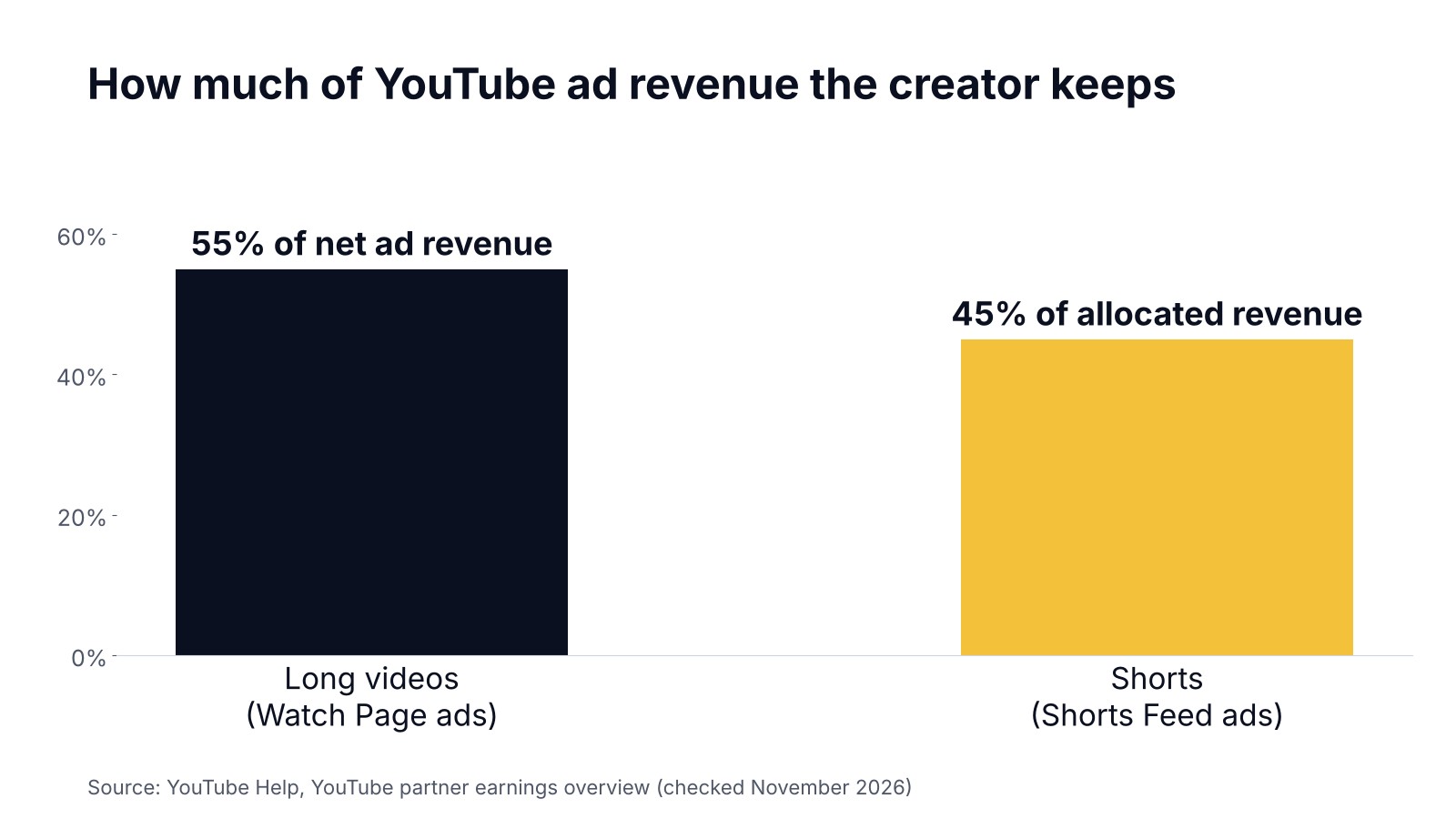
Per the YouTube partner earnings overview, creators get 55 percent of net revenue from ads on long videos (the Watch Page), and 45 percent of the revenue allocated to them from the Shorts creator pool, based on their share of views.
Ads are only one stream. Faceless channels also earn from affiliate links (software, hosting, tools), sponsorships, digital products and services. I explain affiliate income in my Hostinger affiliate journey.
How AdSense payments reach you in Pakistan
YouTube pays through an AdSense for YouTube account. According to Google’s AdSense payment methods table, wire transfer and check are available in Pakistan, while EFT and Hyperwallet are not. YouTube Help now says Western Union Quick Cash is no longer available for creators to select, so plan on a bank wire transfer.
The money flow, step by step:
- Create your AdSense for YouTube account from YouTube Studio when you apply for YPP. Use your legal name exactly as on your CNIC and bank account.
- When earnings reach US$10, Google asks you to verify your address. Per the AdSense payment thresholds page, the address verification threshold is $10, and a PIN letter arrives by post. Keep your postal address accurate.
- At the $10 payment method selection threshold, add your bank details for wire transfer: account title, IBAN and your bank’s SWIFT code.
- Once your balance reaches the $100 payment threshold, you become eligible for a payout by wire transfer in the next monthly cycle.
- Your bank converts the dollars to PKR. Ask your branch how they handle foreign remittances and keep every bank advice slip.
The monthly payment calendar
AdSense for YouTube pays on a fixed monthly cycle. These dates are from YouTube Help’s payment process page:
| When | What happens |
|---|---|
| 7th to 12th | Last month’s earnings are finalized and posted in AdSense for YouTube |
| By the 20th | Your total balance must reach the payment threshold, and any change to payment details or removal of a payment hold must be complete. If not, the balance rolls over to next month |
| 21st to 26th | Payment is issued and shows as “Payment pending”. If the 21st is a weekend or holiday, it may be issued on the next business day |
| After that | A wire transfer can take up to 15 business days to reach your bank, depending on the bank |
YouTube also says it cannot pay early for any reason. Payments get held most often because of a name mismatch between AdSense and the bank account, a missing PIN, or missing tax info. Fix all three well before the 20th of the month you expect to cross the threshold.
Taxes on YouTube income: US withholding and FBR
US tax info in AdSense
Google’s U.S. tax requirements for YouTube earnings page says every creator, including those outside the US, should submit US tax info in AdSense by December 10 each year. With valid tax info, only earnings from US viewers are subject to withholding, at 0 to 30 percent depending on your country’s tax treaty with the US. If an individual submits no tax info, Google may withhold 24 percent of total worldwide earnings. You see your actual rate after you submit the form.
FBR and the Rs195 benchmark
Pakistani creators also need to think about local tax. As reported by Arab News on October 7, 2026, FBR now uses a benchmark of Rs195 per 1,000 YouTube views for monetized content, following an April regulatory order and a September 23 notification. Income is taken as the higher of the benchmark or your actual earnings, and creators can rebut the estimate with proof such as YouTube revenue reports and bank credits. The same report says creators can deduct up to 30 percent of revenue as expenses and must pay quarterly advance tax.
Tax rules are changing fast, so keep monthly YouTube Analytics revenue reports and bank slips, and speak to a tax practitioner before filing. This guide is general information, not tax advice.
How much does YouTube automation cost in Pakistan?
You can start with almost no money if you do the work yourself. Here is a realistic tool stack, as of November 2026:
| Task | Free way to start | Paid upgrade |
|---|---|---|
| Research | YouTube search and free plans of research tools | Paid research plans when you scale |
| Scripts | Free tiers of ChatGPT, Claude or Gemini | A paid AI plan for longer research |
| Voice | Your own voice and a basic mic, ElevenLabs Free | ElevenLabs Starter $6 or Creator $22 per month |
| Editing | CapCut or DaVinci Resolve free versions | Paid editors or a freelance editor |
| Thumbnails | Free design tools | A freelance thumbnail designer |
| Music | YouTube Audio Library | Paid music licensing |
Your biggest real cost is not software. It is time, a stable internet connection, and backup power. If you plan to outsource, budget per video: script plus voice plus edit plus thumbnail, multiplied by your weekly uploads, for at least six months before income starts.
Outsourcing: how to hire a faceless channel team
Outsource only after you have a format that works, otherwise you pay to make bad videos faster. Pakistan has thousands of skilled editors and writers on Fiverr and Upwork, and many started exactly the way I describe in my guide to starting freelancing in Pakistan.
- Write an SOP for every role: script structure, voice tone, editing rules, thumbnail style.
- Hire one role at a time, usually the editor first.
- Run paid test tasks with two or three freelancers on the same script and compare.
- Keep ownership: the channel, Google account, AdSense and passwords stay in your name only. Give editors upload access through YouTube Studio permissions, never your password.
- Review every video before publishing. You are responsible for every policy strike.
Video editing, scriptwriting and thumbnail design are also excellent skills to sell yourself. See my list of high paying freelancing skills for 2026. If you are a brand that wants a team to run a channel for you, you can hire my team.
Scams to avoid: fake automation courses and buying channels
This space attracts more scammers than almost any other online earning topic in Pakistan. Red flags I see every month:
Fake YouTube automation courses
- Promises of “passive income 24/7”, “autopilot” or a fixed monthly income.
- Screenshots of earnings with no channel name you can verify.
- Teaching templated mass production, which YouTube’s monetization policies refuse to monetize.
- Upsells to a “done for you” channel or a private WhatsApp group after you pay.
- Certificates from no recognized body.
Everything you need is free on YouTube’s Help Center and in quality free content. If you do pay for training, pay for a skill (editing, scripting, design), not for a promise.
Buying a monetized channel
Sellers on Facebook groups and Telegram offer “monetized channels” for sale. The risks are serious: the seller can recover the Google account later, the channel may already have strikes or a history of reused or repetitive content, its audience will not match your niche, and any subscribers or views that were bought break YouTube’s fake engagement policy. Many buyers lose the money and the channel.
Other traps
- “AdSense approval” agents who ask for your passwords.
- Finance channels that promote binary options apps or schemes promising fixed returns. Never do it, your viewers trust you.
Growth mistakes that kill faceless channels
- Changing niche every 10 videos, so the algorithm never learns who to show you to.
- Ignoring analytics: low click through means fix packaging, early drop off means fix the hook.
- Quitting too early. Many channels need dozens of uploads before growth starts.
A realistic 90 day plan to start
- Days 1 to 7: pick two candidate niches, research 50 outliers, and choose one.
- Days 8 to 14: create the channel, branding and a list of 60 video ideas in 3 to 5 pillars.
- Days 15 to 45: publish 2 long videos and 3 to 5 Shorts per week, all made by you with AI as assistant.
- Days 46 to 75: study analytics, double down on the best pillar, improve hooks and thumbnails.
- Days 76 to 90: write SOPs, hire one freelancer if the format works, and set up an affiliate or digital product.
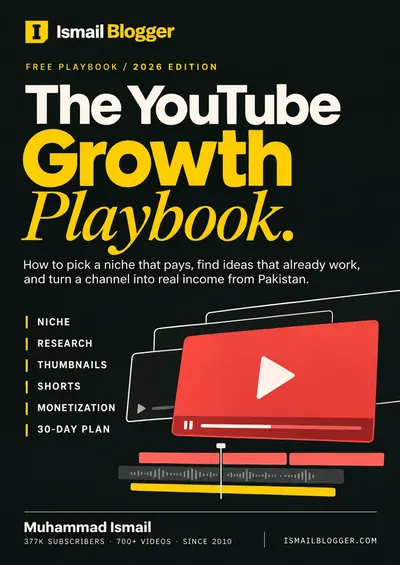
Give the channel a full year of consistent work before you judge it. If you want this plan as a checklist, the YouTube Growth Playbook is free.
YouTube automation in Pakistan: FAQ
Is YouTube automation allowed by YouTube?
Yes. Faceless channels and AI assisted production are allowed. What YouTube does not monetize is reused content without substantive changes, and generic, repetitive or mass produced videos with little original value.
Can a faceless YouTube channel get monetized in Pakistan?
Yes. Pakistan is on the YouTube Partner Program availability list, and the 1,000 subscriber requirements above apply.
Is YouTube automation profitable in Pakistan?
It can be, but there is no fixed income. Earnings depend on niche, audience country, video length and consistency. Most channels earn nothing for the first several months, so treat it as a business with risk.
How much does YouTube pay per 1,000 views in Pakistan?
There is no fixed rate. Your RPM depends on topic and audience location. FBR’s 2026 tax benchmark is Rs195 per 1,000 views for monetized content, which an FBR official described as below average for normal Pakistani content.
Can I start YouTube automation without investment?
Yes, if you do the work yourself with free tools: free AI tiers, your own voice, free editors and free research plans. Paying for outsourcing only makes sense after you have a format that works.
How do I receive YouTube money in Pakistan?
Through AdSense for YouTube, by wire transfer to your Pakistani bank account, following the payment calendar above.
Can I use Western Union or Payoneer for YouTube payments in Pakistan?
Not as things stand in November 2026. YouTube Help says Western Union is no longer available for creators to select, and Google’s payment methods table lists only check and wire transfer for Pakistan. Payoneer is not one of Google’s payment options.
How long does YouTube take to review a monetization application?
Typically about 1 month, according to YouTube, and longer when application volumes are high.
My channel was rejected for reused or repetitive content. When can I reapply?
After a first rejection you can appeal within 21 days or reapply after 30 days. After a repeat rejection the wait is 90 days. Change the channel before you reapply, not only the application.
Do I need to disclose AI voice or AI visuals?
Only when it is realistic and could mislead, such as a cloned voice of a real person or a realistic scene that never happened. AI help with scripts, titles or thumbnails needs no disclosure.
Should I buy a YouTube automation course or a monetized channel?
No to both. Income promise courses usually teach templated content YouTube will not monetize, and bought channels can be recovered by the seller or carry strikes.
Have a question I did not cover? Ask your own question and I will answer it. I share practical YouTube and AI breakdowns every week on my YouTube channel, and the tools I personally use are on my resources page.
Written by Muhammad Ismail (Ismail Blogger), founder of Ismailblogger in Islamabad, earning online since 2010, with 377K YouTube subscribers, 33,000+ Udemy learners, a TEDxFAST Peshawar talk and the creator of TubeMind and Breakoutly. Last updated November 2026.
Free playbook
The YouTube Growth Playbook 2026
Niche selection, outlier research, packaging, Shorts and getting paid in Pakistan. Free PDF, opens instantly.
Get it free →Keep reading
Related articles
 Freelancing · 18 min readFreelancing in Pakistan 2026: How to Start, Get Paid and Grow (Beginner Guide)Read article →
 Marketing · 13 min readReal Earning Apps in Pakistan 2026: 9 Checked Apps and How to Spot Fake OnesRead article →
 Marketing · 14 min readOnline Earning in Pakistan Without Investment: 15 Real Ways for 2026Read article →