
Short answer: Yes, YouTube income is taxable in Pakistan. Since 1 July 2026 your bank deducts 5% from every payment that comes from a social media platform (10% if you are not on the Active Taxpayers List), and for a resident creator that 5% is only the minimum tax. You then file a return on IRIS, work out tax on your profit using the normal slabs of 0% to 45%, and pay whichever figure is higher.
Key takeaways
- Bank deduction: 5% of each YouTube payment under the new section 154B, 10% if your name is not on the ATL.
- It is a minimum tax, not the full tax: residents still file a return and pay more if the slab tax on their profit is higher.
- FBR has a floor for your income: Rs 195 per 1,000 views or your real earnings, whichever is higher, with expenses capped at 30% of revenue.
- Rough breakeven: up to about Rs 136,000 a month in YouTube revenue, the 5% already cut by the bank covers your whole bill. Above that, expect to pay extra.
- The old 0.25% or 1% export rate is no longer the safe assumption for money paid by YouTube itself.
- Deadline: 30 September each year for the return, plus quarterly advance tax under the new rules.
Want your own number? The YouTube tax calculator compares the 5% bank deduction, the Rs 195 benchmark and the slab tax for you. For other income, use the income tax calculator. If you also earn from client work, the freelancer tax calculator covers that side.
Every rule below is taken from FBR’s own documents, opened on 12 November 2026, with rupee examples you can copy.
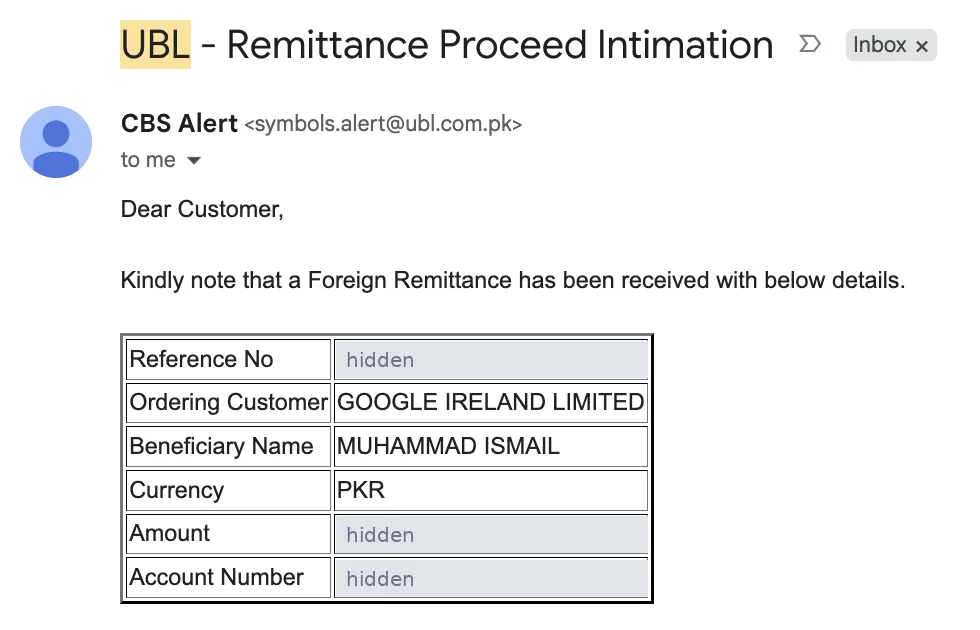
From my own channel: my AdSense payments reach my bank account between the 22nd and the 26th or 27th of the month, after an email from Google, and tax is deducted on them regularly. The rates on this page come from FBR’s documents, not from my bank statement, so you can check each one yourself.
Is YouTube income taxable in Pakistan?
Yes. If you live in Pakistan for 183 days or more in a tax year, you are a resident, and a resident pays tax on income from anywhere in the world. AdSense money from Google is business income in your hands, the same as a shop or an agency.
That covers every way a channel earns:
- Ad revenue on long videos and Shorts
- Channel memberships, Super Chat and Super Thanks
- YouTube Premium revenue share
- Brand deals and sponsorships, paid in cash or in products
- Affiliate commissions and your own courses or merchandise
Two things changed in 2026. Parliament added a bank level deduction for creators, and FBR wrote a special procedure that tells it how much income to expect from a channel of your size.
What changed for YouTubers in 2026?
| Date | What happened | What it means for you |
|---|---|---|
| 1 April 2026 | FBR published draft rules for social media income (SRO 545 and 546) | First sight of the Rs 195 per 1,000 views benchmark |
| 1 July 2026 | Finance Act, 2026 inserted section 154B into the Income Tax Ordinance | Banks and wallets deduct 5% when platform money lands in your account |
| 23 September 2026 | FBR notified the final rules: SRO 1640, 1641 and 1642 | A minimum income formula, a 30% expense cap and quarterly advance tax |
| October 2026 | Daily Pakistan reported a draft to replace the word “YouTube” with “social media platforms” in the benchmark rules (13ZP and 19R) | Still a draft. I could not find it on FBR’s site on 11 November 2026 |
You can read section 154B on printed page 338 of the Ordinance as amended up to 30 June 2026. The rate sits in Division IIIAB of Part III of the First Schedule and it is one line long: “The rate of tax to be deducted under section 154B shall be 5%.”
How much tax do YouTubers pay in Pakistan?
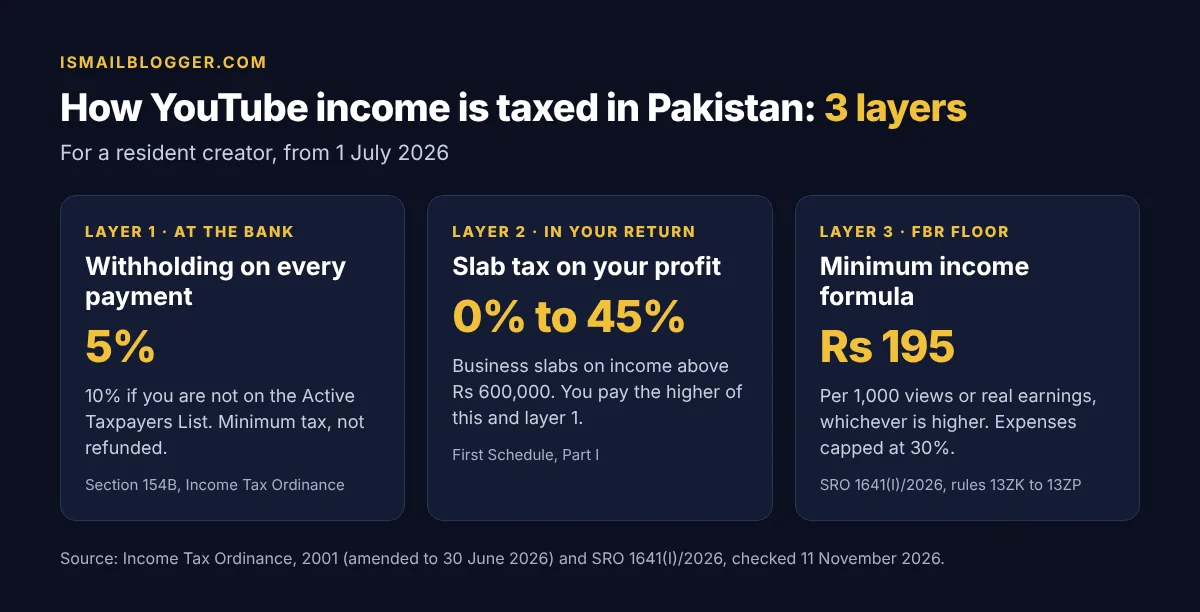
There are three layers. Each one can raise your bill, none lowers it.
Layer 1: 5% at the bank
Under section 154B, every banking and non-banking financial institution must deduct tax when an amount that represents “revenues received from social media platforms” is credited to your account. The law names YouTube, Facebook, Instagram and TikTok, and it covers money that arrives through payment service providers too.
For a resident this deduction is a minimum tax. For a non-resident with no permanent establishment in Pakistan it is a final tax.
Layer 2: the normal slabs on your profit
At the end of the year you file a return and calculate tax on your profit with the table for business individuals. These are the rates printed in the First Schedule and used in our calculator for tax year 2026-27:
| Taxable income for the year | Tax |
|---|---|
| Up to Rs 600,000 | 0% |
| Rs 600,001 to Rs 1,200,000 | 15% of the amount above Rs 600,000 |
| Rs 1,200,001 to Rs 1,600,000 | Rs 90,000 + 20% of the amount above Rs 1,200,000 |
| Rs 1,600,001 to Rs 3,200,000 | Rs 170,000 + 30% of the amount above Rs 1,600,000 |
| Rs 3,200,001 to Rs 5,600,000 | Rs 650,000 + 40% of the amount above Rs 3,200,000 |
| Above Rs 5,600,000 | Rs 1,610,000 + 45% of the amount above Rs 5,600,000 |
If the slab tax is more than the 5% already deducted, you pay the difference. If it is less, the 5% stays with FBR. That is what “minimum tax” means: no refund of the gap.
If you also have a job, the salaried table applies only when salary is more than 75% of your taxable income. Otherwise the business table above applies to everything, salary included. Above Rs 10 million of taxable income a 10% surcharge is added to the tax.
Layer 3: FBR’s minimum income formula
SRO 1641 of 23 September 2026 added Chapter IIA to the Income Tax Rules for resident persons who earn from remunerative social media content. It sets a floor under the income you declare:
- Minimum income = A minus B
- A is your total remuneration: the higher of (a) Rs 195 x total views / 1,000, or (b) what you really received, in cash or in kind
- B is your expenses, up to a maximum of 30% of total revenue
So in FBR’s eyes your taxable income from the channel cannot be less than 70% of your revenue, however much you spent on cameras and editors.
On paper, a Pakistani YouTuber cannot show less than 70% of channel revenue as income: FBR caps expenses at 30% under rule 13ZK.
Worked examples: Rs 100,000, Rs 250,000 and Rs 500,000 a month
These are illustrations, not real channels. I have assumed the creator is on the ATL, earns only from YouTube, receives everything through a bank, and claims the full 30% expense cap.
| Rs 100,000 a month | Rs 250,000 a month | Rs 500,000 a month | |
|---|---|---|---|
| Revenue for the year | Rs 1,200,000 | Rs 3,000,000 | Rs 6,000,000 |
| 5% deducted by the bank | Rs 60,000 | Rs 150,000 | Rs 300,000 |
| Income after 30% expenses | Rs 840,000 | Rs 2,100,000 | Rs 4,200,000 |
| Slab tax on that income | Rs 36,000 | Rs 320,000 | Rs 1,050,000 |
| Tax for the year (the higher one) | Rs 60,000 | Rs 320,000 | Rs 1,050,000 |
| Extra to pay with the return | Rs 0 | Rs 170,000 | Rs 750,000 |
| Tax as a share of revenue | 5.0% | 10.7% | 17.5% |
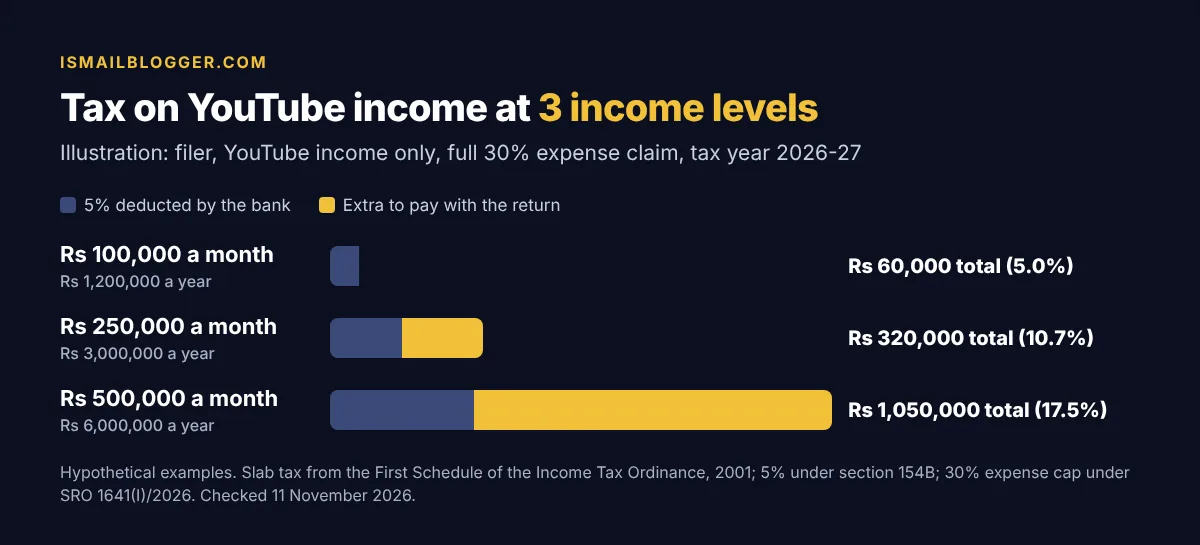
In the first column the slab tax is only Rs 36,000, but the bank has already taken Rs 60,000, and the creator does not get the Rs 24,000 back.
The breakeven point. With the full 30% expense claim, slab tax equals the 5% deduction at about Rs 1,636,000 of revenue a year, roughly Rs 136,000 a month. Below that line the bank deduction is your whole tax. Above it, keep money aside for the return.
Every time AdSense pays, move a fixed share into a separate account for tax. The table gives the share. At Rs 250,000 a month the total bill is about 10.7% of revenue and the bank has taken 5%, so about 6% more is the amount to park.
YouTube views tax: the Rs 195 per 1,000 views rule
Rule 13ZP defines “revenue per mille” as the revenue generated per 1,000 views on a video shared on YouTube and says it “shall be taken as PKR 195 and is subject to revision from time to time”.
A channel gets 12 million views in the year. FBR’s benchmark is 12,000 x Rs 195 = Rs 2,340,000. Suppose AdSense really paid Rs 1,500,000. The rule takes the higher figure, so the starting point is Rs 2,340,000 unless the creator can “demonstrate evidence to this effect to the satisfaction of the Commissioner”.
| Views in the year | FBR benchmark at Rs 195 per 1,000 |
|---|---|
| 1 million | Rs 195,000 |
| 5 million | Rs 975,000 |
| 12 million | Rs 2,340,000 |
| 50 million | Rs 9,750,000 |
Three practical points:
- Compare it with your own RPM. Open YouTube Studio, go to Analytics, then Revenue, and convert your RPM into rupees. If it is under Rs 195, you will need evidence.
- Shorts channels are the most exposed. The rule says “total number of views” and does not separate Shorts from long videos, while Shorts usually earn far less per view. Our guide to YouTube Shorts monetization in Pakistan explains why.
- Evidence means documents. Keep the monthly AdSense payment receipts, the YouTube Analytics revenue export for the tax year and the bank statement that shows each credit.
The wording of the scope rule is “every resident person deriving income from interaction with users in Pakistan through social media platforms”. The rule does not say how views from other countries are treated. Until FBR clarifies it, do not assume foreign views are outside the formula.
Is YouTube income an IT export taxed at 0.25% or 1%?
That was the usual answer until June 2026.
Section 154A taxes export of services at 0.25% for IT exporters registered with PSEB and 1% for others, as a final tax when its conditions are met. AdSense income was treated as an export of services.
Section 154B now deals with one thing only: revenues received from social media platforms. It has its own rate (5%) and its own status (minimum tax for residents). Profit reported at budget time that creators had been pulled out of the reduced export regime.
What I can confirm from the Ordinance: section 154B exists, the rate is 5%, and nothing in it sends creators back to section 154A. What I could not find on FBR’s site on 11 November 2026 is a circular that explains, in FBR’s own words, how banks should separate platform payments from other service exports. So plan on 5%, and ask your bank how it coded your last AdSense credit.
Where the export rates can still matter:
- Client work. Editing, thumbnails or channel management for a foreign client is a service export, not platform revenue. See freelancer tax in Pakistan.
- Foreign brand deals paid straight to you. The payer is a company, not a platform. How your bank treats the remittance depends on the purpose code, so confirm it before you assume a rate.
- Local brand deals. A Pakistani company that pays you for a sponsored video normally deducts withholding tax on services and gives you a certificate. Keep it, because it goes into your return.
Filer vs non filer: 5% or 10%
The Tenth Schedule of the Ordinance doubles the withholding rate for anyone who is not on the Active Taxpayers List. Rule 10 of that Schedule lists the sections that are exempt from the doubling. Section 154A is on the list. Section 154B is not.
| On the ATL | Not on the ATL | |
|---|---|---|
| Bank deduction on YouTube payments | 5% | 10% |
| On Rs 1,200,000 a year | Rs 60,000 | Rs 120,000 |
| On Rs 6,000,000 a year | Rs 300,000 | Rs 600,000 |
Best first step if you are not a filer: register on IRIS and file your return before your next AdSense payment. On Rs 100,000 a month, being off the ATL costs an extra Rs 5,000 every month.
What expenses can a YouTuber deduct?
Expenses must be for the channel and you need proof. Typical ones:
- Camera, lenses, microphones, lights and computers (claimed over time as depreciation, not all in one year)
- Editing software, music and stock footage subscriptions
- Internet and the business share of electricity
- Studio rent
- Payments to editors, thumbnail designers and writers
- Travel for shoots
Whatever your real costs, rule 13ZK counts expenses only “up to maximum of 30% of total revenue” when it calculates your minimum income. A travel channel that spends half its revenue on trips will still be measured against 70%.
Pay your team through the bank and keep invoices. Cash payments with no trail are hard to prove.
How to file your YouTube income tax return on IRIS
The return is filed online on IRIS, FBR’s portal. The steps:
- Register. Choose registration for an unregistered person, enter your CNIC, mobile number and email, and confirm the codes sent to both. Your CNIC becomes your NTN.
- Complete your profile. Add your address, your bank account and a business entry for your content work.
- Collect the numbers for 1 July to 30 June. Total YouTube receipts in rupees, tax deducted by the bank, other income, and expenses with proof.
- Open the return for the tax year. Under Declaration, pick the normal income tax return for the year you are filing.
- Enter business income. Put gross receipts and expenses in the business section. SRO 1641 says this income goes in a “special part” of the return. I have not seen that part inside IRIS yet, so check the form for a social media content section before you use the general business fields.
- Enter the tax already deducted. Add the section 154B deduction from your bank’s certificate so it is credited against your bill.
- Fill the wealth statement. List assets, liabilities and personal expenses, and make sure it reconciles. IRIS will not let you submit until the unreconciled amount is zero.
- Pay any balance. Create a payment slip (PSID) in IRIS and pay through your banking app or ATM.
- Submit and save the acknowledgement. Then check that your name shows on the ATL.
The due date for individuals is 30 September after the tax year ends. Income earned from 1 July 2026 to 30 June 2027 goes into the return due on 30 September 2027. FBR often extends the date: for tax year 2026 it moved to 15 October and then to 31 October 2026, as Dawn reported.
Advance tax: rule 13ZM says every person under this special procedure pays advance income tax each quarter, calculated with the same formula, under section 147. If your channel is above the breakeven point, ask your adviser to set up the quarterly payments so the whole balance does not land in September.
What documents do you need to file?
- CNIC and a mobile number registered in your name
- AdSense payment history for the tax year
- YouTube Analytics revenue and views export for the same dates
- Bank statements and the bank’s tax deduction certificate
- Contracts and invoices for brand deals, plus any withholding certificates
- Invoices for equipment, software, rent and team payments
- Last year’s return and wealth statement, if you have filed before
Non resident YouTubers and overseas Pakistanis
SRO 1642 covers non-residents. It applies to a non-resident who earns from interaction with users in Pakistan once the audience passes a threshold: more than 50,000 users in Pakistan during a tax year, or 12,250 users during a quarter. The income formula is the same one residents get, including the Rs 195 benchmark and the 30% cap.
If a non-resident with no permanent establishment in Pakistan receives platform money in a Pakistani account, the 5% deducted under section 154B is the final tax on it.
Whether you are resident is a days test, not a passport test. If you live abroad but spent 183 days or more in Pakistan in the tax year, get advice before you file as a non-resident.
Does YouTube itself cut tax in Pakistan?
No. YouTube does not deduct Pakistani tax: section 154B puts that duty on your bank. What Google can withhold is US tax, which is a separate thing.
- US withholding is taken by Google before the money leaves. You control it by submitting the W-8BEN form in AdSense. Without the form, Google can withhold up to 24% of your worldwide earnings. Our step by step guide to the YouTube US tax form in Pakistan shows how to fill it.
- Pakistan tax is everything on this page: the 5% at your bank and the return on IRIS.
Filling the W-8BEN does not replace your Pakistani return, and paying tax in Pakistan does not replace the W-8BEN. Do both.
6 mistakes that cost YouTubers money
- Staying off the ATL. You pay double at the bank on every payment.
- Treating 5% as the final tax. For residents it is the minimum. The return can show more.
- Still planning on 1%. That was the export rate. Platform money now has its own section.
- Ignoring sponsorships paid in products. The rules count remuneration “whether received in cash or kind”.
- No evidence for a low RPM. If your earnings per 1,000 views are under Rs 195, the proof has to come from you.
- Receiving payments in someone else’s account. The deduction and the tax credit then sit under that person’s CNIC, not yours.
Roman Urdu summary: YouTube ki income par Pakistan me tax lagta hai. 1 July 2026 se bank har payment par 5% kaat-ta hai, aur agar aap filer nahi hain to 10%. Yeh sirf minimum tax hai: saal ke akhir me IRIS par return file karni hoti hai aur agar slab ke hisab se tax zyada banta hai to baqi rakam jama karani hoti hai. FBR ne Rs 195 per 1,000 views ka benchmark bhi rakha hai aur kharche sirf 30% tak maane jate hain. Is liye filer banein, har payment ka record rakhein aur return 30 September se pehle file karein.
FAQs about YouTube income tax in Pakistan
Do small YouTubers have to file a tax return?
If your taxable income for the year is above Rs 600,000, yes. Below that, filing is still worth it because being on the ATL cuts the bank deduction from 10% to 5%. Remember that the 5% is a minimum tax, so it is not refunded even when your slab tax is zero.
What is the FBR rate of Rs 195 per 1,000 views?
It is a benchmark in rule 13ZP of the Income Tax Rules. FBR multiplies your total views by Rs 195 per 1,000 and compares the result with what you really earned. The higher figure is treated as your remuneration unless you prove your real earnings were lower.
Can I get a refund of the 5% tax deducted by the bank?
Not as a resident. Section 154B makes the deduction a minimum tax, so it is credited against your bill but the unused part is not refunded. If your slab tax is higher than the deduction, you pay only the difference.
Does the 5% tax apply to Facebook, TikTok and Instagram income too?
Yes. Section 154B names YouTube, Facebook, Instagram and TikTok and adds “such other similar platforms”. The Rs 195 benchmark, though, is written for views on YouTube videos. A draft to widen that wording was reported in October 2026 and is not final.
Which tax year does the new rule apply to?
The 5% deduction started with the Finance Act, 2026 on 1 July 2026, so it covers payments from that date. Those payments belong to tax year 2027, and that return is due by 30 September 2027.
Do I need a company or NTN to earn from YouTube in Pakistan?
You do not need a company. An individual’s CNIC works as the NTN once you register on IRIS. A company only makes sense for larger channels, and that decision needs a tax adviser.
Is there a YouTube tax calculator for Pakistan?
Yes. Our YouTube tax calculator applies the 5% or 10% bank deduction, the Rs 195 per 1,000 views benchmark and the 30% expense cap, then compares the result with the slab tax on your profit. The higher figure is your tax for the year.
This guide explains the law as printed in FBR’s documents on 12 November 2026. It is general information, not tax advice for your case. Rates and rules change with each Finance Act and SRO, so check the date on anything you rely on.
Keep reading