
Short answer: An SMC trading strategy uses Smart Money Concepts to read a price chart. You mark market structure (highs and lows), wait for liquidity above or below obvious levels to be taken, then look for an entry at an order block or fair value gap in the new direction, with a fixed stop loss and a planned target. It is a way of organising price action, not a secret code of the banks, and it does not guarantee profits. Learn it on a demo account first.
Key takeaways
- Smart money concepts (SMC) rest on a few ideas: market structure, break of structure (BOS), change of character (CHoCH), order blocks, fair value gaps, liquidity and liquidity sweeps.
- A typical SMC trading strategy is: higher timeframe bias, mark liquidity, wait for a sweep, confirm a CHoCH, enter at an order block or fair value gap, target the opposite liquidity.
- SMC is subjective. Two traders can mark different order blocks on the same chart, and I could not find independent, peer reviewed evidence that it beats other methods.
- Risk management decides your results more than entries do: risk a small, fixed share of your account per trade and keep a journal.
- Published disclosures show most retail CFD accounts lose money (70% to 89% in the sources below).
- This article is education only. It is not a signal, not a trade recommendation and not an offer to manage money.
Most people meet SMC through short clips that show only the winning trades. Below, each concept gets its own diagram (drawn from simulated prices, not copied screenshots), then one step by step framework, then the places where SMC fails. Written and checked on 12 November 2026.
My position on trading: trading is risky. I do not recommend it to anyone before proper education, and then only with money you are 100% ready to lose.
This guide is education, not financial, legal or tax advice.
What are smart money concepts (SMC)?
Smart money concepts are a set of price action ideas built around one story: large players (banks, funds, big traders) need a lot of orders to fill their positions, so price often moves to where many stop losses and pending orders sit, and then turns. SMC traders try to read the footprints of that behaviour on a normal candlestick chart.
Much of the vocabulary is new, but many ideas are old. An order block is close to what classic traders call a supply or demand zone. A liquidity sweep is close to a stop hunt or a false breakout. So judge SMC as a way of reading charts, not as inside information.
| SMC term | Plain meaning | Classic price action cousin |
|---|---|---|
| Market structure | The pattern of swing highs and lows | Trend (higher highs and higher lows) |
| BOS (break of structure) | Price breaks a swing in the trend direction | Trend continuation breakout |
| CHoCH (change of character) | First break against the trend | Early trend reversal signal |
| Order block | Last opposite candle before a strong move | Supply or demand zone |
| Fair value gap (FVG) | Three candle gap with no overlap | Imbalance or price gap |
| Liquidity | Clusters of stop and pending orders | Obvious support and resistance |
| Liquidity sweep | Wick through a level, then close back inside | Stop hunt or false breakout |
What are BOS and CHoCH in market structure?
Everything in SMC starts with structure. In an uptrend, price makes higher highs (HH) and higher lows (HL). In a downtrend, lower highs (LH) and lower lows (LL).
- Break of structure (BOS): in an uptrend, a candle closes above the last higher high. It confirms the trend is still alive.
- Change of character (CHoCH): in an uptrend, price closes below the last higher low that created a new high. It is the first warning that buyers are losing control.
- Use candle closes, not wicks, to mark breaks. A wick through a level is often a liquidity sweep, not a break.
- Pick one timeframe for structure (for example the 4 hour) and one for entries (for example the 15 minute). More than two timeframes and the breaks start to contradict each other.
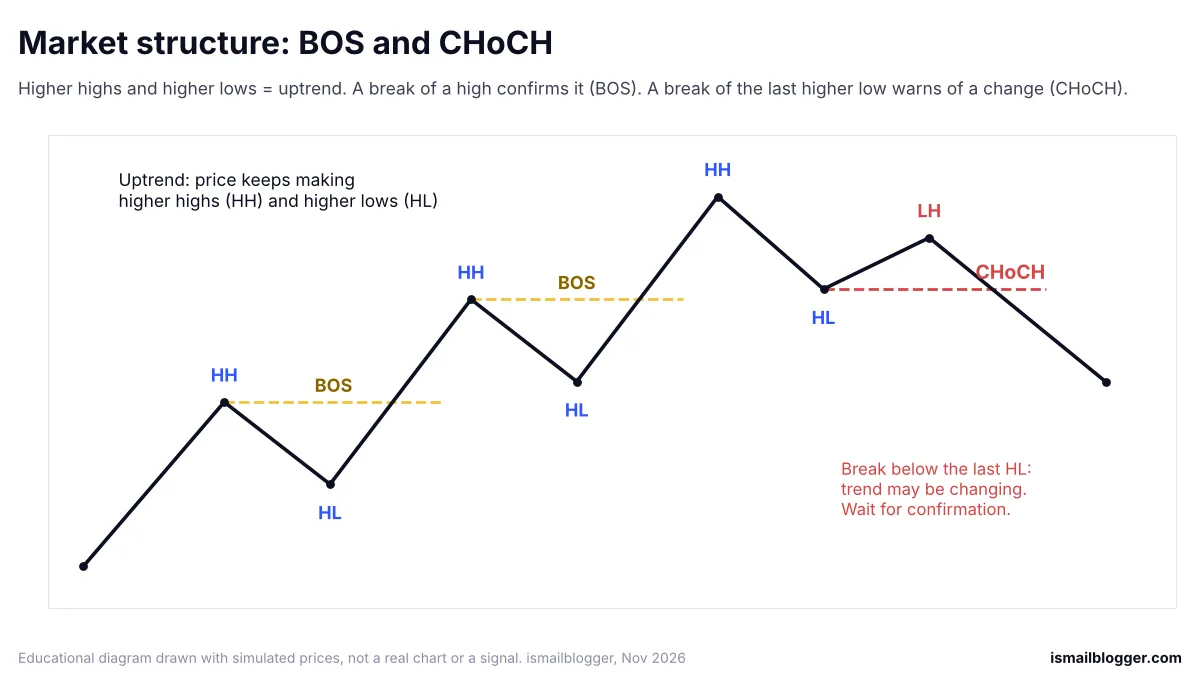
One CHoCH is not a reversal. Many uptrends print a CHoCH, then make a new high anyway. SMC traders usually want a CHoCH plus a sweep of liquidity plus a clean entry zone before they act.
What is a liquidity sweep?
In SMC, liquidity means places where many orders are likely waiting. Above equal highs and old swing highs sit buy stops (stop losses of sellers and breakout buy orders). This is called buy side liquidity. Below equal lows and old swing lows sit sell stops, called sell side liquidity.
A liquidity sweep happens when price pushes through one of these levels, triggers those orders, and then closes back on the other side. The idea is that a large player used those orders to fill a position in the opposite direction.
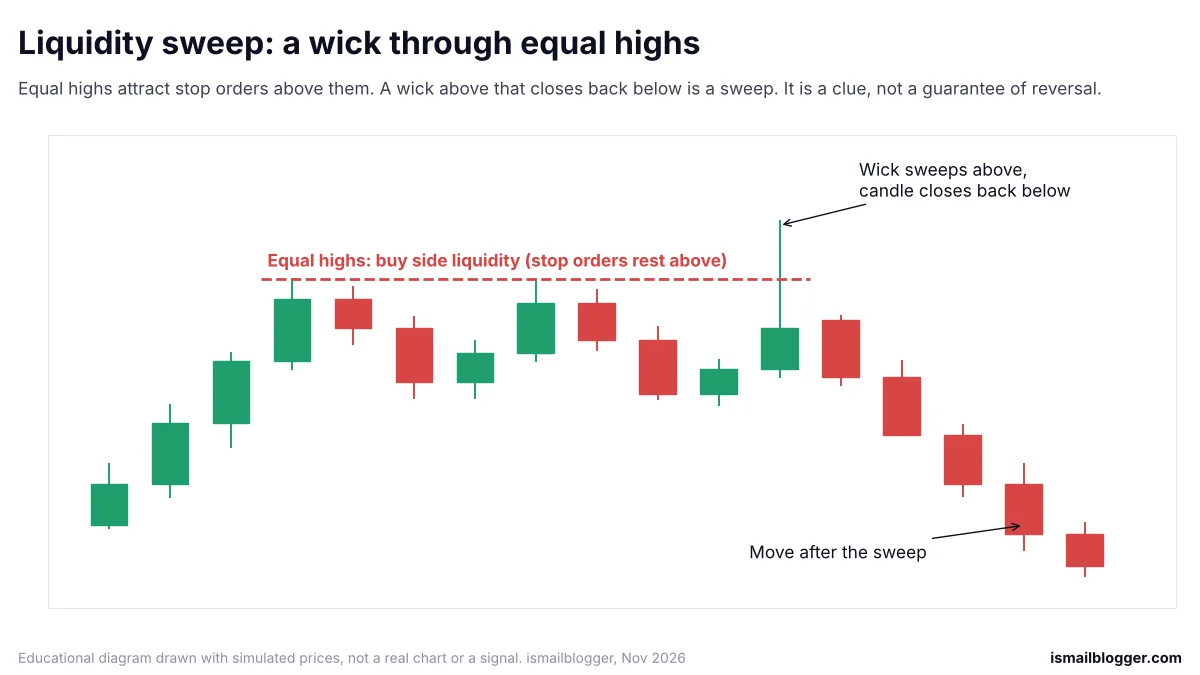
- Equal highs or equal lows on the chart are the most obvious liquidity. So are the previous day’s and previous week’s high and low.
- A sweep is more meaningful when it happens at a higher timeframe level, not in the middle of a range.
- If price closes beyond the level and keeps going, it was a breakout, not a sweep. Your stop must handle that case.
How do you mark an order block?
A bullish order block is the last down (bearish) candle before a strong up move that breaks structure. A bearish order block is the last up candle before a strong down move that breaks structure. Traders mark the zone from that candle’s high to its low (some use only the body) and wait for price to return.
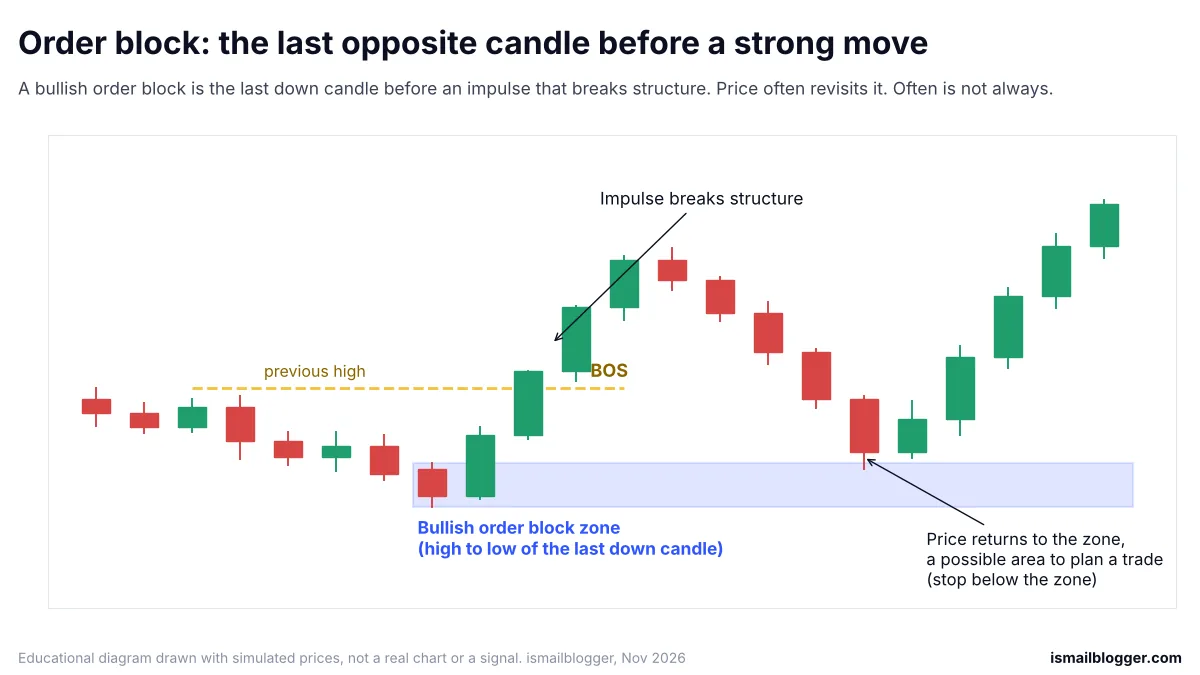
Checks that SMC traders commonly use to filter order blocks:
- The move away from it broke structure (a BOS or CHoCH). No break, no order block.
- The move was strong and left a fair value gap behind it.
- It is unmitigated: price has not come back to it yet.
- It sits in the right half of the range: buys from the lower half (discount), sells from the upper half (premium).
- It formed after a liquidity sweep, not in the middle of nowhere.
You will also hear about breaker blocks (an order block that failed and was broken, then acts from the other side) and mitigation blocks. Learn the basic order block well before you add these.
Premium, discount and inducement
Draw a line from the swing low to the swing high of the current range. The upper half is premium (expensive), the lower half is discount (cheap). SMC traders prefer buying in discount and selling in premium. The 50% level is called equilibrium.
Inducement is a small, obvious level just before an order block, for example a minor low. The idea is that early traders enter there, and their stops become the liquidity that price takes before reaching the real zone. In practice: wait for that small level to be taken before you look for an entry.
What is a fair value gap (FVG)?
A fair value gap is a three candle pattern. In a bullish FVG, the high of candle 1 is below the low of candle 3, so candle 2 moved so fast that the wicks of 1 and 3 never overlapped. The gap between them is the FVG. SMC traders expect price to come back and fill part or all of that gap before continuing.
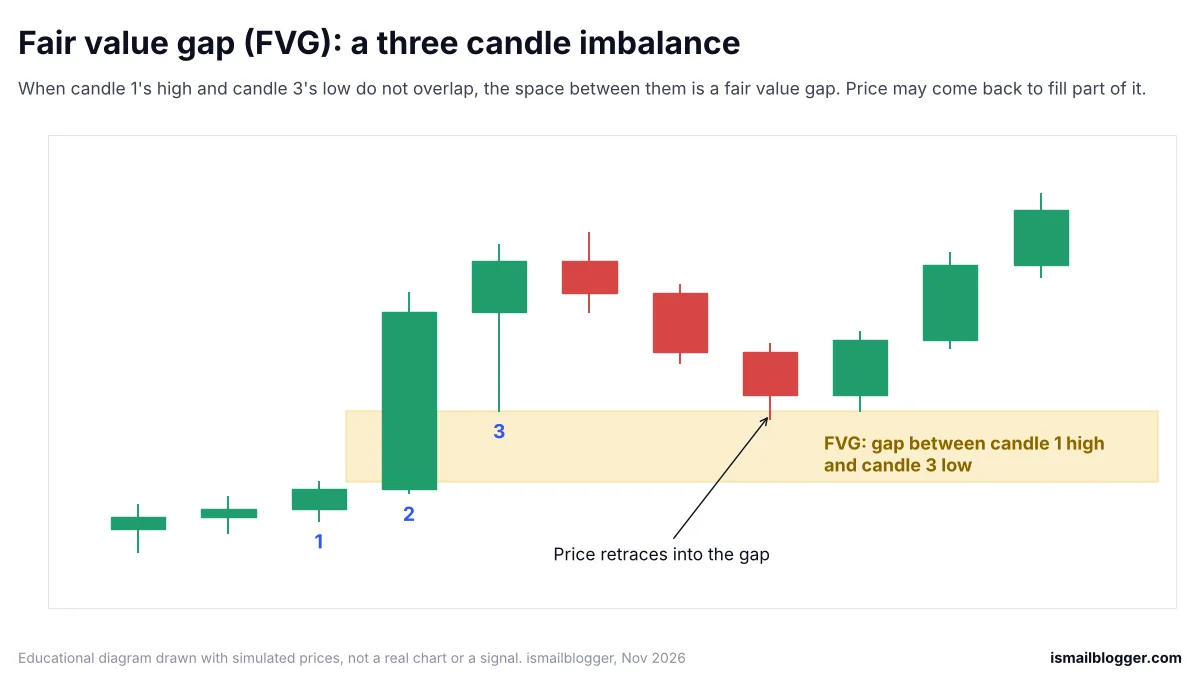
- FVGs appear all the time on small timeframes. Most are noise. The useful ones line up with structure and an order block.
- Some traders call a filled gap “mitigated” and stop using it after that.
- During big news, gaps can be filled and then broken in seconds. Spreads also widen then, which raises your cost.
A step by step SMC trading strategy framework
Use this as a learning checklist on a demo account, not a system to copy with real money.
- Set the bias on a higher timeframe. On the daily or 4 hour chart, is structure bullish (HH and HL) or bearish (LH and LL)? Only look for trades in that direction at first.
- Mark liquidity. Equal highs and lows, previous day high and low, obvious swing points. These are your possible sweep areas and your targets.
- Wait for price to reach a higher timeframe zone in discount (for buys) or premium (for sells), ideally an order block or FVG.
- Look for a sweep. For a buy, price takes sell side liquidity below a low and closes back above it.
- Confirm on a lower timeframe. Wait for a CHoCH in your direction on the 15 minute or 5 minute chart.
- Refine the entry. Use the order block or FVG that caused that CHoCH as your entry zone.
- Place the stop beyond the sweep low (for a buy) or sweep high (for a sell). If price goes there, your idea was wrong.
- Set the target at the opposite liquidity, for example the next equal highs. Only take the trade if the reward is at least 2 times the risk after costs.
- Size the position so that hitting the stop costs no more than your fixed risk (see below).
- Record everything in your journal, including the trades you skipped.
SMC does not give you certainty. It gives you a place to be wrong. A good SMC trade is one where the stop is clear and small compared with the target.
Does SMC trading work? The honest limits
A lot of SMC content online is selling a course, a signal group or a funded account. This is the part it leaves out:
- It is subjective. Which swing counts, which candle is the order block, whether a break was a sweep or a real break: different traders mark them differently, and most charts shown online are marked after the move.
- No independent proof. I looked for peer reviewed or independent testing that shows SMC beats simpler methods and did not find any. Treat any win rate claim without a full, verifiable trade history as marketing.
- You cannot see “smart money” directly. On spot forex there is no single central order book. A retail chart shows price, not who placed the orders. The story is a useful model, not a fact.
- It struggles in ranges and news. Inside choppy ranges you get CHoCH after CHoCH. Around big news, spreads widen and stops can slip.
- Small timeframes multiply costs. Many SMC traders use 1 to 5 minute entries. Spread and commission are a much bigger share of a small stop.
- The base rate is harsh. IG discloses that 70% of its retail investor accounts lose money on spread bets and CFDs, and EU regulators found 74% to 89% across providers in 2018 (ESMA). No chart method changes that by itself.
How much should you risk per SMC trade?
The 1% rule and position size
Decide a fixed share of your account you will risk on any one trade, commonly 0.5% to 1% for beginners. Then:
Position size = (account size x risk %) / (distance to stop x value per point)
Example: your account is Rs100,000 and you risk 1%, which is Rs1,000. If your stop is 200 points away and each point is worth Rs5 per contract, one contract risks Rs1,000. That is your maximum size. If the stop is wider, you trade less, not more.
Why reward to risk and win rate go together
| Win rate | Reward to risk | Result per trade (before costs) |
|---|---|---|
| 40% | 1 : 2 | 0.4 x 2 minus 0.6 x 1 = +0.2R |
| 50% | 1 : 1 | 0.5 x 1 minus 0.5 x 1 = 0R, so costs make it negative |
| 30% | 1 : 3 | 0.3 x 3 minus 0.7 x 1 = +0.2R |
| 60% | 1 : 0.5 | 0.6 x 0.5 minus 0.4 x 1 = minus 0.1R |
R means the amount you risk per trade. This is simple arithmetic, not a forecast. Even a positive number can turn negative once spreads, commissions and slippage are added.
Rules that protect you
- Set a daily loss limit, for example 2R, and stop trading for the day when you hit it.
- Never add to a losing trade to “average down”.
- Avoid high leverage. A smaller position with a sensible stop beats a big position with a tight one.
Backtesting and journaling your SMC trades
Before real money, check that you can apply the same rules the same way 100 times:
- Write your rules in one page: bias timeframe, entry timeframe, what counts as a sweep, CHoCH, order block, stop and target.
- Scroll back on a chart and mark setups with those exact rules, without peeking ahead (a common minimum is 100). Record every one, winners and losers.
- Forward test on a demo account; a common minimum is a month.
- Review weekly. Which mistakes repeat? Which setups lose most?
| Journal column | Example entry |
|---|---|
| Date, market, timeframe | 11 Nov, gold futures, 15m entry, 4h bias |
| Setup | Sell side sweep, CHoCH, bullish OB with FVG |
| Entry, stop, target | Entry, stop below sweep low, target equal highs |
| Planned R | 1 : 2.5 |
| Result in R and money | +2.5R or minus 1R |
| Followed rules? | Yes or no, and which rule was broken |
| Emotion | Calm, rushed, revenge, bored |
| Screenshot link | Before and after |
Where can you legally practise SMC in Pakistan?
The State Bank of Pakistan (SBP) said in May 2022 that residents may not send money to offshore forex, margin or CFD platforms through any payment channel. The regulated local route is futures on PMEX through a PMEX registered broker, and the SECP has warned repeatedly, most recently in December 2025, about fake trading apps.
I explain all of this, with sources, in my guide to forex trading in Pakistan. For crypto charts, read is crypto legal in Pakistan and crypto trading in Pakistan before you put in any money.
- Practise on a demo account first. No money leaves the country and mistakes cost nothing.
- If you trade real money, use a regulated route and start without leverage or with very small size.
Scam warning: many “SMC mentors” sell signals, “managed accounts” or ask you to deposit with a broker they choose. For crypto platforms, check the name in the PVARA checker first. The SECP warned in December 2025 about fake platforms, fake dashboards and people offering free investment tips to lure investors (Profit). I do not run a signal group and I do not manage accounts, so never give anyone your money or login to trade for you, whatever name they use. See my crypto scams guide.
FAQ
Is the SMC trading strategy profitable?
Not by itself. Nothing about SMC guarantees profit. I found no independent evidence that SMC beats other methods, and broker disclosures show most retail CFD accounts lose money. What decides the result is your position size and your costs, not the name of the method.
What is the difference between BOS and CHoCH?
A break of structure (BOS) is a break in the direction of the trend, for example a new higher high in an uptrend. A change of character (CHoCH) is the first break against the trend, for example a close below the last higher low. BOS suggests continuation, CHoCH warns of a possible change.
What is the win rate of the SMC trading strategy?
There is no verified win rate for SMC. I found no independent test of it, and any figure without a full trade history is marketing. A 40% win rate at 1 to 2 reward to risk is only +0.2R per trade before costs.
Is SMC the same as ICT?
They overlap a lot. Many SMC terms such as order blocks, fair value gaps and liquidity are taught in ICT style content too. Different educators define details differently, so pick one clear set of definitions and stick to it.
Which timeframe is best for SMC?
Beginners usually do better with a higher timeframe for bias (4 hour or daily) and a 15 minute chart for entries. Very small timeframes raise costs and noise.
Can I use SMC for crypto and gold?
Yes, the concepts apply to any liquid market. Crypto trades all week and moves fast, so size smaller. In Pakistan, check the legal position first and use regulated routes only.
Do you give SMC signals?
No. I do not sell signals, manage accounts or ask anyone to deposit with a broker. Anyone using my name to do that is a scammer.
Have a question about any of this? Send it through Ask Ismail.
Keep reading
Related articles
 Trading · 20 min readForex Trading in Pakistan 2026: Is It Legal? SBP Rules, PMEX, Costs and RisksRead article →
 Tax · 20 min readFreelancer Tax in Pakistan 2026: Rates, Filer Status and How to FileRead article →
 Marketing · 14 min readAffiliate Programs in Pakistan (2026): 12 Programs That Can Actually Pay YouRead article →