Short answer: The most common crypto scams in Pakistan are fake investment apps that show a fixed daily profit, Telegram and WhatsApp task or “trading” groups, fake exchange support, and “recovery agents” who rob victims a second time. If you have been hit, stop paying, save your evidence, call your bank or wallet at once, and report it to the National Cyber Crime Investigation Agency (NCCIA) on helpline 1799, then to PVARA or SECP depending on the case. All of this was checked on 12 November 2026.
Key takeaways
- Almost every crypto scam in Pakistan has one of three signs: guaranteed profit, a fee before withdrawal, or a request for your OTP, password or seed phrase.
- The money usually leaves through ordinary bank accounts and mobile wallets first, so your bank or wallet helpline is the first call, before any government office.
- Report the crime to NCCIA (helpline 1799). Report a crypto platform to PVARA, and a fake investment scheme or fake broker app to SECP.
- Renting out your bank account or wallet to “move USDT” does not make you a partner. It makes you the person the investigators find first.
- Recovery is rare once funds are sent to a crypto wallet. Anyone who promises to recover your money for an upfront fee is running a second scam.
- Ismailblogger never takes investments. If someone uses my name to ask for money, it is fraud. See the official scam alert.
On this page
- How big is the crypto scam problem in Pakistan?
- Types of crypto scams in Pakistan: the 10 common ones, the red flag, what to do
- How to spot a fake crypto app in Pakistan: 8 red flags
- Real crypto scam cases in Pakistan, with dates
- Three scams that need a closer look
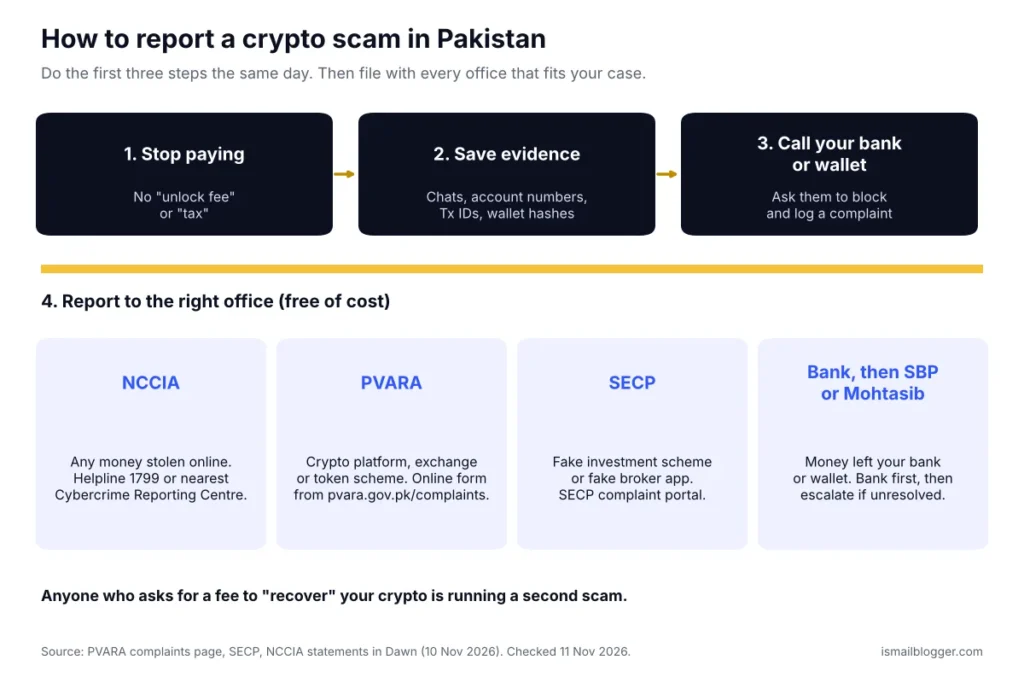
- Scammed already? What to do in the first 24 hours
- How to report a crypto scam in Pakistan: which office handles what
- Can I recover money from a crypto scam?
- FAQ: crypto scams in Pakistan
Below: the 10 common types, documented Pakistani cases up to November 2026, a first 24 hours plan, and the correct office for each situation.
This guide is education, not financial, legal or tax advice.
How big is the crypto scam problem in Pakistan?
I could not find an official figure for crypto scam losses in Pakistan. The overall cyber crime picture is this. In January 2026 the Minister of State for Interior told the National Assembly that NCCIA received more than 150,000 complaints in the past year, with over 81,000 related to financial fraud, and that 1,095 suspects had been arrested, as reported by Profit on January 17, 2026. That number covers all online fraud, not only crypto.
Chainalysis, in a report dated January 13, 2026, counted at least $14 billion received by crypto scams worldwide in 2025 and projected the final figure could pass $17 billion. It also found that impersonation scams grew more than 1,400% in a year. In the United States alone, the FBI IC3 2025 annual report recorded 61,559 complaints of crypto investment fraud with $7.2 billion in losses. Those are global and US figures, not Pakistani ones. The same FBI report does list Pakistan among the top 20 foreign countries filing complaints with IC3, with 1,514 complaints of all types in 2025.
Published Pakistani cases show how little comes back. On 10 November 2026 Dawn reported two NCCIA cases from Rawalpindi. In one, a man was added to a WhatsApp group called “v185-Wharton” that promised big investment profits, and he transferred Rs 21,018,511 to various beneficiary accounts. NCCIA had recovered Rs 1.4 million. In the other, a Facebook contact and a “businessman” on WhatsApp sent a link that installed an app called “Onchainus.net”. The victim lost over Rs 2.9 million and Rs 1.8 million was recovered.

Types of crypto scams in Pakistan: the 10 common ones, the red flag, what to do
Scammers mix these types together. A WhatsApp “trading class” can lead to a fake app, then to a referral chain, and later to a recovery agent. Use the table to recognise the pattern, not just the name.
| Scam type | How it works | Red flag | What to do |
|---|---|---|---|
| 1. Fake investment or “trading” app | You deposit USDT or rupees into an app or website that shows a fixed daily profit. The balance on screen is only numbers typed by the scammer. Withdrawals fail or need a “fee”. | Fixed daily or monthly profit. The app comes from a link in a chat. Deposits go to personal accounts. | Do not deposit. If you already have, pay nothing more to “unlock” a withdrawal. Report to NCCIA and PVARA. |
| 2. Telegram or WhatsApp task group | You get a small payout for simple tasks such as liking or subscribing. Then you must “prepay” to unlock bigger tasks, and the prepaid amounts keep growing. | Any job where you pay first to earn. | Leave after taking screenshots. Do not send a “final” payment to get earlier money back. |
| 3. Signal or “VIP” trading group | Admins post winning screenshots, sell a paid tier, or push everyone to deposit on one unknown platform they control. | Profit screenshots, countdown offers, an admin who offers to trade for you. | Never send money to an admin. No one sells a real edge for a few thousand rupees. |
| 4. Fake exchange support and phishing | A “support agent” replies to your comment, messages or calls you, or a lookalike website asks you to log in. They want your OTP, password or seed phrase, or tell you to move funds to a “safe wallet”. | Support contacted you first. The link came in a message. | Open the official app yourself and use in app support only. Change your password and turn on two factor login. |
| 5. Romance or “pig butchering” | A stranger builds friendship or romance over weeks, then introduces a trading platform. You see fake profit, add more, and later face “taxes” before withdrawal. | Someone you have never met in person guides your investments. | Stop sending money and tell a family member. Shame is what keeps victims paying. |
| 6. Fake airdrop and wallet drain approval | A site offers free tokens and asks you to connect your wallet and approve a transaction. The approval lets a contract move your tokens out. | “Claim now” links. A wallet pop up asking permission to spend your tokens. | Reject it. If you signed, revoke the approval and move what is left to a new wallet. |
| 7. Recovery scam | After a loss, a “lawyer”, “hacker” or fake official promises to trace and return your funds for an upfront fee. | Guaranteed recovery. A fee first. Requests for your seed phrase or remote access to your phone. | Never pay. Report through the offices in the table below instead. |
| 8. Account renting (money mule) | You are offered commission to receive rupees in your bank account or wallet and forward them, or to buy USDT with them. | “Just use your account, we do the rest.” | Refuse. If you already did it, stop, keep every record and speak to a lawyer. |
| 9. Ponzi and referral chain | Early members are paid from new deposits. Income depends on levels and team bonuses. It collapses when new joiners slow down. | You earn more for recruiting than for any real product. | Do not bring in friends or family. Report the scheme to SECP. |
| 10. Impersonation of creators and brands | Fake accounts use a known person’s name, photo or AI generated video to promote a group or collect “investments”. | A famous name messaging you with an offer. A username that is slightly different. | Check the person’s official channels. For my name, see the scam alert page. |
How to spot a fake crypto app in Pakistan: 8 red flags
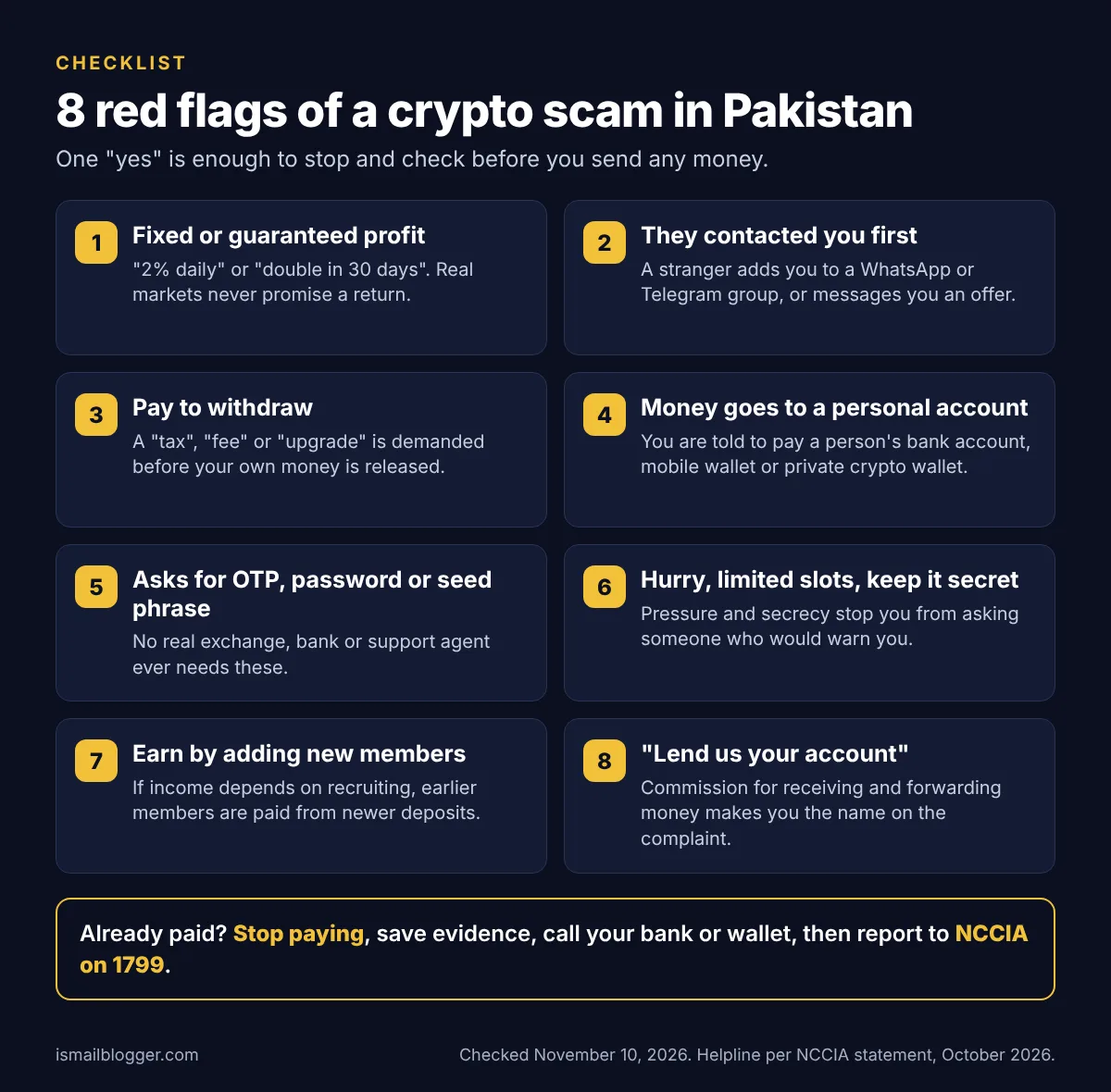
You do not need to memorise ten scam names. If an offer guarantees profit, asks you to pay before you can withdraw, wants a code or seed phrase, or pays you for recruiting, treat it as a scam until proven otherwise.
One more check is new in 2026. The State Bank of Pakistan now allows banks to open accounts for virtual asset firms that hold a PVARA licence, including separate client money accounts that do not accept cash deposits, and limited purpose accounts for NOC holders that are still completing licensing, as Pakistan Today reported on 15 April 2026. A real platform working under that system pays and collects through its own company accounts. If a “crypto app” asks you to send rupees to a person’s bank account, JazzCash or Easypaisa number, that alone tells you it is not a licensed platform. I could not open sbp.org.pk from my connection on 12 November 2026, so I am relying on that report for the circular’s wording.
Real crypto scam cases in Pakistan, with dates
These are documented cases and regulator warnings, as reported by the sources linked. Most are allegations under investigation unless a conviction is mentioned.
| Date | What happened | What it shows |
|---|---|---|
| January 2022 | The FIA cyber crime unit in Sindh said at least 11 apps stopped working after collecting deposits through Binance wallets, with Telegram groups giving “expert” signals. The FIA estimated the loss at nearly $100 million (Profit, January 7, 2022). | Fake apps, signal groups and referral bonuses are one combined model, and it is not new. |
| July 2025 | NCCIA raided a call centre in Faisalabad and arrested 149 people, including 71 foreigners. The agency said it was “involved in Ponzi schemes and investment fraud” (Arab News, July 10, 2025). | These are organised operations with staff, not one person with a phone. |
| September 2025 | NCCIA Gujranwala registered FIR 170/2025 after a Sangla Hill resident lost Rs 1.28 million to people posing as a foreign company, using fake WhatsApp numbers and misleading ads (APP, September 19, 2025). | Money was collected through several bank accounts and mobile numbers. |
| November 2025 | SECP warned about an app called “TSLWEA/TSL WEALTH” that falsely used a licensed broker’s name, and about AI generated ads with celebrity images pulling people into WhatsApp groups (Profit, November 21, 2025). | A famous face or a real company name in an ad proves nothing. |
| December 2025 | NCCIA arrested 15 foreign nationals and 19 Pakistanis in Karachi over fake crypto and forex platforms. Officials said victims were shown fake profits and, once the “investment” reached around $5,000, were asked for extra fees and then blocked. The Sindh home minister estimated the fraud at about $60 million (Profit, December 26, 2025). | The “pay a fee to withdraw” step is the final squeeze, not a real charge. |
| October 2026 | A court sentenced three people to seven years each after a citizen lost Rs 19.391 million through a fake app impersonating a foreign private bank, according to NCCIA (ARY News, October 22, 2026). | Convictions happen, but they are slow and do not automatically return the money. |
| November 2026 | A Rawalpindi resident lost Rs 21,018,511 after joining a WhatsApp investment group. The money went to multiple beneficiary accounts, and NCCIA had recovered Rs 1.4 million so far (TechJuice, November 9, 2026; Dawn, November 10, 2026). | Even with an arrest, most of the money can stay missing. |
| November 2026 | A Rawalpindi man contacted through Facebook and then WhatsApp clicked a link that installed an app called “Onchainus.net” and lost Rs 2,915,872. NCCIA recovered Rs 1.8 million (Dawn, November 10, 2026). | The “app” is often just a link from a chat, not something from a real exchange. |
Dawn reported on October 22, 2025 on a data scientist who lost wallet funds after saving his 12 word seed phrase in a Facebook Messenger chat with himself, and who was shown $30 “growing” to $300 on a fake coin launch that never allowed withdrawal.
Three scams that need a closer look
Account renting: “use your bank account to move USDT”
This one is sold as easy commission. Someone sends rupees to your bank account, JazzCash or Easypaisa wallet. You forward the money or buy USDT with it and keep a small cut. What you are not told is that the rupees are often stolen from another victim, and your account is now the visible link in the chain.
In Karachi, officials said funds were collected in bank accounts, converted into crypto and sent across borders. In Rawalpindi, the victim paid into multiple beneficiary accounts. Those account holders are the first people investigators can identify. Back in December 2021, the FIA reportedly froze bank accounts in the names of 1,064 individuals linked to crypto transactions (Bitcoin.com News, December 30, 2021). In August 2026 the Lahore High Court held that receiving funds in a bank account is not, by itself, proof of fraud, but the people in that case had still been named by the FIA and needed pre arrest bail, as TechJuice reported on August 3, 2026.
The same risk applies when you sell USDT to strangers for bank transfers. You cannot know where the buyer’s rupees came from. That is why I never present P2P through Pakistani bank accounts or wallets as a method to follow. It is a risk to understand, and I explain it in my Binance P2P in Pakistan risk guide.
Fake airdrops and wallet approvals
With a self custody wallet, a scammer does not always need your seed phrase. Many drain sites ask you to “approve” a contract. As the ethereum.org guide on revoking access explains, once a contract has unlimited access to a token in your wallet, it can spend all of those tokens, with no recovery option for you. The same guide lists tools for viewing and revoking the approvals on your address. If you ever typed your seed phrase into a website, revoking is not enough: create a new wallet and move what remains.
People pretending to be Ismailblogger
Fake accounts, WhatsApp numbers and Telegram groups use my name, photos and videos to collect “investments”. I do not take investments, manage accounts, sell signals or contact anyone first with an opportunity. My only official channels are listed on the official scam alert page. If an account using my name asks you for money, send screenshots and the account link to hello@ismailblogger.com and report it on the platform.
I never take investments, manage accounts or sell signals, so any account that asks for money in my name is fake.
Scammed already? What to do in the first 24 hours
Act fast: money that is still sitting in a Pakistani bank account can sometimes be stopped. Do these in order.
- Stop paying. A “tax”, “verification deposit” or “unlock fee” does not release a scam withdrawal. Every extra payment is a new loss.
- Do not warn the scammer or delete anything. Stay in the group long enough to capture it. Do not uninstall the app before you have screenshots.
- Save evidence. NCCIA’s own guidance asks for screenshots, contact numbers and transaction details (ARY News, September 28, 2026). Collect chats with dates visible, usernames and profile links, phone numbers, the account titles and numbers you paid, transaction IDs, bank or wallet statements, crypto wallet addresses and transaction hashes, and the app or website link.
- Call your bank or wallet helpline. Say it is fraud, ask them to block the transfer if possible and to secure your account or card, and get a complaint number. Follow up in writing the same day.
- Lock your accounts. Change passwords on your email, exchange and banking apps, turn on two factor login, and revoke wallet approvals. If you shared an OTP or seed phrase, assume that account or wallet is compromised.
- Report the crime to NCCIA. Call 1799, visit the nearest NCCIA office, or call Police 15. Keep the complaint number.
- Report the platform to the right regulator. PVARA for crypto platforms, SECP for investment schemes and fake broker apps. The table below shows which one fits.
- Report the account where it lives. Use the report option on WhatsApp, Telegram, Facebook, Instagram or TikTok. If the scammer used an exchange account, send the exchange your evidence and complaint number and ask it to review that account.
- Tell someone you trust, and ignore “recovery” offers. Once you post about a loss, expect messages from people offering to get it back. They are part of the problem.
How to report a crypto scam in Pakistan: which office handles what
Different offices handle different parts of the same scam, so you will often file two complaints. I re checked each contact below on 12 November 2026 against the regulators’ own pages or official statements. For other situations such as hacked WhatsApp accounts or fraud calls, use the step by step Pakistan scam complaint help page.
| Your situation | Report to | How | Good to know |
|---|---|---|---|
| Money stolen through any online fraud: fake app, Telegram or WhatsApp group, impersonation, phishing | NCCIA (cyber crime agency) | Helpline 1799, as NCCIA repeated in an October 2026 statement (TechJuice, October 19, 2026), or the nearest NCCIA office. Police 15 call systems were linked to NCCIA in October 2026 (APP, October 17, 2026). | This is the criminal complaint. Bring your CNIC and evidence. NCCIA repeated the 1799 helpline and “nearest NCCIA circle” advice on 10 November 2026 (Dawn). Its online complaint site, complaint.nccia.gov.pk, blocked my automated check on 12 November 2026, so I could not confirm its form from here. |
| A crypto platform, exchange or token scheme that cheated you or looks unlicensed | PVARA (crypto regulator) | PVARA online complaint form, linked from the PVARA complaints page. | PVARA says it acknowledges within 2 business days, gives a reference number, and a full investigation may take 30 to 60 days. It does not promise refunds. |
| A fake investment scheme, a company taking deposits, or an app posing as a licensed broker | SECP | SECP complaint portal (SECP XS), email scams@secp.gov.pk, or toll free 0800 88008, as listed in an SECP notice (Business Recorder, September 5, 2025). | SECP has said a company registration certificate does not allow anyone to take deposits or offer investment schemes (Profit, September 4, 2025). |
| The money left your bank account or mobile wallet | Your bank or wallet first, then SBP | Bank helpline and a written complaint. If it is not resolved, SBP runs the Sunwai complaint portal for banks and microfinance banks (Profit, December 30, 2023). A PTA advisory lists the SBP number as (021) 111 727 273 (APP, April 13, 2026). | I could not open sunwai.sbp.org.pk or sbp.org.pk from my connection on 12 November 2026, so confirm the address on sbp.org.pk. |
| A commercial bank did not resolve your complaint | Banking Mohtasib Pakistan | Online complaint form. The official procedure says to write to your bank first and, if it fails to resolve the complaint within 30 days, to file with the Mohtasib. | Free of cost. Its form says it handles commercial banks only, not microfinance banks or investment companies. |
| Scam calls, SMS or SIM misuse | PTA | PTA complaint portal or the PTA CMS app (APP, April 13, 2026); the PTA number 0800 55055 is given in Profit, August 6, 2025. | PTA deals with the number or SIM. For lost money, also file with NCCIA. |
| Someone is using my name or the Ismailblogger brand | Ismailblogger, plus NCCIA if you lost money | Email hello@ismailblogger.com with screenshots and the account link. | Official channels are listed on the scam alert page. |
Report even when the money is probably gone, because complaints are what trigger action. Under the Virtual Assets Act, 2026, wilfully providing an unlicensed virtual asset service is punishable with up to five years in prison, a fine of up to Rs 50 million, or both (section 54), and section 61 gives PVARA the power to have unlicensed services blocked (Act text on pvara.gov.pk). A regulator cannot block an app nobody reported.
Can I recover money from a crypto scam?
Usually not. A crypto transfer cannot be reversed by a bank, an exchange or the sender once it is confirmed. If your USDT went to a scammer’s wallet, getting it back depends on investigators identifying a real person and finding assets, which takes months and often fails.
Your chances are better when the money moved through Pakistani bank accounts and you report fast. NCCIA does return money in some cases: on November 1, 2026 it handed back Rs 5.99 million to a fraud complainant in Rawalpindi (APP, November 1, 2026). But compare that with the Rawalpindi WhatsApp group case above, where Rs 1.4 million out of Rs 21 million had been recovered. Plan for the loss, and treat any recovery as a bonus.
What you must not do is pay someone to recover it. The FBI’s 2025 report counted 10,516 complaints about recovery scams in the United States, with $1.4 billion in reported losses, a figure that can include the original scam. It specifically warns about fake law firms and people impersonating government officials (FBI IC3 2025 annual report). The pattern here is the same: a “cyber expert”, “FIA officer” or “blockchain lawyer” who needs a fee, a deposit or your seed phrase. Real complaints go to NCCIA, PVARA, SECP and the Banking Mohtasib, not to a paid agent.
FAQ: crypto scams in Pakistan
Is USDT itself a scam?
No. USDT is a token designed to follow the US dollar, and it is widely used on exchanges. Scammers prefer it because transfers are fast, work across borders and cannot be reversed. The scam is the person or platform you send it to, not the token.
How do I check if a crypto app or exchange is licensed in Pakistan?
PVARA states that all virtual asset service providers must obtain a licence before offering services in Pakistan, and its FAQ says a No Objection Certificate “does not constitute a license”. The FAQ also says licensees must publish their licence number and Pakistan office address on their own website. On 12 November 2026 PVARA’s own website still named no exchange with a full licence. The step by step method is in my guide on how to check a licensed crypto exchange in Pakistan, and the free PVARA checker runs any platform through 7 red flag questions.
Can the police or NCCIA trace a crypto wallet?
Wallet transfers are visible on public blockchains, so the path of funds can often be followed. Putting a name on a wallet is the hard part, and it usually needs an exchange to cooperate. In the 2022 app case, the FIA said it had identified at least 26 suspect wallet addresses and wrote to Binance for details (Profit, January 7, 2022). So always include wallet addresses and transaction hashes in your complaint.
The scammer is outside Pakistan. Should I still report here?
Yes. The Karachi and Faisalabad cases show that operations run by foreigners can have local offices and local staff. Your NCCIA complaint is what connects your loss to such a case. If the platform or the payment went through a US company, you can also file at ic3.gov, which accepts complaints from other countries.
Is it illegal to lose money to a scam, or to have used an unlicensed app?
Being a victim is not a crime, so report it. The criminal offence in section 54 of the Virtual Assets Act, 2026 is aimed at whoever wilfully provides an unlicensed virtual asset service, not at the customer. I did not find a section that punishes an ordinary user for using a platform, but I am not a lawyer and the law is new, so take legal advice if your account has been frozen or you are named in a case.
Should I stop using crypto completely to stay safe?
That is your decision, and staying out is a valid choice. If you do take part, the scams above mostly catch people who are rushed, promised profit, or new to wallets. Get education first, and use only money you are fully ready to lose.
If you are looking at an offer right now and cannot tell whether it is real, send it to me through Ask Ismail before you send anyone money.
Keep reading
Related articles
 Crypto · 7 min readIs HTX Legal in Pakistan? Real or Fake (2026 Check)Read article →
 Crypto · 21 min readIs Crypto Halal or Haram? What Scholars Say About Spot, Futures and Margin (2026)Read article →
 Crypto · 10 min readBitget Wallet in Pakistan and India (2026): Card, Safety and Legal StatusRead article →