

Short answer: A wealth statement in Pakistan is the list of everything you own and owe on 30 June, filed on IRIS with your income tax return under section 116 of the Income Tax Ordinance. It must reconcile: the change in your net assets has to equal your income and other inflows minus your expenses, so the unreconciled amount is zero.
Key takeaways
- Who files: every resident individual who files an income tax return, whatever the income. The old Rs 1 million threshold was removed from tax year 2013.
- The formula: closing net assets = opening net assets + inflows minus outflows. On the tax year 2026 form, personal expenses are counted inside outflows.
- Value: assets go in at cost, not at today’s market price.
- Unreconciled amount: it must be 0, or the return cannot be submitted.
- Penalty: not furnishing the wealth statement costs 0.1% of taxable income per week or Rs 100,000, whichever is higher (section 182, entry 1AA).
- Revision: allowed under section 116(3), but never after five years from the return’s due date.
This guide follows the Income Tax Ordinance, 2001 as amended up to 30 June 2026 and FBR’s own help pages, checked on 15 November 2026. The rupee figures in the examples are made up for teaching.
If you have not registered yet, start with my guide on how to become a filer in Pakistan, then come back here. To estimate the tax itself, use the income tax calculator.
What is a wealth statement in Pakistan?
It is a statement of your personal assets and liabilities on the last day of the tax year, 30 June for most people. Under section 116 it also carries the assets of your dependents (a spouse’s assets only if the spouse is dependent, an explanation added by the Finance Act 2024), assets you transferred during the year, your family’s expenses for the year, and the reconciliation statement of wealth.
FBR’s return page gives the test: this year’s wealth must differ from last year’s “by the same amount as your income has exceeded/fallen short of your expenses”.
A wealth statement is not a test of how rich you are. It is a test of whether your income, your spending and your assets tell the same story.
Who must file a wealth statement?
Section 116(2) says every resident taxpayer who is an individual and files a return of income “shall furnish a wealth statement and wealth reconciliation statement for that year along with such return”.
| Person | Wealth statement needed? | Basis |
|---|---|---|
| Salaried person filing a return | Yes | Section 116(2) |
| Freelancer, YouTuber, shopkeeper, landlord | Yes | Section 116(2) |
| Member of an association of persons (AOP) | Yes | Proviso to section 116(2) |
| Non resident individual | Not under 116(2), which covers residents only | Section 116(2) |
| Anyone who gets a notice from the Commissioner | Yes, by the date in the notice | Section 116(1) |
There is no income limit, for salaried people or anyone else. The Rs 1 million threshold that old articles and videos repeat was removed by the Finance Act 2013.
What goes in the wealth statement?
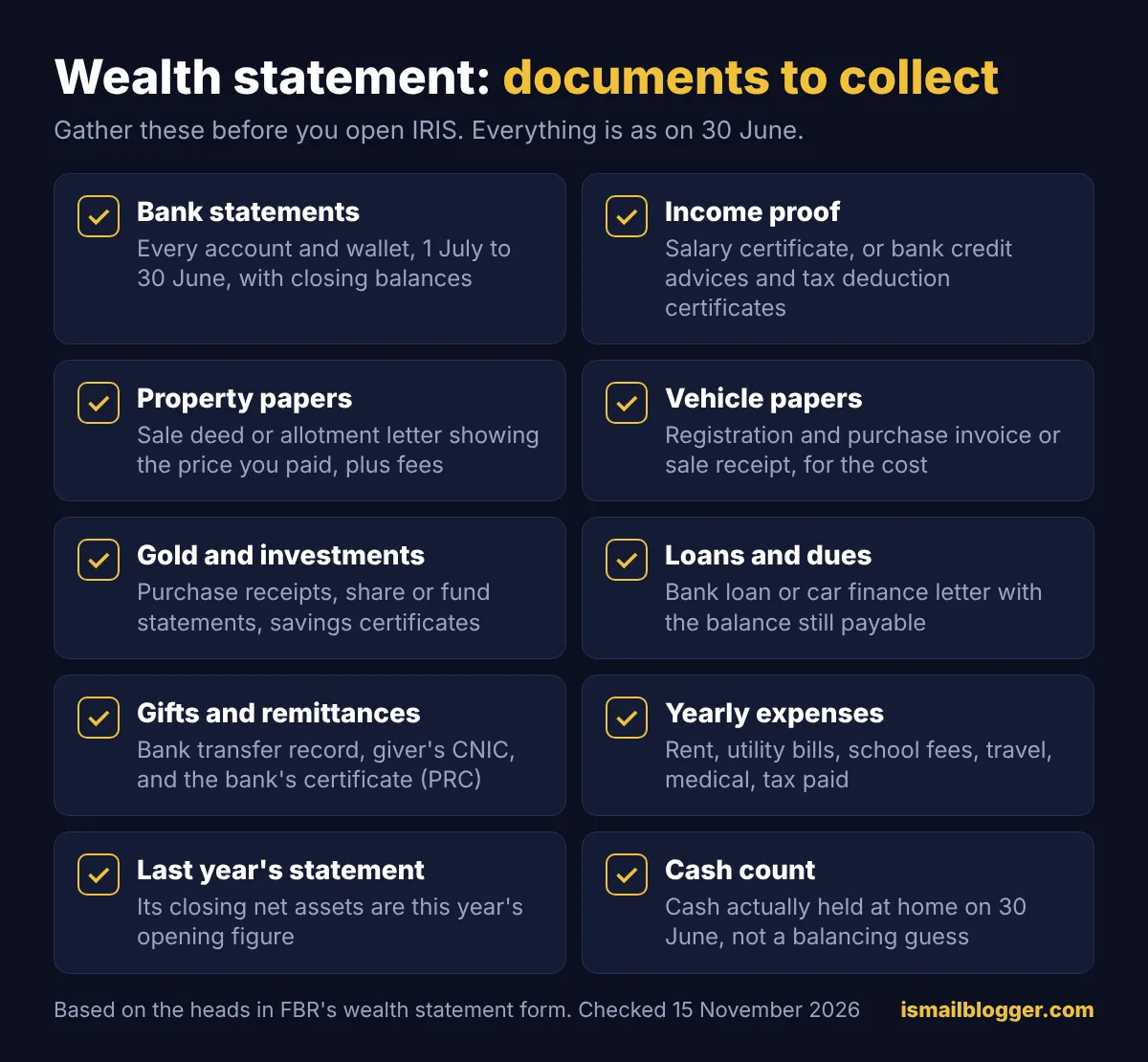
These heads come from FBR’s return instructions and wealth statement form.
| Part | What you enter | Rule to remember |
|---|---|---|
| Property | Plots, house, flat, shop, agricultural land | Purchase cost plus fees and taxes paid on purchase |
| Vehicles | Car, motorcycle | Cost, even if the market price has changed |
| Bank balances | Every account, including wallets and dormant accounts | Balance on 30 June from the statement |
| Cash | Notes and coins at home | Only cash you really hold |
| Gold, shares, savings certificates | Under precious possessions and investments | Cost when bought |
| Assets abroad | Foreign bank account, property, shares | Cost in rupees, in a separate column |
| Liabilities | Bank loan, car finance, personal loan, credit card dues | Amount still payable on 30 June |
| Personal expenses | Rent, rates and taxes, vehicle running, local and foreign travelling, electricity, water, gas, telephone, medical, educational, club, wedding and other events, donations and zakat, insurance, other household expenses | Enter the household spending by head. A family member’s share goes in as an inflow, not here |
The instructions state: “All assets must be declared at cost, including ancillary expenses.” A plot bought for Rs 3 million stays at Rs 3 million plus purchase costs, even if it is worth Rs 8 million today.
Assets in the name of your spouse or children go in your statement only if you paid for them. For a financed car, show the full price as an asset and the unpaid balance as a liability.
How does the wealth reconciliation statement work?
The reconciliation is one equation. These are the lines on the “Reconciliation of Net Assets” screen of the tax year 2026 return, as notified by FBR in S.R.O. 1495 of 2 September 2026 (form read on 20 November 2026):
| Line on the form | What it is |
|---|---|
| Net Assets Current Year | Your assets minus liabilities on this 30 June |
| Net Assets Previous Year | The same figure from last year’s statement |
| Increase / Decrease in Assets | This year minus last year |
| Inflows | Income declared in the return (normal tax, exempt, and final or fixed tax income), adjustments in inflows, foreign remittance, inheritance, gift received, and contribution in expenses by family members |
| Outflows | Personal expenses, adjustments in outflows, and gift given |
| Unreconciled Amount | The increase, minus (inflows minus outflows). It must be 0 |
Two details surprise people. Personal expenses are not a separate line: they sit inside Outflows. And if other family members share the household costs, their share is not subtracted from your expenses. It is entered as an inflow, on the line “Contribution in Expenses by Family Members”.
A loan is not an inflow. Put it in liabilities. The borrowed money raises your bank balance and your liabilities by the same amount, so net assets do not change and nothing needs explaining.
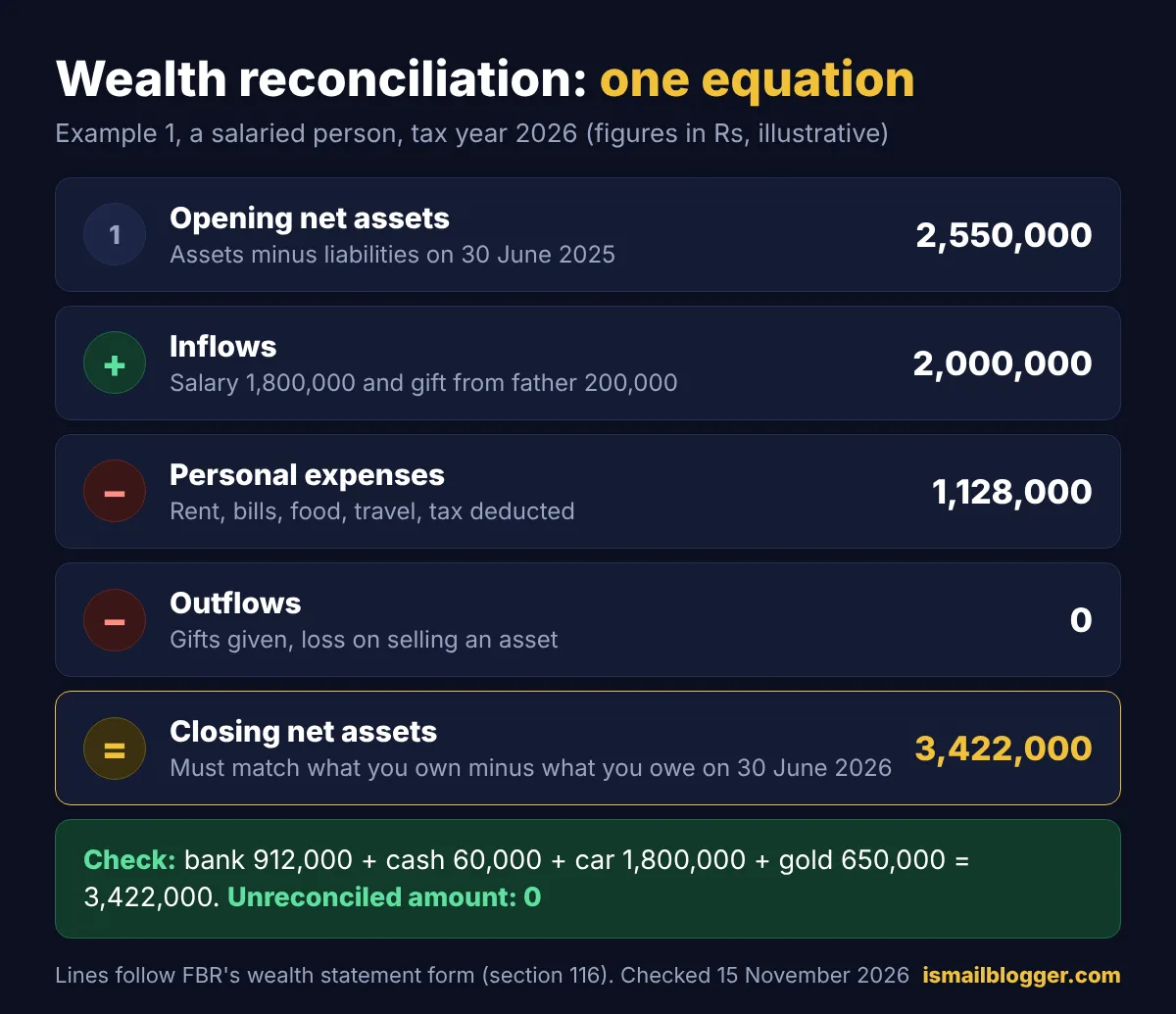
Example 1: a salaried person
Bilal earns Rs 150,000 a month. This is his tax year 2026 (1 July 2025 to 30 June 2026).
He starts with net assets of Rs 2,550,000. His inflows are salary of Rs 1,800,000 and a Rs 200,000 gift from his father by bank transfer. His personal expenses are Rs 1,128,000, which includes the tax deducted from his salary. Expected closing net assets: 2,550,000 + 2,000,000 minus 1,128,000 = Rs 3,422,000.
His real assets must give the same closing figure:
| Asset or liability | 30 June 2025 | 30 June 2026 |
|---|---|---|
| Bank balance | 400,000 | 912,000 |
| Cash in hand | 50,000 | 60,000 |
| Car, at cost | 1,800,000 | 1,800,000 |
| Gold, at cost (bought Rs 350,000 more this year) | 300,000 | 650,000 |
| Liabilities | 0 | 0 |
| Net assets | 2,550,000 | 3,422,000 |
Net assets rose by Rs 872,000, and inflows minus outflows (2,000,000 minus 1,128,000 of personal expenses) are also Rs 872,000. Unreconciled amount: 0.
Example 2: a freelancer with foreign income
Hamza is a freelancer without PSEB registration, so his bank deducted 1% tax on client payments.
| Line | Rs |
|---|---|
| Opening net assets (30 June 2025) | 970,000 |
| Inflow: freelance receipts through the bank (taxed at 1%, section 154A) | 3,000,000 |
| Inflow: foreign remittance from his brother in Dubai | 500,000 |
| Personal expenses, including Rs 30,000 tax deducted | 1,350,000 |
| Outflow: gift to his mother | 150,000 |
| Expected closing net assets | 2,970,000 |
| Asset or liability | 30 June 2025 | 30 June 2026 |
|---|---|---|
| Bank balance | 600,000 | 1,150,000 |
| Cash in hand | 40,000 | 70,000 |
| Laptop and motorcycle, at cost | 430,000 | 430,000 |
| Car bought this year, paid by bank transfer | 0 | 1,400,000 |
| Loan from a friend (Rs 20,000 repaid this year) | 100,000 | 80,000 |
| Net assets | 970,000 | 2,970,000 |
Increase: Rs 2,000,000. Inflows 3,500,000 minus outflows 1,500,000 (personal expenses 1,350,000 plus the 150,000 gift): also Rs 2,000,000. Unreconciled amount: 0.
His freelance money is income, so it sits in the income lines. Only his brother’s money is foreign remittance. The tax side of both is explained in my remittance tax guide.
Example 3: a mismatch, and how to find it
Sana’s net assets went from Rs 1,500,000 to Rs 2,600,000, an increase of Rs 1,100,000. Her salary was Rs 1,440,000 and her expenses Rs 900,000, which explains only Rs 540,000. IRIS shows an unreconciled amount of Rs 560,000.
Checking each line against her bank statement, she finds two errors:
- Her father gave her Rs 400,000 by bank transfer and she did not enter it as a gift. Inflows become Rs 1,840,000.
- She entered her car at today’s market price, Rs 1,960,000, but she paid Rs 1,800,000. Assets were overstated by Rs 160,000, so the real increase is Rs 940,000.
Now 1,840,000 minus 900,000 = Rs 940,000. The unreconciled amount is 0.
The redesigned IRIS shows a hint next to the number: a positive amount means you probably over declared assets and expenses or under declared income, and a negative amount means the opposite.
Never type a made up figure into cash in hand or “others” just to force a zero. Under section 111, an asset or expense you cannot explain can be added to your income and taxed. Find the real missing entry.
Want to check your own numbers before you open IRIS? Our free wealth reconciliation calculator follows the tax year 2026 form line by line and shows your unreconciled amount, so you can find the gap before FBR does.
Enter an amount to see the result.
How to file the wealth statement in IRIS
The logged in IRIS screens could not be opened for this guide. The steps follow the screens printed in FBR’s tax year 2026 form (S.R.O. 1495 of 2026) and FBR’s older IRIS help file, so a button may sit in a slightly different place on your screen.
- Log in to IRIS and open the return of income for the tax year from the Declaration menu.
- Fill the income part first, because the reconciliation pulls your income from it.
- In the left menu, open “116 – Wealth Statement”. It has three screens: “116A – Foreign Assets/Liabilities”, “Personal Assets / Liabilities” and “Reconciliation of Net Assets”.
- On “Personal Assets / Liabilities”, add each asset and loan with its cost.
- On “Reconciliation of Net Assets”, press the Expenses button under Outflows and enter your yearly spending by head: rent, electricity, educational, medical, local and foreign travelling, wedding events and the rest.
- On the same screen, fill the inflow lines that apply to you: foreign remittance, inheritance, gift received, and, in a joint family, “Contribution in Expenses by Family Members”. Add any gift you gave under Outflows.
- Press Calculate and look at the unreconciled field. FBR’s help file says: “If it is not 0, wealth is not reconciled. Revisit data until value in this field becomes 0.”
- Submit. According to FBR, filing is confirmed when the return and the wealth statement have moved out of the Draft folder.
First time filers: what is your opening wealth?
In your first return there is no last year’s figure. Your opening net assets are what you owned on the previous 30 June, at cost, minus what you owed. Every later year starts from this number.
Gifts, remittances and foreign assets
Gifts and loans: use the bank
A loan, advance or gift received from another person, other than by crossed cheque, banking channel or digital means from a person holding an NTN, is treated as your income for that year. So a cash gift can create a tax bill instead of explaining your wealth. Take gifts and personal loans by bank transfer and keep the giver’s CNIC.
Foreign remittances and section 111(4)
Money sent from abroad through banks, exchange companies or money transfer operators and converted into rupees is protected from the “unexplained income” rule up to Rs 5 million in a tax year, if you hold the bank’s certificate. That certificate is the proceeds realization certificate. Above Rs 5 million, be ready to explain the source. For your own purchases, section 75A requires a banking instrument or digital transfer for property above Rs 5 million and any other asset above Rs 1 million, which is why Hamza paid for his car by bank transfer.
Foreign assets and section 116A
Foreign assets go in the wealth statement itself. Section 116A also requires a separate foreign income and assets statement from a resident individual with foreign income of USD 10,000 or more, or foreign assets worth USD 100,000 or more. The penalty for not filing it is 2% of the foreign income or the value of the foreign assets for each year of default.
Deadline and penalties
The wealth statement is due with the return: 30 September after the tax year ends, unless FBR extends it. For tax year 2026 the date was extended to 31 October 2026, as reported by Tribune, so a return filed now is late.
| Default | Penalty in section 182 |
|---|---|
| Wealth statement or reconciliation not furnished (entry 1AA) | 0.1% of taxable income per week, or Rs 100,000, whichever is higher |
| Return not filed by the due date (entry 1) | Higher of 0.1% of tax payable per day or Rs 1,000 per day; minimum Rs 10,000 if 75% or more of income is salary, Rs 50,000 in other cases; maximum 200% of tax payable |
| Foreign income and assets statement not filed (entry 1AAA) | 2% of foreign income or foreign asset value, for each year |
The return penalty is reduced by 75%, 50% and 25% if you file within one, two or three months of the due date. A late return also keeps you off the Active Taxpayers List unless you pay a surcharge of Rs 25,000 as an individual. See filer vs non filer in Pakistan for the cost, and run an ATL check after filing.
How to revise a wealth statement under section 116(3)
Section 116(3) lets you correct an omission or wrong figure by filing a revised wealth statement with a revised reconciliation and your reasons. Three limits apply:
- It must be filed before you receive a notice under section 122(9) for that tax year.
- It cannot be revised after five years from the due date of the return for that year. IRIS blocks it with a message.
- The Commissioner can declare a revision void, after hearing you, if it is not a bona fide correction.
In classic IRIS, the FBR FAQs give the path as Declaration, then “Returns/Statements (Revised)”, then “116(3) (Wealth Statement)”.
On 30 September 2026 FBR said in a press release that it had found 85 taxpayers who revised wealth statements for tax years 2014 to 2019 to insert cash, gold, prize bonds and property never declared before. Use revisions only to correct honest mistakes.
Roman Urdu mein: wealth statement kya hai?
Wealth statement aap ke assets aur qarzon ki list hai jo 30 June par banti hai aur income tax return ke sath IRIS par jama hoti hai. Formula seedha hai: pichhle saal ki net wealth, jama is saal ki aamdani aur gifts, minus ghar ke kharche, barabar is saal ki net wealth. Agar unreconciled amount zero nahi hai to return submit nahi hogi, is liye har entry bank statement se mila kar likhein.
Common mistakes in the wealth statement
- Market value instead of cost. It inflates assets and creates a gap you cannot explain.
- Expenses that are too low. Rent, school fees and bills leave a record.
- Cash that does not exist. A balancing figure in cash has to go somewhere next year.
- Opening balance not matching last year’s closing. They must be the same number.
- Leaving out tax paid. Tax deducted left your pocket, and FBR’s expense form has a head for rates and taxes.
FAQ
Is a wealth statement mandatory for a salaried person?
Yes. Section 116(2) requires every resident individual who files a return to furnish a wealth statement and wealth reconciliation statement with it. There has been no minimum income level since 2013.
What is the unreconciled amount in IRIS?
It is the difference between the change in your net assets and what your inflows and outflows (which include personal expenses) explain. It must be zero. FBR says a wealth statement that does not reconcile will not let you submit the return.
Do I enter property and gold at market value or cost?
At cost. FBR’s instructions say all assets must be declared at cost, including ancillary expenses. Today’s market price does not change the figure.
Can I revise my wealth statement?
Yes, under section 116(3), with a revised reconciliation and reasons, before a notice under section 122(9) is received for that year. It cannot be revised after five years from the due date of the return for that tax year.
What is the penalty for not filing a wealth statement?
Section 182, entry 1AA, sets the penalty at 0.1% of taxable income per week or Rs 100,000, whichever is higher. Late return penalties and loss of Active Taxpayers List status can apply as well.
Your next step
Open your bank statements for 1 July to 30 June and write down four numbers: opening net assets, inflows, outflows (personal expenses included) and closing net assets. If they balance on paper, they will balance in IRIS.
This is general information, not tax advice for your case. If you have a business, property sales, foreign assets or an old statement to fix, speak to a tax practitioner before you submit.
Keep reading
Related articles
 Freelancing · 26 min readPSEB Registration for Freelancers 2026: Keep 0.75% More, Fee, Documents and StepsRead article →
 Tax · 28 min readFreelancer Tax in Pakistan 2026: Pay 0.25% or 1%, Then File It RightRead article →
 Tax · 17 min readYouTube Income Tax in Pakistan (2026-27): Rates, Rules and How to FileRead article →