

Short answer: Remittance tax in Pakistan depends on what the money is. Money that a relative abroad sends you is not taxed, and the bank deducts nothing when it arrives. What gets taxed is income that comes from abroad: freelance and IT export payments are taxed at 0.25% with PSEB registration or 1% without it, and YouTube or other social media earnings at 5%, or 10% if you are not a filer. Section 111(4) of the Income Tax Ordinance also protects up to Rs 5 million a tax year of remittances from questions about “unexplained income”, as long as you keep the bank’s certificate.
Key takeaways
- Family remittances: no income tax and no deduction on receipt. Gifts from relatives are not income.
- The Rs 5 million rule: up to Rs 5 million a tax year of remittances through banks or money transfer companies cannot be treated as unexplained income, if you have the bank’s PRC.
- Freelancers: 0.25% with PSEB registration, 1% without, the same for filers and non filers, until tax year 2029.
- YouTubers and creators: 5% on platform money, 10% if you are not on the Active Taxpayers List (new from 1 July 2026).
- Non filers: 0.8% tax when they withdraw more than Rs 50,000 in cash in a day, whatever the source of the money.
Enter an amount to see the result.
Is there tax on remittances in Pakistan?
It depends on what the money is, not on how it arrives. The same USD 1,000 can be tax free as a gift from your brother in Dubai, taxed at 1% as payment from a foreign client, or taxed at 5% as YouTube revenue. Banks apply the rate based on the type of payment, so the purpose of the transfer matters more than the amount.
Here is the full picture for tax year 2027 (1 July 2026 to 30 June 2027), checked against the Income Tax Ordinance as amended up to 30 June 2026 and FBR’s withholding rate card for 2026-27:
| Money you receive from abroad | Filer (on ATL) | Non filer | Section | What kind of tax |
|---|---|---|---|---|
| Family support from a relative | 0 | 0 | Not income | None |
| Freelance or IT services, PSEB registered | 0.25% | 0.25% | 154A | Final, if you file your return |
| Freelance or services, not PSEB registered | 1% | 1% | 154A | Final, if you file your return |
| YouTube, Facebook, TikTok, Instagram revenue | 5% | 10% | 154B | Minimum tax for residents |
| Export of goods | 1.25% | 1.25% | 154 | Minimum tax |
| Cash withdrawal above Rs 50,000 in a day | 0 | 0.8% | 231AB | Advance, adjustable |
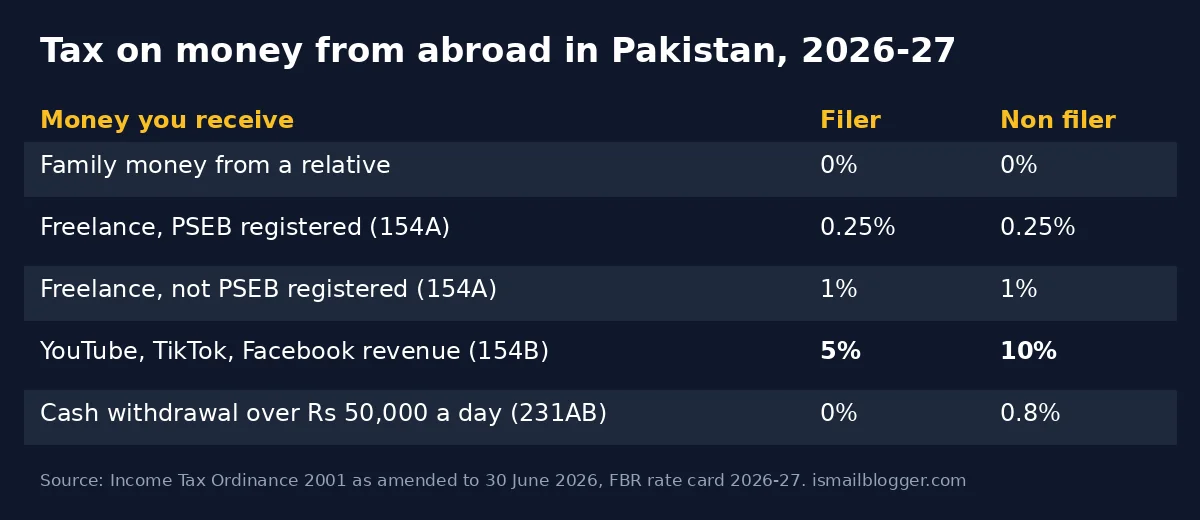
A remittance is taxed for what it is, not for where it comes from. Family money is a gift; client money is income.
Family remittances: why they are not taxed
Under section 39(1)(la), money or property received as a gift is taxable income, but the law excludes gifts from a “relative”. Section 85(5) defines relative widely: parents, grandparents, children, brothers and sisters, uncles, aunts, cousins, your spouse, and the same relatives of your spouse. So when your father, sister or husband sends you money from abroad, it is not income at all.
There is also no withholding section for inward home remittances. FBR’s rate card for 2026-27 has no row for them, so the bank credits the full amount.
The Rs 5 million protection under section 111(4)
FBR can add money to your income if you cannot explain where it came from (section 111). Section 111(4) switches this off for foreign remittances. In the current text, it does not apply to:
“any amount of foreign exchange remitted from outside Pakistan through normal banking channels not exceeding five million Rupees in a tax year that is en-cashed into rupees by a scheduled bank and a certificate from such bank is produced to that effect.”
An explanation added by the Finance Act 2022 says that money through money service bureaus, exchange companies and money transfer operators (Western Union, MoneyGram, Ria and similar) also counts as normal banking channels. The cap is Rs 5 million per tax year, and the Finance Act 2026 did not change it.
Three things people often get wrong:
- It is protection, not an exemption. Above Rs 5 million, family money is still not taxable, but you must be ready to explain its source: who sent it, your relationship, and the bank records.
- The certificate matters. The “certificate from such bank” is the proceeds realization certificate. I explain how to get one at any bank in my guide to the PRC (proceeds realization certificate).
- Many websites still quote section 111(4)(a). That clause was replaced by the Finance Act 2021. The current text is plain section 111(4).
Gifts from friends are different
A gift from someone who is not a relative, such as a friend or a former employer, is not covered by the relative exclusion in section 39(1)(la). In my reading it can be treated as income from other sources at normal slab rates. FBR has not issued a circular on this exact case, so if you receive large amounts from a friend abroad, keep written proof and speak to a tax adviser.
Freelancers: 0.25% or 1% under section 154A
Payments from foreign clients for IT and IT enabled services are export proceeds. When your bank converts them, it deducts tax under section 154A at the rate in Division IVA of the First Schedule:
| You are | Rate | Valid until |
|---|---|---|
| Registered with PSEB as a freelancer | 0.25% of the proceeds | Tax year 2029 (the Finance Act 2026 extended it) |
| Not registered with PSEB | 1% of the proceeds | Ongoing |
This rate is the same for filers and non filers, because the Tenth Schedule excludes section 154A from the non filer increase. But there is a catch: the deduction is your final tax only if you file your income tax return. If you do not file, FBR can tax that income at normal slab rates instead, with the 1% treated as a credit. So filing still matters for freelancers.
On USD 2,000 at an example rate of Rs 280, the bank deducts Rs 1,400 with PSEB registration and Rs 5,600 without it. The PSEB fee is Rs 1,000 for a new registration, so it pays for itself once your yearly proceeds pass about Rs 133,000. Read my guides on PSEB registration for freelancers and tax for freelancers in Pakistan for the full process, or check your numbers with the freelancer tax calculator.
Ask your clients or your platform to send payments with the IT services purpose code, and check it on your PRC. If a freelance payment is credited as a family remittance, nothing is deducted, but the money is still business income, and you lose the simple final tax treatment on it.
YouTubers and creators: the new 5% under section 154B
The Finance Act 2026 added section 154B. Since 1 July 2026, banks deduct 5% of money that comes from social media platforms such as YouTube, Facebook, Instagram and TikTok, including when it arrives through a payment service. FBR’s rate card shows 10% for people who are not on the Active Taxpayers List.
For residents of Pakistan this 5% is a minimum tax: if the tax on your yearly profit under the normal slabs is higher, you pay the difference when you file. I cover the full method, including FBR’s figure of Rs 195 per 1,000 views, in YouTube income tax in Pakistan, and you can estimate your own bill with the YouTube tax calculator.
Non filers: the 0.8% cash withdrawal tax
Section 231AB applies to anyone not on the Active Taxpayers List, whatever the source of the money. When your cash withdrawals from all your bank accounts add up to more than Rs 50,000 in a single day, the bank deducts 0.8%. The rate is not doubled, because the Tenth Schedule excludes this section from the non filer increase. Withdraw Rs 2 lakh of your brother’s remittance in one day as a non filer, and Rs 1,600 is deducted.
There is no special exemption for remittance accounts any more; the old ones ended with the Finance Act 2021. The simplest fix is to become a filer: see filer vs non filer in Pakistan for what else changes.
What to keep for your tax file
- A PRC for each remittance, or a yearly statement of PRCs (S-PRC) from your bank.
- The purpose code used for each payment (freelance or family).
- For family money: the sender’s name, relationship and country.
- In your return: show family remittances in the wealth statement reconciliation as foreign remittance or gift, and freelance income under the right head.
Remittance tax FAQ
Quick answers to the questions people ask most.
Do overseas Pakistanis pay tax on money they send home?
Pakistan does not tax the sender for sending money home, and the receiver pays nothing on family support. A non resident’s own foreign income is generally outside Pakistan’s tax. The sender’s own country may have its own rules.
Is there tax on receiving money through Western Union or MoneyGram?
Not on family money. Section 111(4) treats money transfer operators and exchange companies as normal banking channels, so the Rs 5 million protection applies to them too, as long as you have the certificate.
What happens if I receive more than Rs 5 million in a year?
It is not taxed automatically. The protection from “unexplained income” stops at Rs 5 million, so for the amount above it you should be able to show where it came from: the relative who sent it and the bank records.
Is the 1% freelancer tax deducted again when I file?
No. If you file your return, the tax deducted under section 154A is your final tax on that income. You report it, but you do not pay slab tax on top.
This article is general education, not tax advice. Rates and sections checked against the Income Tax Ordinance 2001 as amended up to 30 June 2026 (Ordinance) and FBR’s 2026-27 rate card on 13 November 2026. They change with every Finance Act.
Keep reading
Related articles
 Freelancing · 7 min readHow to Receive Money From Abroad in Pakistan (Family and Client Payments)Read article →
 Freelancing · 7 min readPayPal in Pakistan 2026: Is It Available? Legal Ways to Get Paid InsteadRead article →
 Freelancing · 6 min readProceeds Realization Certificate (PRC): What It Is and How to Get ItRead article →