
Short answer: Freelancer tax in Pakistan on foreign client income is 0.25% of the export proceeds if you sell IT or IT enabled services and are registered with the Pakistan Software Export Board (PSEB), and 1% in any other case. The 0.25% rate now runs up to tax year 2029. Your bank deducts it when the payment arrives, and it counts as your final tax only if you also file an income tax return. Income from local Pakistani clients is taxed under the normal slab rates instead.
Key takeaways
- Foreign client income received through a Pakistani bank is taxed under section 154A: 0.25% of proceeds for PSEB registered IT and IT enabled exporters (tax years 2024 up to 2029), 1% in any other case.
- The bank deducts the tax “at the time of realization of foreign exchange proceeds”. You do not pay it separately.
- The deduction is a final tax only when conditions are met. The first condition in the law is “return has been filed”.
- Local client income is not export income. It goes under the normal slabs for non salaried individuals: 0% up to Rs 600,000 of taxable income, then 15% to 45%.
- Being on the Active Taxpayers List (ATL) is what “filer” means in daily life. You get there by filing your return on IRIS, on time.
- Missed the deadline for tax year 2026? Under section 182A you only get onto the ATL after filing and paying a Rs 25,000 surcharge as an individual (raised from Rs 1,000 by the Finance Act, 2026), or by filing a six month no property undertaking, Form ATL-U, on IRIS.
| Income | Tax | How it is paid |
|---|---|---|
| Foreign income, with PSEB registration | 0.25% of proceeds | Bank deducts |
| Foreign income, without PSEB registration | 1% of proceeds | Bank deducts |
| Local client income | Slabs, 0% to 45% of profit | Paid with the return |
Want your number first? Enter your yearly income in the free freelancer tax calculator to see the 0.25% or 1% tax on foreign client payments. For local client income, use the income tax calculator with the 2026-27 slabs. Money from family abroad is a different case: the remittance tax calculator separates it from client payments.
Most blog posts on freelancer tax copy each other, and many still quote section 65F or a 35% top rate that are no longer in the law. So for this guide I opened the law itself: the Income Tax Ordinance, 2001, amended up to 30 June 2026, published by FBR. Every rate below comes from that document, with the section number, checked on 12 November 2026. The PSEB, State Bank and FBR pages are linked in each section.
This guide is education, not financial, legal or tax advice. Ask a tax adviser to confirm your own case before you file.
Do freelancers pay tax in Pakistan?
Yes. What changes is how each payment is taxed. There are two systems:
- Export income: a client outside Pakistan pays you and the money comes into your Pakistani bank account as foreign exchange. This is taxed at a small fixed percentage of the gross amount under section 154A.
- Local income: a client inside Pakistan pays you in rupees. This is taxed on your profit under the normal slab rates.
Many freelancers have both. If you are not sure how the money reaches your bank in the first place, see my guide to Fiverr withdrawal in Pakistan.
What is the freelancer tax rate in Pakistan in 2026?
Here is the wording, so you do not have to trust anyone’s summary, including mine.
Section 154A: who deducts and when
Section 154A (Export of Services), sub-section (1), says: “Every authorized dealer in foreign exchange shall, at the time of realization of foreign exchange proceeds on account of the following, deduct tax from the proceeds at the rates specified in Division IVA of Part III of the First Schedule”.
The list that follows includes two clauses that matter to freelancers:
- Clause (a): “exports of computer software or IT services or IT enabled services where the exporter is registered with and duly certified by the Pakistan Software Export Board (PSEB)”.
- Clause (b): “services or technical services rendered outside Pakistan or exported from Pakistan”.
An “authorized dealer in foreign exchange” is, in practice, your bank.
First Schedule, Part III, Division IVA: the two rates
Division IVA (Export of Services) has a two row table. I am quoting both rows:
| S. No. | Types of receipts (as written in the law) | Rate of tax |
|---|---|---|
| 1 | “Export proceeds of Computer software or IT services or IT Enabled services by persons registered with Pakistan Software Export Board” | “0.25% of proceeds for tax years 2024 up to tax year 2029” |
| 2 | “Any other case” | “1% of proceeds” |
A footnote in the same document records that the end year was changed to 2029 by the Finance Act, 2026. A tax year normally runs from 1 July to 30 June, so on this wording the 0.25% rate covers income up to 30 June 2029 unless Parliament changes it again.
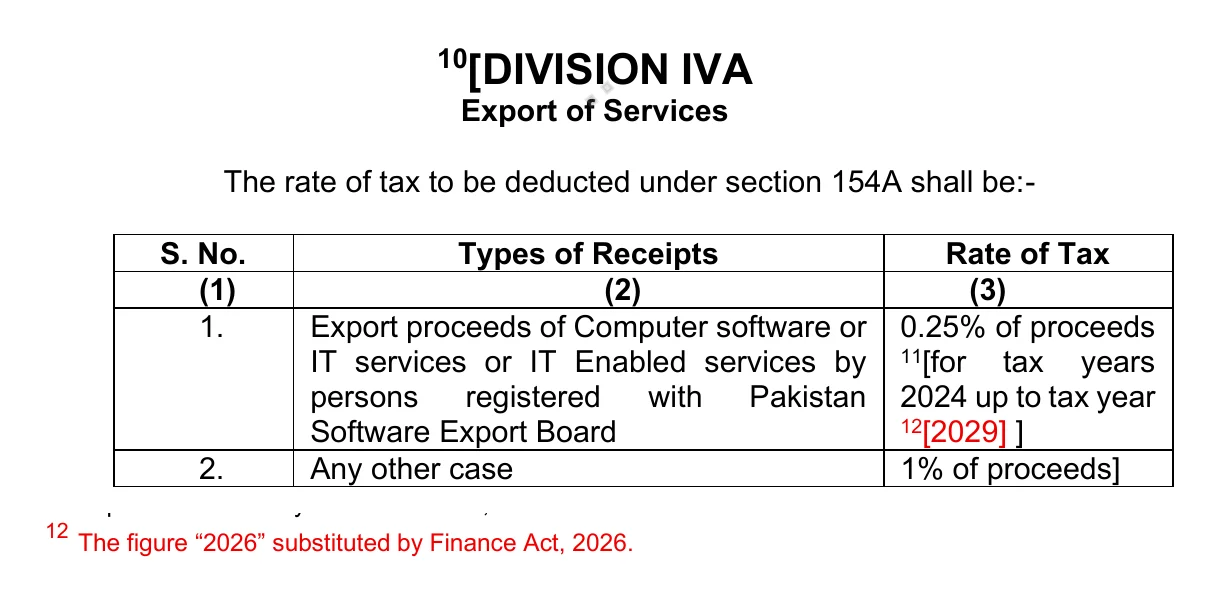
Two things to notice. First, the percentage applies to the proceeds, meaning the gross amount received, not your profit. Second, the 0.25% row needs both conditions: the service must be IT or IT enabled, and you must be registered with PSEB. A developer who is not registered falls into “any other case” at 1%.
What counts as IT and IT enabled services?
Section 2 of the Ordinance defines both, and both lists are open ended (“include but not limited to”):
- IT services, clause (30AD): “software development, software maintenance, system integration, web design, web development, web hosting and network design”.
- IT enabled services, clause (30AE): “inbound or outbound call centres, medical transcription, remote monitoring, graphics design, accounting services, Human Resource (HR) services, telemedicine centers, data entry operations, cloud computing services, data storage services, locally produced television programs and insurance claims processing”.
Graphic design and data entry are named. Content writing, video editing, voice over and social media management are not named, although the lists are not closed. If your skill is not on the list, do not assume the 0.25% rate. Ask PSEB whether they register your category, and ask your bank which rate it is applying.
What “final tax” means in plain words
Final tax means the small amount the bank deducted is the complete income tax on that income. You do not add that income to your slab calculation again.
Section 169 of the Ordinance spells out the trade off. Where tax is final, “the income shall not be chargeable to tax under any head of income in computing the taxable income of the person” and “no deduction shall be allowable under this Ordinance for any expenditure incurred in deriving the income”. In simple words: a very low rate, but on the gross amount, with no expense claims and no loss set off against it.
The conditions most blogs skip
Section 154A(2) says the tax is final “upon fulfilment of the following conditions”:
- “return has been filed”;
- “withholding tax statements for the relevant tax year have been filed if required under the Ordinance”;
- “sales tax returns under Federal or Provincial laws have been filed, if required under the law”, with a proviso that this condition does not apply to an exporter under clause (a), meaning the PSEB registered IT exporter;
- “no credit for foreign taxes paid shall be allowed”.
Sub-section (3) then says the final tax treatment “shall not apply to a person who does not fulfill the specified conditions or who opts not to be subject to final taxation”, and that this option is exercised every year when you file your return under section 114.
So the 0.25% or 1% is final only if you file. No return, no final tax. And section 114(1)(ae) separately requires a return from “every person whose income for the year is subject to final taxation”. A freelancer with only export income still has to file.
One more point for freelancers who are not PSEB registered: the sales tax condition can apply to you. Sales tax on services is mostly a provincial matter in Pakistan, and I could not verify each province’s rules for exported services for this article. Raise it with your adviser.
How is freelancer remittance taxed in Pakistan?
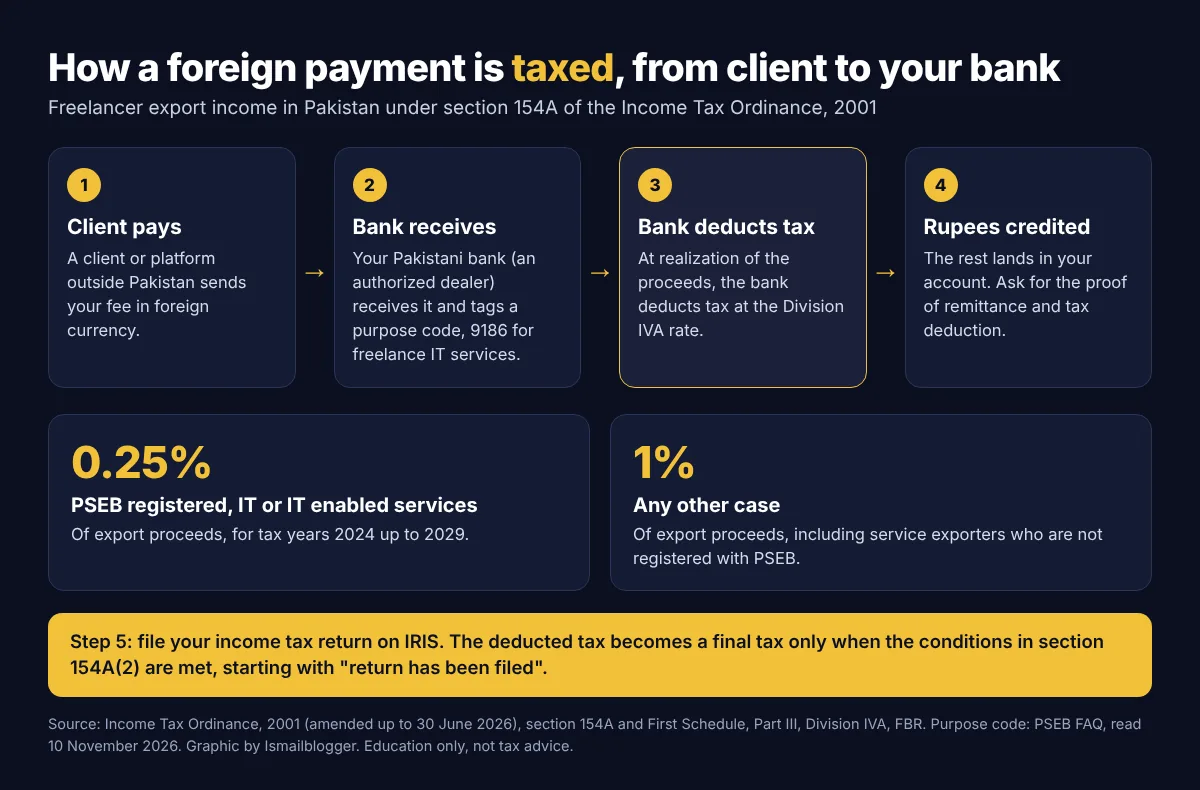
The graphic shows the whole route. The only step you do yourself is the last one: after the tax year ends, you file a return and declare the export receipts and the tax the bank already deducted.
The purpose code freelancers should know: 9186
The PSEB FAQ lists the State Bank purpose codes for IT remittances. The freelancer code is 9186, described as “Freelance in computer and information services: remittances received by resident individuals/households from reputed overseas IT firms and online platforms on account of freelance of computer and information systems services”. Other codes on the same list include 9184 for export of computer software and 9185 for other computer services.
PSEB warns on that page that if the wrong code is used, for example a general remittance code, “you may not be recognized as an IT exporter”. It also explains that the Proceeds Realization Certificate (PRC) and R-Form come from your bank and should show the IT code. So ask your bank two questions in writing: which purpose code are my foreign credits tagged with, and what rate of tax is being deducted under section 154A?
I could not confirm on an official page how every payment company (Payoneer, Wise and others) is coded by every bank. So ask your own bank.
New in 2026: State Bank rules for freelancer remittances
The State Bank changed how banks handle freelancer payments on 6 April 2026, in a circular (EPD Circular Letter No. 06). Its annexure matters for your tax trail in three ways:
- Purpose code tagged once: the bank takes a one time declaration about the service you provide, tags the matching purpose code to your account, and uses it to report your foreign receipts. If you do more than one kind of work, you tell the bank when a payment is for a different service.
- No Form R: freelancers “shall not be required to submit Form R” for their export receipts any more. The bank still reports each receipt under the relevant purpose code.
- Dollar account and retention: the bank opens an Exporters’ Special Foreign Currency Account with your rupee account, and you can keep 5,000 USD a month or 50% of export proceeds, whichever is higher, in it. Banks must process export receipts within one working day.
For tax, do two things: make the service declaration correctly, and collect the bank’s yearly certificate of tax deducted under section 154A.
PSEB registered vs not registered vs local client income
| Point | PSEB registered, IT or IT enabled export | Not registered, or other exported services | Local client income |
|---|---|---|---|
| Legal basis | Section 154A(1)(a); Division IVA, row 1 | Section 154A(1)(b); Division IVA, row 2 | Normal rules; First Schedule, Part I, Division I |
| Rate | 0.25% of proceeds, tax years 2024 up to 2029 | 1% of proceeds | Slab rates: 0% to 45% of taxable income |
| Charged on | Gross amount received | Gross amount received | Profit after allowable business expenses |
| Who collects | Your bank | Your bank | You pay with your return; a local client may also deduct tax when paying you |
| Final tax? | Yes, if the section 154A(2) conditions are met | Yes, if the conditions are met, including the sales tax return condition where it applies | No |
| Return required? | Yes | Yes | Yes, if you cross the taxable limit or meet any other filing trigger in section 114 |
The PSEB FAQ says the same in one line: “0.25% tax on IT Export Revenue if the PSEB registration is valid”. Freelancers who are not registered pay 1%.
What PSEB registration costs and needs
According to the same PSEB page, checked on 12 November 2026:
- New freelancer membership fee: Rs 1,000. Renewal: Rs 2,000.
- Documents for a new freelancer: personal NTN (with no business), a personal bank account opening or maintenance certificate, and your CNIC.
- For renewal, only your latest tax return (Form 114 of FBR) is required. In other words, the 0.25% rate depends on filing too.
- Processing for freelancers takes up to 1 working day after submission, and you register on the PSEB portal.
I walk through the registration screens in my PSEB freelancer registration guide.
How is local client income taxed?
If a Pakistani company or individual pays you in rupees, section 154A does not apply. That income is business income and goes into your taxable income after allowable expenses. The Ordinance gives two tables for individuals. If salary is more than 75% of your taxable income, the salaried table applies. Otherwise you are in the table for “every individual and association of persons except a salaried individual” (the self employed, non salaried table). These are the current non salaried rates, as printed in the First Schedule, Part I, Division I (table substituted by the Finance Act, 2024):
| Taxable income | Rate of tax |
|---|---|
| Up to Rs 600,000 | 0% |
| Rs 600,001 to Rs 1,200,000 | 15% of the amount exceeding Rs 600,000 |
| Rs 1,200,001 to Rs 1,600,000 | Rs 90,000 + 20% of the amount exceeding Rs 1,200,000 |
| Rs 1,600,001 to Rs 3,200,000 | Rs 170,000 + 30% of the amount exceeding Rs 1,600,000 |
| Rs 3,200,001 to Rs 5,600,000 | Rs 650,000 + 40% of the amount exceeding Rs 3,200,000 |
| Above Rs 5,600,000 | Rs 1,610,000 + 45% of the amount exceeding Rs 5,600,000 |
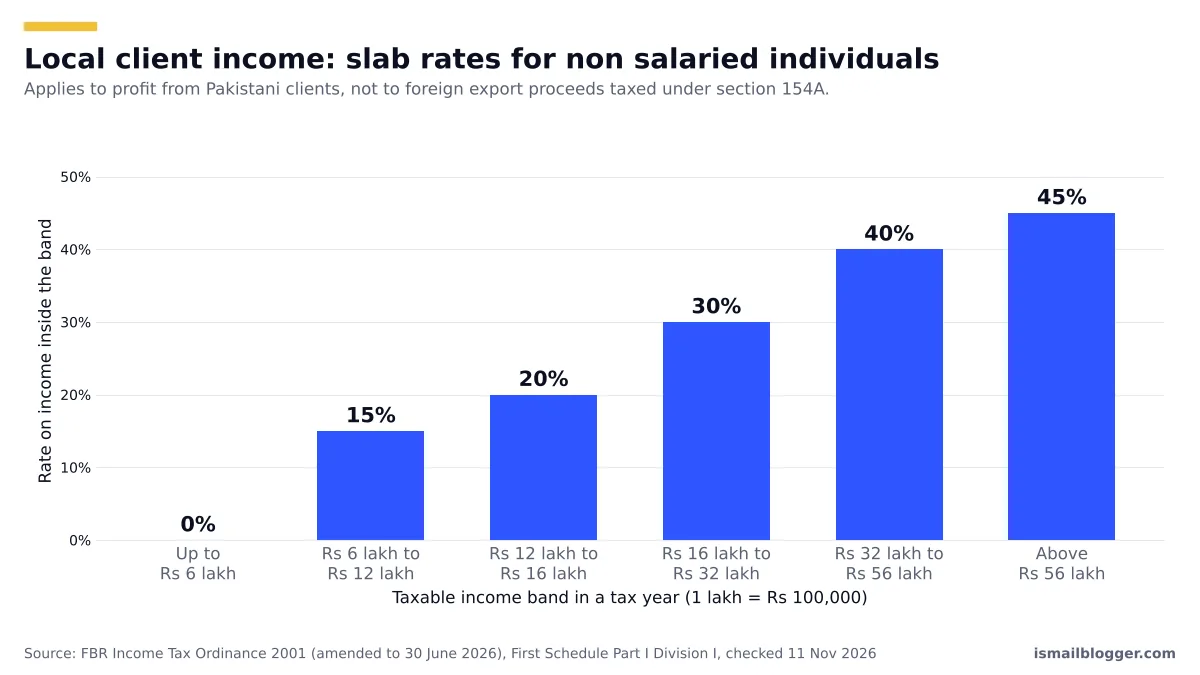
Several guides I read still show a 35% top rate. That is the older table, which this document shows only in a footnote as replaced. Slabs change with budgets, and a surcharge can apply at high incomes, so always check the latest Ordinance on fbr.gov.pk before you calculate.
A local company may also deduct withholding tax when it pays your invoice (section 153). I am not quoting those rates here because they depend on the type of service and client. Ask the client for the deduction certificate and give it to your adviser.
How much tax on Rs 3,000,000 of freelance income? (example)
This is a made up example to show the arithmetic only. It is not a real person and not an income promise.
Suppose a freelance web developer receives Rs 3,000,000 from foreign clients in a tax year, all through a Pakistani bank account.
- If registered with PSEB: 0.25% of Rs 3,000,000 = Rs 7,500 deducted by the bank across the year.
- If not registered: 1% of Rs 3,000,000 = Rs 30,000 deducted.
- Difference: Rs 22,500 for the year.
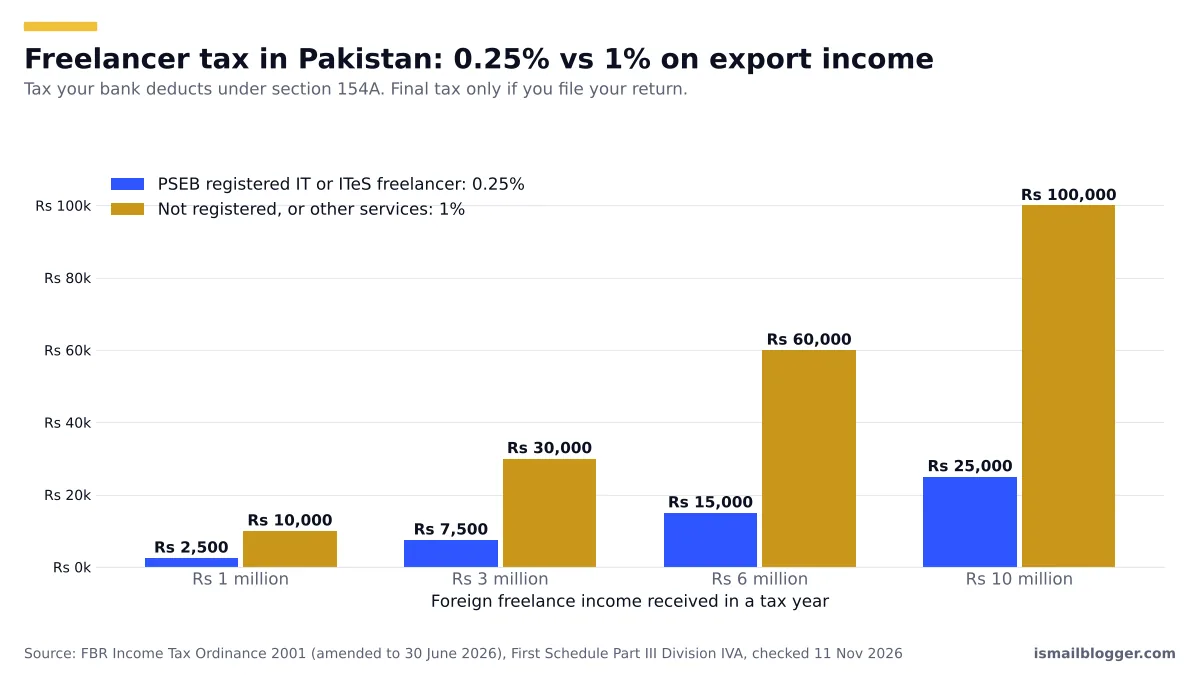
Now suppose the same person also earns a profit of Rs 1,000,000 from local clients after expenses. That falls in the second slab: 15% of the amount above Rs 600,000, which is 15% of Rs 400,000 = Rs 60,000.
Rs 1,000,000 of local profit carries eight times the tax of Rs 3,000,000 of PSEB registered export income. That gap is why PSEB registration and the right purpose code matter. These are my own calculations from the rates above; your real numbers depend on your facts.
The bank’s 0.25% or 1% becomes your final tax only after you file your return.
Filer vs non filer: what the Active Taxpayers List changes
In everyday talk, a “filer” is someone whose name is on the Active Taxpayers List. FBR describes the ATL as “a central record of online Income Tax Return filers for the previous Tax Year”. It is published every year on 1 March, stays valid until the last day of February of the next year, and is updated every Monday.
FBR lists these benefits of being on the ATL: lower tax deducted by banks on profit and cash withdrawals, lower tax on registering and transferring vehicles, a lower rate on buying and selling property, lower withholding on capital gains on securities, dividends and prize bond winnings, and the ability to claim back overpaid tax.
In the law, the Tenth Schedule says that where tax has to be deducted from a person not on the ATL, the rate “shall be increased by hundred percent” of the normal rate, with some exceptions. One exception is interesting for freelancers: rule 10 of that Schedule says it does not apply to “tax collected or deducted under section 154A”. So on my reading, the bank’s 0.25% or 1% on export proceeds is not doubled just because you are off the list.
But that does not make filing optional. Without a return, the deduction does not become a final tax at all, and you pay the higher non ATL rates everywhere else in your financial life. The filer vs non filer calculator shows that gap in rupees.
To check your status, FBR gives three ways: the online ATL status check, downloading the list, or SMS. For an individual, type ATL, a space, then your 13 digit CNIC, and send it to 9966. My ATL check guide shows each one.
What if you file late?
Section 182A says a person who misses the due date is not included in the ATL for that year, unless the return is filed late and a surcharge is paid. The Ordinance as amended up to 30 June 2026 puts that surcharge at Rs 25,000 for an individual, Rs 50,000 for an association of persons and Rs 100,000 for a company (the footnotes say the Finance Act, 2026 raised all three). FBR’s own ATL surcharge page still showed the older Rs 1,000 figure for individuals when I checked it on 12 November 2026. Treat the law text as the current position and confirm the amount on IRIS before paying. Section 182A also means no refund while you are off the list, and no additional payment for a delayed refund. There is one way around the surcharge: after filing late, submit a six month undertaking in Form ATL-U on IRIS that you will not buy any property, under SRO 2097 of 10 November 2026. Buying property in those six months cancels the benefit. The cheaper option is still simple: file on time.
How to file a tax return as a freelancer in Pakistan
These are the steps FBR’s own pages confirm. IRIS screens change, so follow FBR’s tutorials for the clicks.
The full walkthrough is in my guide on how to become a filer in Pakistan. In short:
- Register with FBR. FBR treats you as registered once you are e-enrolled on the IRIS portal, and for individuals the 13 digit CNIC is the NTN (section 181(4) says the same). For online registration you need a SIM registered against your own CNIC, a personal email address and a scanned certificate of maintenance of a personal bank account in your own name.
- Log in to IRIS. First time filers register first, then log in with the registration number and password. If you already have an NTN but no login, use “E-enrollment for Registered Person” on the login screen.
- Complete the return and the wealth statement. FBR requires both the Return of Income form and the Wealth Statement, and section 116(2) makes the wealth statement compulsory for every resident individual who files. It must reconcile: the change in your wealth has to match your income minus your expenses. Declare your export receipts and the tax the bank already deducted under section 154A, plus any local income under the normal rules. Field names in IRIS change, so use FBR’s video tutorials linked from that page the first time.
- Submit and confirm. FBR says submission is confirmed “when both the forms have moved from the Draft folder to Completed Task”. Check that, then check your ATL status by SMS after the next weekly update.
Step 5: Know the deadline
Section 118(3) sets the due date for individuals as 30 September after the end of the tax year. For income earned from 1 July 2025 to 30 June 2026 (tax year 2026), that was 30 September 2026. FBR can extend the date under section 214A. News reports, for example ProPakistani on 15 October 2026, said FBR first moved it to 15 October and then to 31 October 2026. I could not open the official FBR notification itself, so treat those dates as reported, not verified.
The extended date has now passed, so a tax year 2026 return filed today is a late return under section 182A. A return can also be revised within five years to correct an omission, according to FBR.
Records every freelancer should keep
FBR states that persons with taxable income must keep income tax return records for six years. Build this folder from your first payment:
- Proof of each remittance: the bank’s credit advice and, where your bank issues it, the Proceeds Realization Certificate showing the purpose code.
- Bank statements for every account that receives freelance income.
- The bank’s certificate or statement of tax deducted under section 154A for the year.
- Invoices and contracts, or platform earning statements from Fiverr, Upwork and similar sites.
- Your PSEB registration certificate and renewal, if registered.
- For local clients: invoices, payment proof and any tax deduction certificates.
- Expense receipts for local income (software, internet, equipment), since expenses only count against income taxed under normal rules.
- A simple monthly sheet: date, client, amount in foreign currency, rupees credited, tax deducted.
Common mistakes freelancers make with tax
- Letting PSEB registration lapse. The PSEB FAQ says the 0.25% applies “if the PSEB registration is valid”.
- Quoting section 65F or an “80% rule”. Many guides still mention a 100% tax credit for IT exports under section 65F with an 80% banking condition. In the current Ordinance that clause appears only in a footnote as omitted by the Finance Act, 2022. Do not plan around it.
- Receiving client money in a relative’s account or in cash. Section 154A works through your own bank account. Money that never shows as your export proceeds has no clean tax trail.
FAQs about freelancer tax in Pakistan
How much tax does a freelancer pay in Pakistan in 2026?
On foreign client income received through a Pakistani bank: 0.25% of proceeds if you export IT or IT enabled services and hold a valid PSEB registration, and 1% in any other case (First Schedule, Part III, Division IVA). Profit from local clients is taxed under the non salaried slabs, 0% to 45% (Part I, Division I). Keep the PSEB registration renewed every year, or the bank applies 1%.
My freelance income is below Rs 600,000. Do I still need to file?
If any of it is export income taxed under section 154A, yes. Section 114(1)(ae) requires a return from every person whose income is subject to final taxation, and filing is also the first condition for the final tax treatment. The Rs 600,000 threshold in the slab table matters for income taxed under normal rules, such as local client profit.
Can I claim my laptop, internet and software as expenses against foreign income?
Not under the final tax regime. Section 169 says no deduction is allowed for expenses incurred in earning income that is subject to final tax. Section 154A(3) does let a person opt out of final taxation each year at the time of filing, which moves that income into the normal rules.
Is YouTube or social media income taxed the same way?
Not necessarily. The Finance Act, 2026 added a separate section 154B for “revenues received from social media platforms”. The First Schedule (Part III, Division IIIAB) sets that deduction at 5%, and for a resident person the section treats it as a minimum tax, not a final tax.
Is Fiverr and Upwork income taxed in Pakistan?
Yes, when it reaches your Pakistani bank account as foreign exchange it is export income under section 154A, so the bank deducts 0.25% or 1%. The platform’s own fees are cut before the money leaves the platform.
Does a non filer pay double tax on freelance remittances?
Not on the section 154A deduction itself, on my reading of the law. The Tenth Schedule doubles many withholding rates for people not on the ATL, but its rule 10 lists “tax collected or deducted under section 154A” as an exception. Non filers still pay higher rates on bank cash withdrawals, property, vehicles and more, and without a return the 154A deduction is not a final tax.
Where can I confirm the current rates myself?
Open the latest Income Tax Ordinance on fbr.gov.pk (under Legal Resources, then Ordinance) and search for “154A” and “Division IVA”. It takes five minutes and it is the only source that settles an argument. For PSEB rules, use the PSEB industry facilitation page.
A filed return is what makes online income count at a bank or an embassy. Check your purpose code, file on time and keep the bank’s tax certificate. If I did not answer your question, send it through Ask Ismail.
Keep reading