
Short answer: PSEB registration for freelancers is an optional yearly membership with the Pakistan Software Export Board for individuals who sell IT or IT enabled services to clients abroad. You apply online with three documents (a personal NTN, your CNIC and a personal bank account certificate), pay Rs. 1,000 after initial approval, and in return your bank should deduct 0.25% tax on your IT export receipts instead of 1%. Renewal costs Rs. 2,000 a year and needs your latest tax return.
Key takeaways
- PSEB registration is optional for freelancers. PSEB’s own FAQ says only call centers must register to operate legally.
- You need a personal NTN with no business name, your CNIC (both sides) and a personal bank account opening or maintenance certificate.
- The fee on PSEB’s pages today is Rs. 1,000 for a new freelancer and Rs. 2,000 for renewal. Membership is yearly.
- The law gives a 0.25% tax rate on export proceeds of IT and IT enabled services to persons registered with PSEB. The Finance Act, 2026 extended it to tax year 2029. Any other case is 1%.
- Registration does not file your tax return for you. Filing a return is a condition in the law and PSEB asks for your latest return at renewal.
- After you get the certificate, give it to your bank and ask them to use purpose code 9186 for your freelance remittances.
Everything below comes from PSEB’s own pages, the PSEB portal and the Income Tax Ordinance on FBR’s website, checked on 12 November 2026. Where two official pages disagree, I say so.
This guide is education, not financial, legal or tax advice. Fees and rules can change, so confirm in the PSEB portal before you pay.
What is PSEB freelancer registration and who should register?
PSEB is the Pakistan Software Export Board, the body that registers IT companies, call centers and freelancers in Pakistan. Its old address, pseb.org.pk, now redirects to techdestination.com, so the site called Tech Destination is the official one. The login and sign up pages are on portal.techdestination.com.
According to the FAQ on PSEB’s Industry Facilitation page, you can register as a freelancer, which is PSEB’s registration for an individual, if you are working independently in the IT or IT enabled services sector, with a valid personal NTN and a personal bank account, and with no business on that NTN. The same FAQ says:
- Freelancers working through Upwork, Fiverr, Freelancer, Toptal and similar platforms are eligible.
- Students who freelance part time can apply, as long as they have an NTN and a personal bank account.
- There is no minimum income to qualify.
- Freelancers from any city or region of Pakistan can apply.
- A business owner cannot apply as a freelancer. If your NTN shows a registered business, PSEB treats you as a sole proprietor, and that is the company or firm route, not the freelancer route.
The sign up form also asks you to confirm that you are 18 or older.
Is PSEB registration mandatory for freelancers?
No. PSEB’s FAQ says call center registration is necessary to operate legally, while company and freelancer registration is optional. You can start and run a freelance career without it. If you are still at the stage of choosing a skill or a platform, read my guide to freelancing in Pakistan first and come back to this when payments start arriving.
Who should register?
In my view, register when two things are true: you receive foreign payments into a Pakistani bank account, and the work is IT or IT enabled services. The calculation below shows when the fee pays for itself. If you only have local clients, or you have not earned yet, there is no hurry.
What changed for PSEB freelancers in 2026?
Three things are different since the June 2026 budget, checked on 12 November 2026:
- The 0.25% rate now runs to tax year 2029. FBR’s copy of the Income Tax Ordinance shows the Finance Act, 2026 replaced “2026” with “2029” in the PSEB line of Division IVA. Without that change, the lower rate would have ended with tax year 2026.
- The fee did not change. PSEB’s Industry Facilitation page still shows Rs. 1,000 for a new freelancer and Rs. 2,000 for renewal.
- Freelancers can now win a PSEB export award. TechJuice reported that PSEB added a Top Freelancer Award to its IT Export Awards 2026, with nominations judged on remittances through banking channels and Proceeds Realisation Certificates for July 2025 to June 2026. I could not find the full rules on PSEB’s own pages, and the reported deadline was August 2026, so treat this as news, not a guarantee for next year. It does show why keeping your PRCs matters.
What are the benefits of PSEB freelancer registration?
I could not find loans, free offices or visas promised to freelancers on PSEB’s pages. This is what the pages do say:
- Lower tax deduction on IT export payments. PSEB’s FAQ says registered freelancers pay only 0.25% tax on export proceeds of IT and IT enabled services, while freelancers who are not registered pay 1%, and that the 0.25% applies “if the PSEB registration is valid”. The law says the same. Details are in the tax section below.
- Recognition as an IT exporter. PSEB’s FAQ on bank codes says remittances must carry the correct IT code “to qualify for PSEB registration, income tax exemption, and export awards”. A certificate also gives your bank a clear reason to tag your payments correctly.
- Access to PSEB programs. The FAQ lists “government-backed incentives and support programs”, capacity building, international visibility, and representation on industry problems. PSEB’s Membership Benefits page mentions free and subsidized trainings and certifications. Most other items on that page (office space, insurance, international exhibitions) are written for companies.
- A support channel. Registered members can raise tickets at PSEB’s Facilitation Desk. The portal lists a toll free number, 0800-01010, and the email support@pseb.org.pk for registration and login problems.
One limit: PSEB’s FAQ says it “does not offer direct tax or legal advice”. It speaks for freelancers with other government bodies, but it will not sort out your personal tax file.
What documents are required for PSEB freelancer registration?
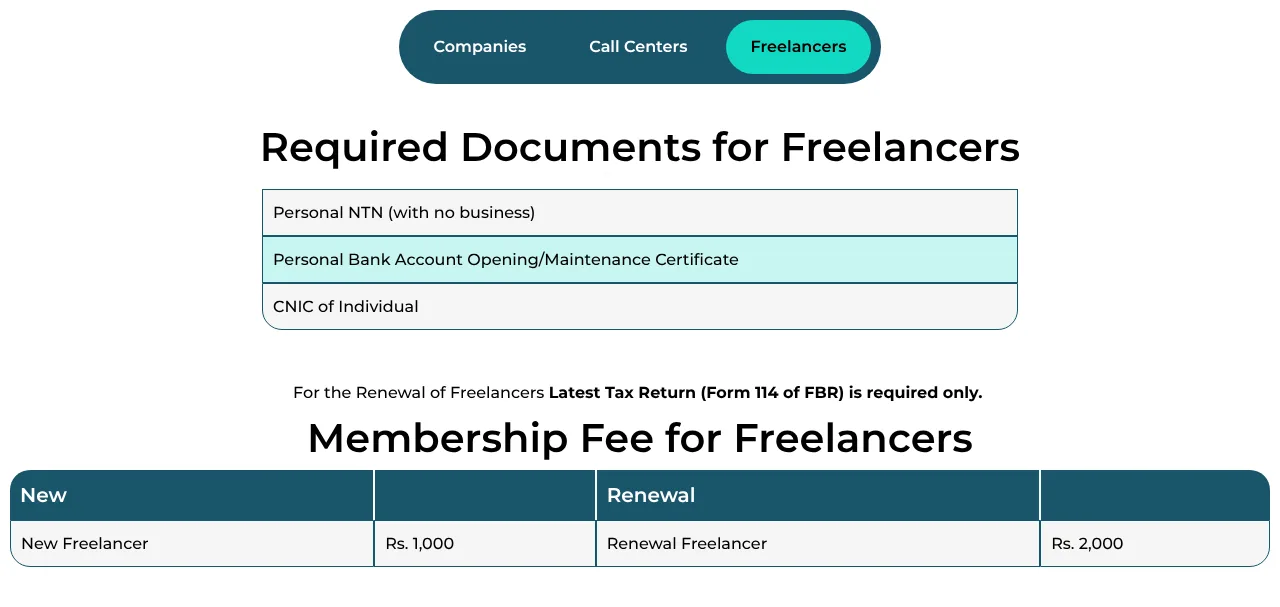
Both official pages, the Freelance Program page and the Industry Facilitation page, list the same three documents for a new freelancer:
- Personal NTN, with no business name. You get this by registering as an individual on FBR’s IRIS portal. If a business name is attached to your NTN, you do not fit the freelancer category.
- CNIC, both sides.
- Personal bank account opening or maintenance certificate. Your bank branch issues this letter. PSEB’s FAQ confirms that a personal bank account is mandatory at the time of registration.
That is the full official list. Some blogs add education certificates, utility bills, portfolio links, photographs or Payoneer screenshots. None of these appear on PSEB’s freelancer document lists today. The portal form may ask you to describe your services, but do not delay your application collecting papers nobody asked for.
How to register with PSEB online as a freelancer, step by step
PSEB lists four steps. I have added the two preparation steps that come before them.
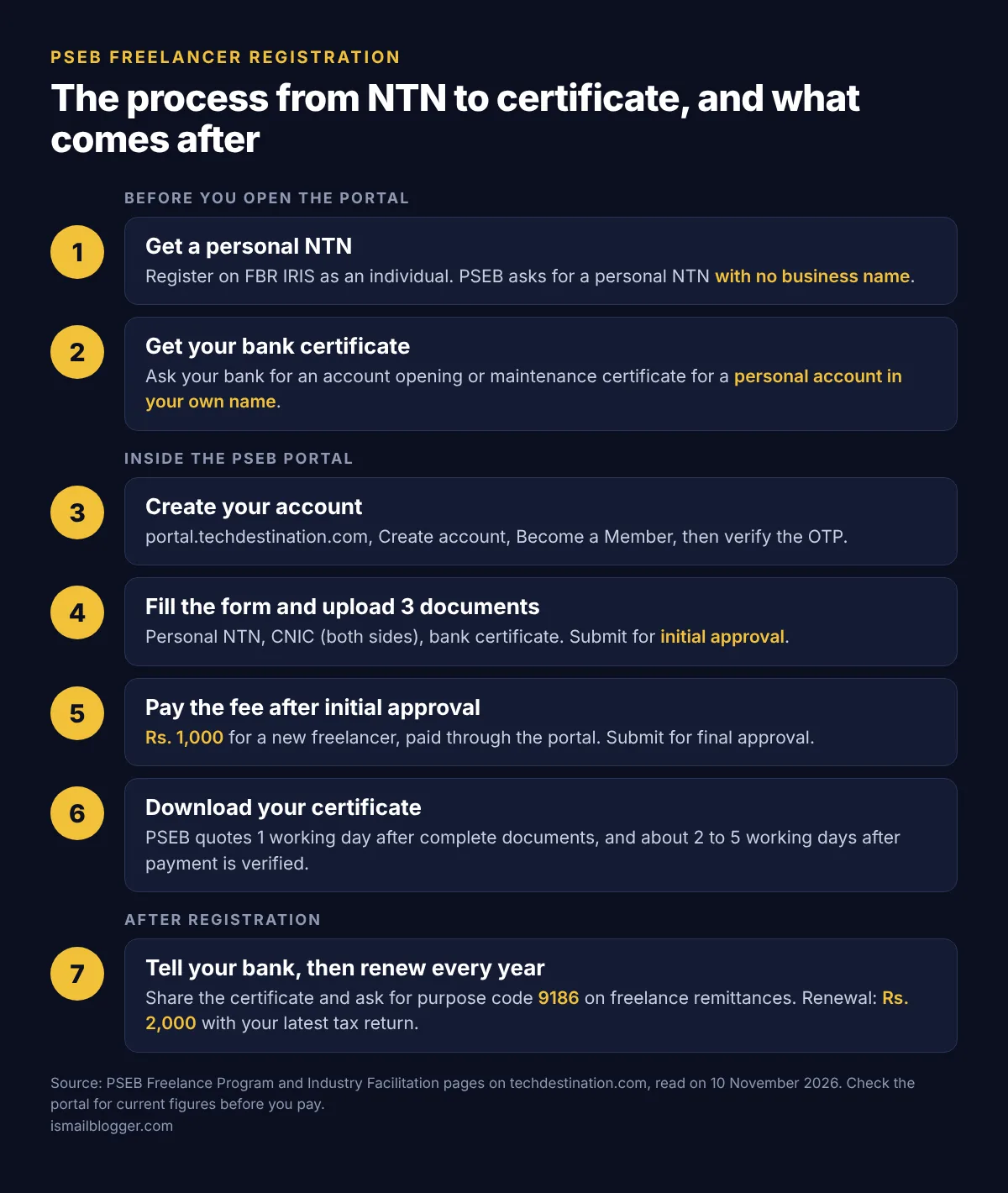
Step 1: Get your personal NTN
Register on FBR’s IRIS portal as an individual. PSEB’s FAQ notes that after online NTN registration FBR requires biometric verification before your IRIS account is fully active. Keep the NTN personal. Do not add a business name just to look professional.
Step 2: Ask your bank for the certificate
Request an account opening or account maintenance certificate for a personal account in your own name. Get this before you start the form so you can finish in one sitting.
Step 3: Create your account on the PSEB portal
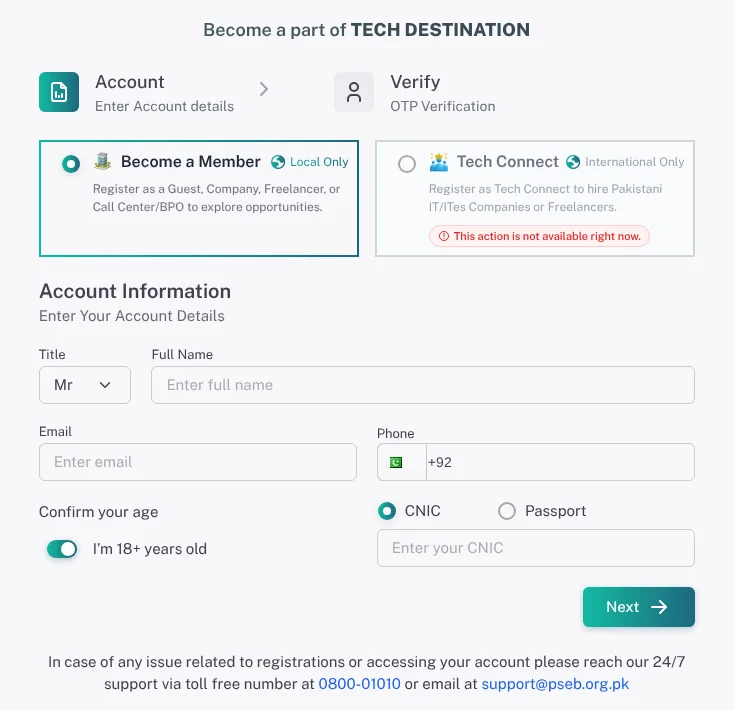
Go to the portal sign up page and choose “Become a Member”, the option for local guests, companies, freelancers and call centers. Enter your title, full name, email, phone and CNIC, confirm your age, and verify the OTP. The Freelance Program page says temporary login credentials are provided automatically.
Step 4: Fill the form, upload the documents and submit
Log in, choose the freelancer registration, fill the online form and upload the three documents. Then submit for initial approval. PSEB warns on the same page that a “submission with missing mandatory information may be declined”, so check every field before you press submit.
Step 5: Pay the fee after initial approval
You pay only after PSEB gives initial approval. Then you upload the payment receipt and submit for final approval. The Freelance Program page says charges “will be received through Payment Gateway only”, which is built into the portal, and that no other payment method will be accepted. The Industry Facilitation page also lists a pay order as an option. Since the two pages differ, I would pay by card through the portal, which both pages accept.
Step 6: Download your certificate
After the payment is verified, PSEB issues the certificate. You can check the status of your application on your dashboard after login at any time. If you forget your password later, use the reset link on the portal login page with your registered email.
What is the PSEB registration fee for freelancers?
These are the figures on PSEB’s pages on 12 November 2026. Both official pages and the FAQ agree on them.
| Item | Amount | Where PSEB shows it |
|---|---|---|
| New freelancer registration | Rs. 1,000 | Freelance Program page (marked “Yearly”), Industry Facilitation page, FAQ |
| Freelancer renewal | Rs. 2,000 | Freelance Program page (marked “Yearly”), Industry Facilitation page, FAQ |
| Late renewal surcharge for freelancers | No amount shown for freelancers | The renewal steps mention “surcharge (if any)”. The FAQ says a surcharge waiver is not allowed. |
Fees can change. The final amount is the one shown in the portal at the payment step, after your initial approval, so read it there before you pay. Some older articles quote other renewal amounts or call the registration free. They do not match the official pages today.
If someone asks for several thousand rupees to “get you PSEB registered”, know that the official fee is Rs. 1,000 and the form takes three documents. Never share your portal password or OTP.
You do not need an agent for PSEB registration: the form is online and asks for three documents.
How long does PSEB registration take?
PSEB gives two different timelines:
- The Industry Facilitation page says that for freelancers “the process takes up to 1 working day after submission”, and its FAQ repeats “1 working day after complete documentation is submitted”.
- The Freelance Program page says that once the registration payment is verified, it usually takes about 2 to 5 working days to process and issue the certificate.
So plan for about one week from a complete submission to a certificate. Blogs that quote two to five weeks are not supported by either official page. If your application is stuck, check the dashboard first, then contact the helpline.
Why do PSEB applications get declined or delayed?
PSEB publishes only two things about this. First, the line I quoted above: missing mandatory information may be declined. Second, its FAQ says PSEB never rejects an application without giving the reason, and the reason is displayed on your dashboard. So if you are declined, log in and read the reason before doing anything else.
The list below is my practical advice. It follows directly from the stated requirements. PSEB does not publish it as a list of rejection reasons.
- A business name on your NTN. The requirement is a personal NTN with no business.
- A bank account that is not personal or not yours. The certificate must be for your own personal account, not a relative’s account or a business account.
- Only one side of the CNIC. PSEB asks for both sides.
- A statement instead of a certificate. The document named is an account opening or maintenance certificate or letter.
- Empty mandatory fields or unreadable scans. Upload clear files and fill every required field.
- Details that do not match. Use the same name and CNIC number on the form as on your NTN and bank certificate.
- Applying while you hold another PSEB registration. The FAQ says a registered freelancer cannot hold a company or call center registration in parallel.
PSEB registered freelancer tax: what the 0.25% rate covers and what it does not
This section quotes the law text itself. I am not a tax adviser. Check your own case with FBR or a qualified consultant.
What the law says
Section 154A of the Income Tax Ordinance, 2001 (FBR’s version amended up to 30 June 2026) says that every authorized dealer in foreign exchange, which in practice means your bank, deducts tax when foreign exchange proceeds are realized. Clause (a) covers “exports of computer software or IT services or IT enabled services where the exporter is registered with and duly certified by the Pakistan Software Export Board”. The rates are in Division IVA of Part III of the First Schedule:
| Type of receipt (wording of the Ordinance) | Rate |
|---|---|
| Export proceeds of computer software or IT services or IT enabled services by persons registered with Pakistan Software Export Board | 0.25% of proceeds, for tax years 2024 up to tax year 2029 |
| Any other case | 1% of proceeds |
A footnote in the same document shows that the Finance Act, 2026 changed the end year from 2026 to 2029. That matches a news report, not a law text, by Business Recorder on 13 June 2026, which said the reduced 0.25% rate on IT export proceeds “has been formally extended through Tax Year 2029”.
Section 154A also says this deduction is a final tax on that income only when conditions are met. The first condition is that a return has been filed. Withholding statements must be filed if the Ordinance requires them from you. The sales tax return condition does not apply to PSEB registered IT exporters. No credit for foreign taxes is allowed, and you may opt out of final taxation each year when you file your return.
A hypothetical example, with my own calculation
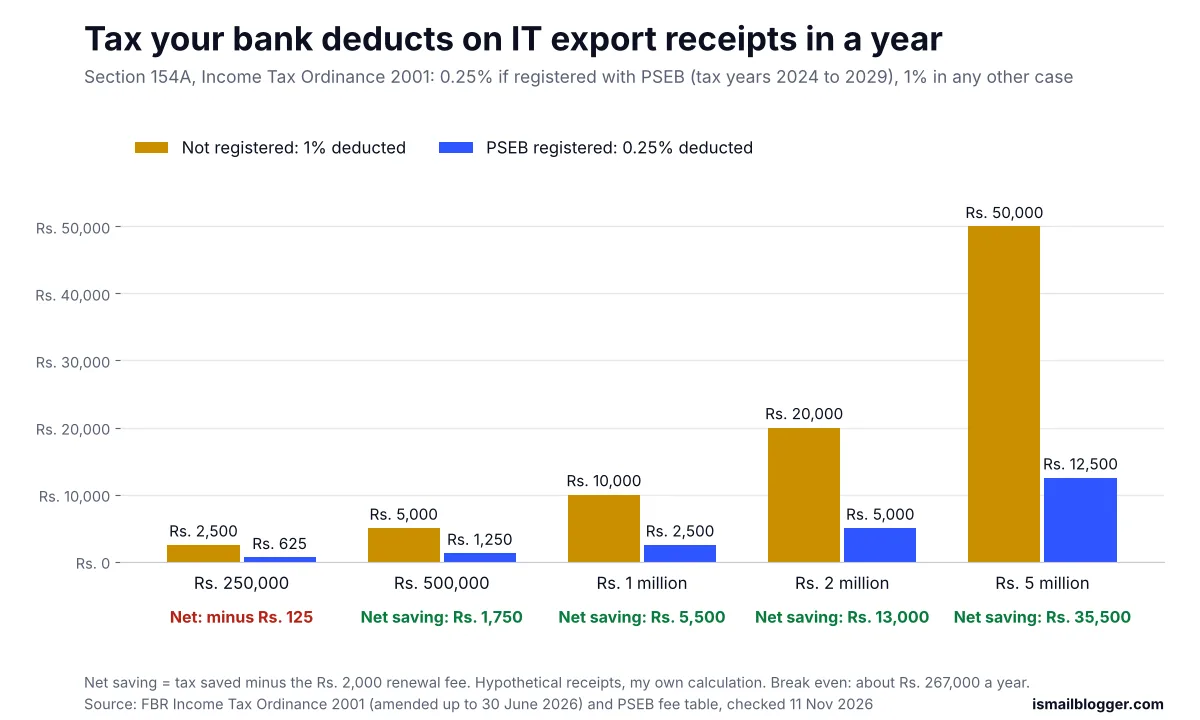
Say a freelancer brings home IT export payments worth Rs. 1,000,000 in a year through a bank. This is an example, not a real case.
- At 0.25%, the deduction is Rs. 2,500.
- At 1%, the deduction is Rs. 10,000.
- The difference is Rs. 7,500 for that year.
To run your own figure, the freelancer tax calculator shows the deduction at both rates.
The gap between the two rates is 0.75%. So, by my calculation, the Rs. 1,000 first year fee is covered once your yearly export receipts through the bank pass roughly Rs. 134,000, and the Rs. 2,000 renewal fee once they pass roughly Rs. 267,000. Below that, register for the other benefits or wait.
What registration does not do
- It does not file your return or make you a filer. You file your own annual income tax return on IRIS. PSEB’s FAQ says filing tax returns is mandatory for renewal.
- It does not cover money that skips the banking channel. The deduction happens when a bank realizes foreign exchange proceeds. Payments that never arrive as export proceeds in your bank account are outside this mechanism.
- It does not cover local clients. Section 154A is about foreign exchange proceeds. Income from Pakistani clients follows the normal rules.
- It does not repair old paperwork. PSEB’s FAQ says that once a bank has used a purpose code for a remittance, it “will not be changed”. You can only correct things going forward.
- It is not permanent. The 0.25% rate in the law runs up to tax year 2029, and PSEB says it applies only while your registration is valid.
Returns, records and local income are covered in my guide to freelancer tax in Pakistan.
Payoneer, Wise or direct bank transfer: does the route matter for PSEB?
PSEB’s own banking FAQ on the Industry Facilitation page lists the usual ways Pakistani freelancers receive money from abroad: Payoneer (linked with Fiverr, Upwork and others), Wise, direct SWIFT bank transfers, and in limited cases Western Union, MoneyGram or Skrill. It also notes that PayPal is not available in Pakistan, and tells freelancers to “always ensure your bank supports the method you choose”.
For the PSEB tax rate, what matters is the last step: the money has to land in your Pakistani bank account as a foreign remittance that the bank records as IT or IT enabled services export. Section 154A works at the moment a bank realizes foreign exchange proceeds. PSEB’s code table describes code 9186 as remittances received by resident individuals “from reputed overseas IT firms and online platforms” for freelance computer and information services, which is exactly the Fiverr and Upwork case.
Check your first credit advice
After your certificate is with the bank, look at the next payment that arrives. Ask the branch which purpose code they used and how much tax was withheld. If it shows a general remittance code or 1%, share the PSEB certificate again and ask them to fix it for future payments, since PSEB says a code that has already been used will not be changed.
Banks may also ask for proof of service. PSEB lists contracts, invoices, platform screenshots, your NTN and a source of funds declaration as typical requests, and says this comes from anti money laundering and foreign exchange rules. Keep these ready. For the platform side of withdrawals, see my guide to Fiverr withdrawal in Pakistan.
Money that stays in a foreign wallet, or reaches you through an informal agent or a crypto P2P trade, does not pass through this bank mechanism. Besides missing the PSEB rate, informal routes carry real fraud risk.
Registered vs not registered: a quick comparison
Every row below comes from PSEB’s pages or the Ordinance, as read on 12 November 2026.
| Point | Registered with PSEB | Not registered |
|---|---|---|
| Is freelancing allowed? | Yes | Yes. PSEB says freelancer registration is optional. |
| Tax deducted by the bank on IT export proceeds (section 154A) | 0.25% of proceeds, tax years 2024 up to 2029, while registration is valid | 1% of proceeds (“any other case”) |
| Yearly cost | Rs. 1,000 for a new freelancer, Rs. 2,000 at renewal | None |
| Paperwork with PSEB | Personal NTN, CNIC, bank certificate. Latest tax return at renewal. | None |
| Income tax return | Required. It is a condition for final tax and for renewal. | Still a condition for final tax under section 154A |
| PSEB trainings, programs and Facilitation Desk as a member | Yes | No. The Facilitation Desk has a guest account option only. |
| Can also hold a PSEB company or call center registration | No, not in parallel | Not applicable |
What to do after you get your PSEB certificate
1. Give the certificate to your bank and ask for purpose code 9186
Banks report every foreign remittance to the State Bank with a purpose code. PSEB’s FAQ says “for freelancer SBP defined code is 9186”, described as freelance in computer and information services. It also warns that if the wrong code is used, for example a general remittance code, “you may not be recognized as an IT exporter”. Visit your branch, hand over a copy of the certificate, and ask them to tag your freelance remittances with 9186 from now on. PSEB’s own advice for a wrong code is the same: share the certificate with the bank and update them about your IT export remittance.
2. Keep proof of every remittance
PSEB’s FAQ explains that the R Form (remittance form) and the PRC (Proceeds Realization Certificate) both come from your bank, and the SBP IT code should be mentioned on them. Ask your bank how to get a PRC for your payments and save each one. The Freelance Program page lists a “summary of export revenue with proper IT/ITeS code defined by SBP” among renewal documents, so these papers are what you will need next year. Keep your invoices, contracts and platform statements in the same folder, because the FAQ notes that banks may ask for proof of service.
3. File your income tax return every year
This keeps the final tax treatment available under section 154A, and you will need the return for renewal. If you do not know how to file, ask a qualified tax consultant the first time and learn the process.
4. Set a reminder for PSEB renewal
PSEB’s FAQ says membership “is valid for one year and must be renewed annually to retain benefits and certification status”. For renewal you log in, update the renewal form, upload documents, get initial approval, pay Rs. 2,000 plus any surcharge, and submit for final approval.
On renewal documents the two official pages differ slightly. The Industry Facilitation page says only the latest tax return (FBR Form 114) is required. The Freelance Program page lists the income tax return for the preceding year and the summary of export revenue with the SBP code. Keep both ready. PSEB also notes that your original registration date stays the same and a late renewal does not extend the certificate period, so renewing late only costs you covered time.
PSEB freelancer registration checklist
- I sell IT or IT enabled services as an individual, and I am 18 or older.
- My NTN is personal, with no business name on it.
- I have a clear scan of both sides of my CNIC.
- I have a bank account opening or maintenance certificate for a personal account in my own name.
- My name and CNIC number are the same on the form, NTN and bank certificate.
- I created my account on portal.techdestination.com myself, with my own email and phone.
- I submitted the form and waited for initial approval before paying.
- I paid the fee shown in the portal and uploaded the receipt.
- I downloaded the certificate and gave a copy to my bank with a request to use code 9186.
- I am saving PRCs, invoices and platform statements for every payment.
- I have a reminder for my tax return and for PSEB renewal.
Should you register with PSEB now?
Register once foreign payments are landing in your Pakistani bank account: it costs Rs. 1,000 and three documents. If you are not earning yet, build the skill first with my freelancing skills guide.
If you get stuck on a step, send me the question on Ask Ismail.
Written by Muhammad Ismail (Ismail Blogger), founder of Ismailblogger in Islamabad, earning online since 2013. Facts checked on 12 November 2026. Fees and rules can change, so confirm in the PSEB portal before you pay.
PSEB registration for freelancers: FAQ
How long is a PSEB freelancer certificate valid?
One year. PSEB says membership must be renewed every year to keep the benefits, and that the original registration date stays the same even if you renew late. A late renewal does not give you extra months.
Does the 0.25% rate apply to Payoneer or Fiverr payments?
It applies to IT export proceeds that your Pakistani bank receives, when you hold a valid PSEB certificate and the bank tags the payment correctly. Payoneer or a platform is only the route. Ask your bank to use code 9186 and check the tax withheld on each credit.
Can I switch from freelancer to company registration later?
Yes, but not in parallel. PSEB’s FAQ says a freelancer can apply for a company membership after surrendering the freelancer membership. While you are a registered freelancer, you cannot also apply for a company, firm or call center registration.
Can I renew if I had no export income this year?
PSEB’s FAQ answers this directly: you can provide a justification on legal paper for not having revenue and commit to provide it later. You will still need your tax return.
Do I need a special freelancer bank account before I apply?
PSEB asks for a personal bank account, not a special product. Its FAQ says some banks offer freelancer accounts, but processes vary from bank to bank. Ask your own bank what it needs to receive foreign payments, and make sure the name on incoming payments matches your account title.
Is PSEB registration the same as registering with FBR?
No. FBR registration gives you an NTN and is where you file your tax return. PSEB registration is a separate yearly membership that certifies you as an IT or IT enabled services exporter. You need the NTN first, and the PSEB certificate does not replace anything you owe to FBR.
What if my work is not IT related?
The freelancer membership is for the IT and IT enabled services sector, and the tax rate in the law is for computer software, IT services and IT enabled services. If you are not sure your service fits, ask PSEB through the helpline or Facilitation Desk before you pay, and ask a tax consultant how your export income is treated.
Keep reading
Related articles
 Tax · 20 min readFreelancer Tax in Pakistan 2026: Rates, Filer Status and How to FileRead article →
 Freelancing · 19 min readFreelancing in Pakistan 2026: How to Start, Get Paid and Grow (Beginner Guide)Read article →
 Freelancing · 19 min readHigh Paying Freelancing Skills in 2026: What Pakistanis Should LearnRead article →