
Short answer: Dropshipping in Pakistan mostly means local cash on delivery (COD) dropshipping: you find the customer, a Pakistani supplier packs and ships the product, the courier collects cash at the door, and you keep the difference after costs. It can work without stock, but your real profit depends on three numbers most guides skip: the return rate, the ad cost per order, and the 2% tax couriers now collect on COD payments. Run those numbers before you pay for any course or supplier plan.
Key takeaways
- The model: you sell, a supplier ships under your name, the courier collects cash, and your margin is paid to you later.
- Returns decide your profit. Every refused COD parcel costs delivery both ways, and one large supplier sets its reward tiers at 60% to 80% delivery ratios.
- Tax is now built in: couriers collect 2% income tax on COD payments (4% for people not on the ATL) under section 6A, and they also withhold sales tax.
- You need registration: the law says couriers and online marketplaces must not serve sellers who are not registered with FBR.
- No investment does not mean no risk. Ads, calls, returns and your time are real costs.
How dropshipping works in Pakistan
There are two very different things people call dropshipping here:
| Local COD dropshipping | International dropshipping | |
|---|---|---|
| Customers | Buyers in Pakistan | Buyers in the US, UK or other countries |
| Supplier | A Pakistani dropshipping platform or wholesaler | Overseas suppliers or print on demand |
| Payment | Cash on delivery through a courier | Card payments through your store |
| Biggest risk | Refused parcels and returns | Payment gateway access and shipping times |
| Tax point | Courier collects tax on COD | Export income through your bank |
This guide is about the local model, because it needs no stock in hand and no foreign payment gateway. If you want to sell abroad instead, read my guide to Etsy in Pakistan first.
The local COD flow, step by step
- You list products on your Facebook page, Instagram, a Shopify or WordPress store, or WhatsApp.
- A customer orders and chooses cash on delivery.
- You confirm the order. AR Dropshipping, for example, asks resellers to call each customer to confirm before forwarding the order.
- The supplier packs and books the parcel with a courier, often under your brand name.
- The courier delivers and collects cash, deducting its charges and the tax.
- The supplier settles your margin after the courier pays them, on the supplier’s payout schedule.
Every step between “customer orders” and “cash collected” can fail. That is the part to plan for.
The real cost of a COD order
Most supplier pages show the selling price and your margin, and stop there. Here is a hypothetical order to show what actually comes out of it. Replace every number with your own supplier’s and courier’s rates.
| Hypothetical order | Amount (Rs) |
|---|---|
| Selling price to customer | 2,500 |
| Supplier’s product price | 1,500 |
| Your gross margin | 1,000 |
| Ad cost per confirmed order (example) | 350 |
| Income tax collected on COD, 2% of 2,500 | 50 |
| Margin left on a delivered order | 600 |
Now add returns. Suppose 3 out of 10 parcels are refused at the door, and each refused parcel costs you Rs 400 in ad spend and return charges. Your 7 delivered orders earn Rs 4,200; your 3 returns cost Rs 1,200. Profit across 10 orders: Rs 3,000, or Rs 300 per order, half of what the “margin” suggested.
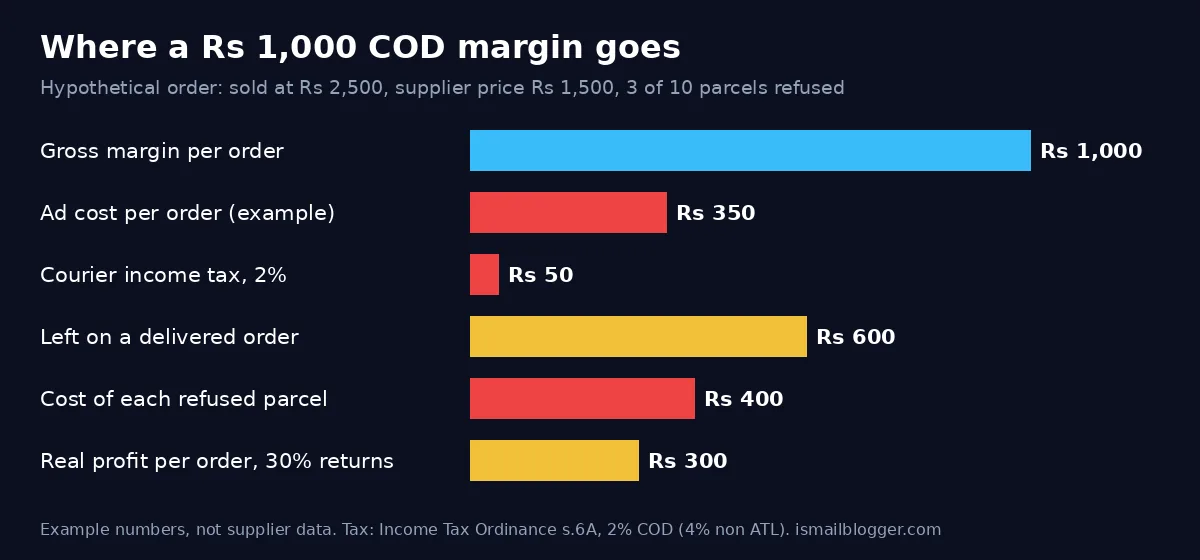
In COD dropshipping, the parcel that comes back is the one that decides whether you made money.
The return rate is not a small detail. AR Dropshipping’s own reward tiers are set at delivery ratios of 80%, 70% and 60%, which tells you suppliers expect a meaningful share of parcels not to be delivered.
Ask every supplier, in writing: who pays when a parcel is refused, how much is charged for the return, and on which day margins are paid. If they will not put it in writing, choose another supplier.
Put your own supplier price, courier charge, ad cost and return rate into this calculator to see your real profit per order and the return rate at which you break even:
Enter an amount to see the result.
Tax on COD orders: what changed in 2025
The Finance Act 2025 brought online selling into the tax net, and the Finance Act 2026 adjusted it. From the Income Tax Ordinance as amended up to 30 June 2026 and FBR’s 2026-27 rate card:
| Rule | What it says |
|---|---|
| Section 6A | Tax on payments for digitally ordered goods delivered within Pakistan through online platforms or websites |
| Rate, cash on delivery | 2% of the gross amount, collected by the courier |
| Rate, online payment | 1% of the gross amount, collected by the payment intermediary |
| Not on the ATL | Double: 4% on COD, 2% online (FBR rate card, section 153(2A)) |
| Turnover up to Rs 200 million | The tax is final, but you may opt out of the final regime when filing, from tax year 2027 |
| Section 181(1A) | Couriers and online marketplaces must not let unregistered vendors use their services |
The tax is collected from the amount payable to the seller, which in a dropshipping deal is usually the supplier who books the parcel. How your margin is then taxed depends on how your supplier records you, so ask them, and keep your own records.
Sales tax applies too. FBR’s circular on the Finance Act 2025 explains that couriers delivering COD orders for e-stores must collect and pay sales tax on those orders, and that for cottage industry and most retailers this is the final sales tax.
Two things to do now:
- Get registered. You need to be on FBR’s records to use couriers and marketplaces as a seller. My guide on how to become a filer in Pakistan walks through IRIS registration.
- Stay on the ATL. Non filers pay double on COD (4% instead of 2%). See filer vs non filer in Pakistan for everything else that doubles.
How to choose a dropshipping supplier
Search results for this topic are full of suppliers ranking their own platforms. Judge them on these points instead:
| Check | Why it matters | Red flag |
|---|---|---|
| Written return policy and charges | Returns decide profit | “We will discuss later” |
| Payout schedule in writing | Your margin waits on them | Different payout terms on the same page |
| Registration fee | Your only upfront cost | Large fees for “premium supplier lists” |
| Courier used and COD remittance time | Affects cash flow | Supplier will not name the courier |
| Product quality and photos | Bad products get refused | Only stolen catalogue photos |
| Order confirmation process | Cuts fake orders | No confirmation step |
To compare courier COD payout times and charges, see my guide to the best courier services in Pakistan.
Where to sell
- Facebook and Instagram pages: the fastest start, but you pay for ads and handle every message.
- Your own website: more trust and control. A Shopify plan or a WordPress store costs money every month, so start only once you have products that sell.
- WhatsApp: good for repeat customers and order confirmation.
- Marketplaces like Daraz: usually require you to hold stock or use their own fulfilment rules, so pure dropshipping is harder there. If you want to earn from Daraz without stock, the Daraz affiliate program is a cleaner route.
Is dropshipping worth it in Pakistan?
It can be, if you treat it as a small business, not a shortcut. It suits you if you can test products with small ad budgets, call customers to confirm orders, and track every return. It does not suit you if you expect profit from day one, cannot spend on ads, or plan to rely on a single viral product.
If you want an online income with fewer moving parts, compare it with the options in affiliate programs in Pakistan, where you never handle parcels or returns.
Be careful with “dropshipping courses” that promise fixed monthly income or sell you a “winning product list”. If a course or supplier asks for a large fee before you have made a single sale, check our scam alert page first.
Dropshipping in Pakistan: FAQ
Quick answers to the questions people ask most.
Can I start dropshipping in Pakistan without investment?
You can start without buying stock, but not without costs. You will spend on ads, a phone for confirmations, possibly a supplier registration fee, and you carry the cost of returned parcels.
Is dropshipping legal in Pakistan?
Yes, selling online is legal. You must follow tax rules: couriers collect income tax and sales tax on COD orders, and couriers and marketplaces are not allowed to serve sellers who are not registered with FBR.
Which is better, Daraz or my own page?
For pure dropshipping, your own page or store is more flexible, because Daraz has its own seller and fulfilment rules. Daraz can work if you hold some stock.
How much tax do I pay on dropshipping orders?
On COD orders the courier collects 2% of the gross amount (4% if the seller is not on the ATL) as income tax, plus sales tax. Online payments are taxed at 1% (2% for non filers).
This article is general education, not tax or business advice. Tax rules checked against the Income Tax Ordinance as amended up to 30 June 2026, FBR’s 2026-27 rate card and FBR Sales Tax Circular 2 of 2025-26 on 14 November 2026. Supplier terms change; get them in writing.
Keep reading
Related articles
 Online Earning · 27 min readOnline Earning for Students in Pakistan: 24 Real Options and a 30 Day PlanRead article →
 Online Earning · 14 min readOnline Earning Websites in Pakistan: 20 Sites That Really Pay (2026)Read article →
 Online Earning · 11 min readInstagram Monetization in Pakistan (2026): Does Instagram Pay, and How Creators Really EarnRead article →













0 comments
No comments yet. Start the conversation!