
DeFi, short for decentralized finance, is a set of financial apps that run on public blockchains and let you swap, lend, borrow and save without a bank in the middle. The rules live in code called smart contracts, and you use them from a crypto wallet you control. For a Pakistani beginner, the honest starting point is to learn how it works without putting money in, because the same design that removes the bank also removes the helpline.
When I started teaching crypto in Pakistan, the hardest part was not Bitcoin. It was explaining why anyone would lend, borrow or trade without a bank in the middle. This is the plain language version of DeFi I give in my workshops, updated for November 2026.
Educational content, not financial advice. DeFi can lose you money through hacks, scams, price crashes and your own mistakes. Never use money you cannot afford to lose.

Key takeaways
- DeFi is financial software on blockchains: no account opening, no branch timings, and no one to call if you make a mistake.
- It is built from a few blocks: a self custody wallet, smart contracts, liquidity pools, lending markets, stablecoins and network fees.
- The main risks are contract bugs, rug pulls, wallet draining approvals, stablecoin depegs, impermanent loss, liquidation and your own mistakes. No yield is safe or guaranteed.
- Pakistan regulates crypto businesses through PVARA. I found no rule written for an individual using a DeFi app from their own wallet, and no fully licensed platform for buying crypto with rupees, as of November 9, 2026.
- You can learn DeFi on a test network with free test tokens that have no value. Anyone promising fixed monthly “halal profit” from DeFi or staking is the biggest red flag.
What is DeFi? A simple definition
Decentralized finance is an open financial system built on public blockchains, mainly Ethereum and networks that copy its model, where anyone with an internet connection can lend, borrow, trade or save. Ethereum.org describes it as products that replace intermediaries like banks with smart contracts, and that usually never take custody of your funds.
Think of it like this. A bank is a building full of people who hold your money and follow rules. DeFi is the same rules written as code, sitting on a public blockchain, holding nothing on your behalf until you choose to interact with it.
To give a sense of size, about $79 billion was locked in DeFi apps on November 9, 2026, according to DefiLlama, which tracks this figure, called total value locked (TVL), every day.
DeFi vs a bank vs a crypto exchange
| Feature | Bank in Pakistan | Crypto exchange (CeFi) | DeFi app |
|---|---|---|---|
| Who holds your money | The bank | The exchange | You, in your own wallet |
| How you get in | CNIC, forms, approval | Email, password, identity check | Only a wallet, no approval |
| Who runs the rules | Bank staff under SBP regulations | The company | Code in smart contracts |
| Opening hours | Branch and system timings | 24 hours, every day | 24 hours, every day |
| Records | Private | Private to the company | Public on the blockchain |
| If something goes wrong | Regulated, with a complaint process | Company support, if it chooses to help | Usually no one. Mistakes are permanent |
This is the confusion I see most at workshops. When you hold USDT on an exchange such as Binance, the company holds your coins and you log in with an email and password. That is centralized finance, often called CeFi. DeFi starts only when coins sit in a wallet where you alone hold the seed phrase, and you connect that wallet to an app.
A note on platforms: Binance and HTX hold PVARA No Objection Certificates (NOCs), and an NOC holder is not a licensed platform. PVARA says an NOC “does not constitute a license to carry on any Virtual Asset Service” (PVARA FAQ). My guide on how to buy crypto in Pakistan explains why the answer today is to wait for a fully licensed platform, and why P2P sellers are a risk, not a route.
How does DeFi work? The building blocks
Every DeFi app is built from the same few blocks. Once you understand them, nothing in DeFi will feel like magic.
| Building block | What it is in plain words | Well known examples | What can go wrong |
|---|---|---|---|
| Self custody wallet | An app or device that stores the keys to your coins. The seed phrase, usually 12 or 24 words, is the master key | MetaMask, Trust Wallet, hardware wallets | Whoever has the seed phrase owns everything. Lose it and nobody can restore it |
| Smart contract | A program on the blockchain that holds funds and releases them only when its coded conditions are met | Every DeFi app is a set of them | Code can have bugs, and once deployed its logic usually cannot be changed |
| Decentralized exchange (DEX) and liquidity pool | Users deposit pairs of tokens into a shared pool, and a formula sets the price as traders swap against it. No sign up, no order book | Uniswap, PancakeSwap | Fake tokens with copied names. Pool depositors can face impermanent loss |
| Lending and borrowing market | You supply tokens for others to borrow, or borrow against collateral worth more than the loan. Rates move with demand | Aave | Liquidation: if your collateral falls in price, the protocol sells it automatically |
| Stablecoin | A token designed to stay at 1 US dollar | USDT, USDC | It can fall below 1 dollar, called a depeg, if trust in its reserves breaks |
| Staking and yield farming | Locking tokens to help secure a proof of stake network, or moving funds between pools to collect fees and reward tokens | Network staking, liquidity rewards | Rewards are variable and paid in tokens that can fall in price. A favourite label for scams |
| Gas fee and network | A fee for every action, “paid regardless of whether a transaction succeeds or fails” (Ethereum.org) | Ethereum, Layer 2 networks, BNB Chain | Every extra network is one more place to make a mistake. Coins sent on the wrong network can be lost |
Borrowing and liquidation: an illustrative example
Here is an illustrative example. You deposit 1,000 dollars of ETH and borrow 500 dollars of USDT against it. If ETH falls sharply, your loan becomes too large compared with your collateral, and the protocol automatically sells part of your ETH to repay the lender, plus a penalty. That is liquidation. Most beginners I meet who “lost money in DeFi” lost it here, not in a hack.
Stablecoins are not a bank account
Stablecoins are tokens designed to stay at 1 US dollar. As of November 9, 2026, the total stablecoin market was worth $281.24 billion according to RWA.xyz, with USDT at about $176.0 billion and USDC at about $69.4 billion.
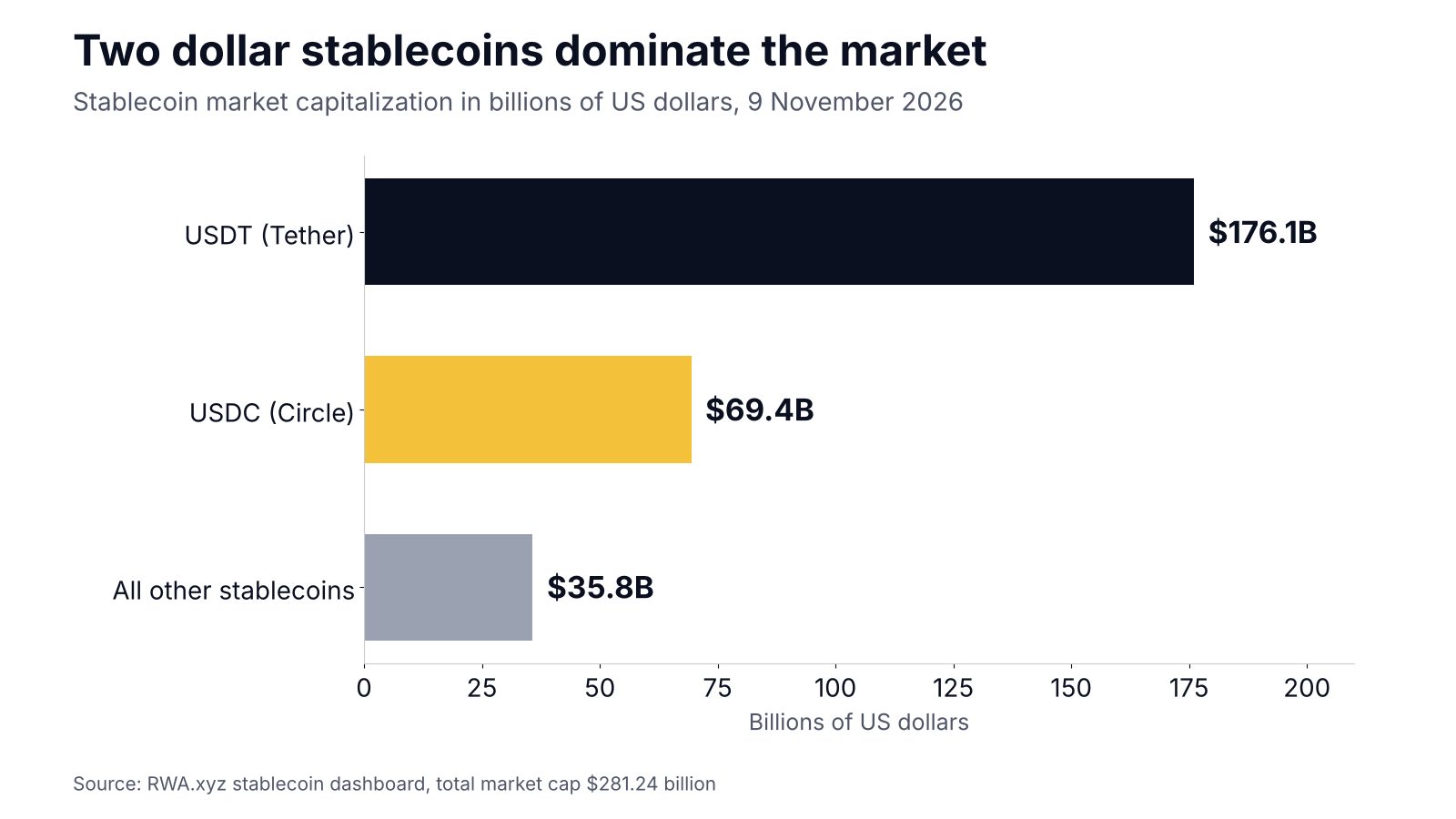
Many Pakistanis are drawn to stablecoins because they track the dollar. But a stablecoin is only as good as its issuer and reserves, it carries no deposit protection, and depegs have happened before. A PVARA advisory of April 26, 2026 also says that any arrangement enabling stablecoin services for users in Pakistan needs prior PVARA authorisation (PVARA advisory). Do not treat any stablecoin as a bank account.
Where does yield come from?
Real yield comes from real activity such as trading fees or borrower interest, and it moves up and down with demand. It is never fixed, never guaranteed and never safe. If nobody can explain where the yield comes from, you are the yield.
Is DeFi safe? The risks in one table
DeFi is not automatically safer because it is “decentralized”. It moves the risk from a bank onto you. These are the risks that actually hurt people.
| Risk | What happens | Honest note |
|---|---|---|
| Smart contract bugs and hacks | A flaw in the code lets an attacker empty the contract | Audits and a long track record reduce this risk. They do not remove it |
| Rug pull | The team behind a new token or pool takes the deposited money or abandons the project, and the token falls to almost nothing | Most common with new, anonymous projects that advertise very high returns |
| Approval and phishing drains | You sign a transaction on a fake site or a malicious app, and it gains permission to spend your tokens | An approval stays active until you revoke it. Ethereum.org advises never giving unlimited access and revoking old approvals regularly (guide) |
| Stablecoin depeg | The token trades below 1 dollar because confidence in its reserves or design breaks | Size helps. It is not a guarantee |
| Impermanent loss | You deposit two tokens into a pool, one moves a lot in price, and you end up with less value than if you had simply held both | Trading fees may or may not cover it |
| Liquidation | Your collateral falls in price and the protocol sells it to repay your loan, plus a penalty | Affects borrowers only. Do not borrow while you are learning |
| Wrong network or wrong address | Coins sent on the wrong network or to a wrong address are usually gone for good | “A transaction sent on Ethereum is irreversible” (Ethereum.org) |
| No customer support or recourse | No helpline, no chargeback and no deposit protection. A smart contract cannot be asked for a refund | Anyone who messages you offering “support” or “fund recovery” is a scammer |
How big is the problem? Chainalysis counted over $3.4 billion stolen across crypto from January to early December 2025, including $1.5 billion from one centralized exchange, Bybit. It also counted 158,000 personal wallet theft incidents affecting at least 80,000 victims, worth $713 million (Chainalysis, December 2025). The same report says DeFi hack losses stayed low in 2024 and 2025 even as money returned to DeFi. Attackers are going after people, not just protocols.
Is DeFi legal in Pakistan? The rules in short
Rules box (checked November 9, 2026). Under the Virtual Assets Act, 2026, the Pakistan Virtual Assets Regulatory Authority (PVARA) licenses businesses that offer crypto services in or from Pakistan. Exchange, custody, and lending and borrowing are all licence categories (PVARA FAQ). The same FAQ does not mention DeFi, staking or self custody wallets, and I found no rule written for an individual who uses a DeFi app from their own wallet. That is not the same as “anything goes”. Crypto is not legal tender, and a person or company that offers exchange, custody or lending services to people in Pakistan as a business needs a PVARA licence. Calling the offer “DeFi” does not change that. An NOC is not a licence, and on November 9, 2026 I could not find any platform holding a full licence.
I do not repeat the full rules on this page. The detail is in my guide on whether crypto is legal in Pakistan, and every dated step is on the Pakistan Crypto Rules Tracker. Not legal advice: rules change quickly, so check pvara.gov.pk yourself and speak to a qualified lawyer or tax adviser about your own situation.
How much do Pakistanis use DeFi?
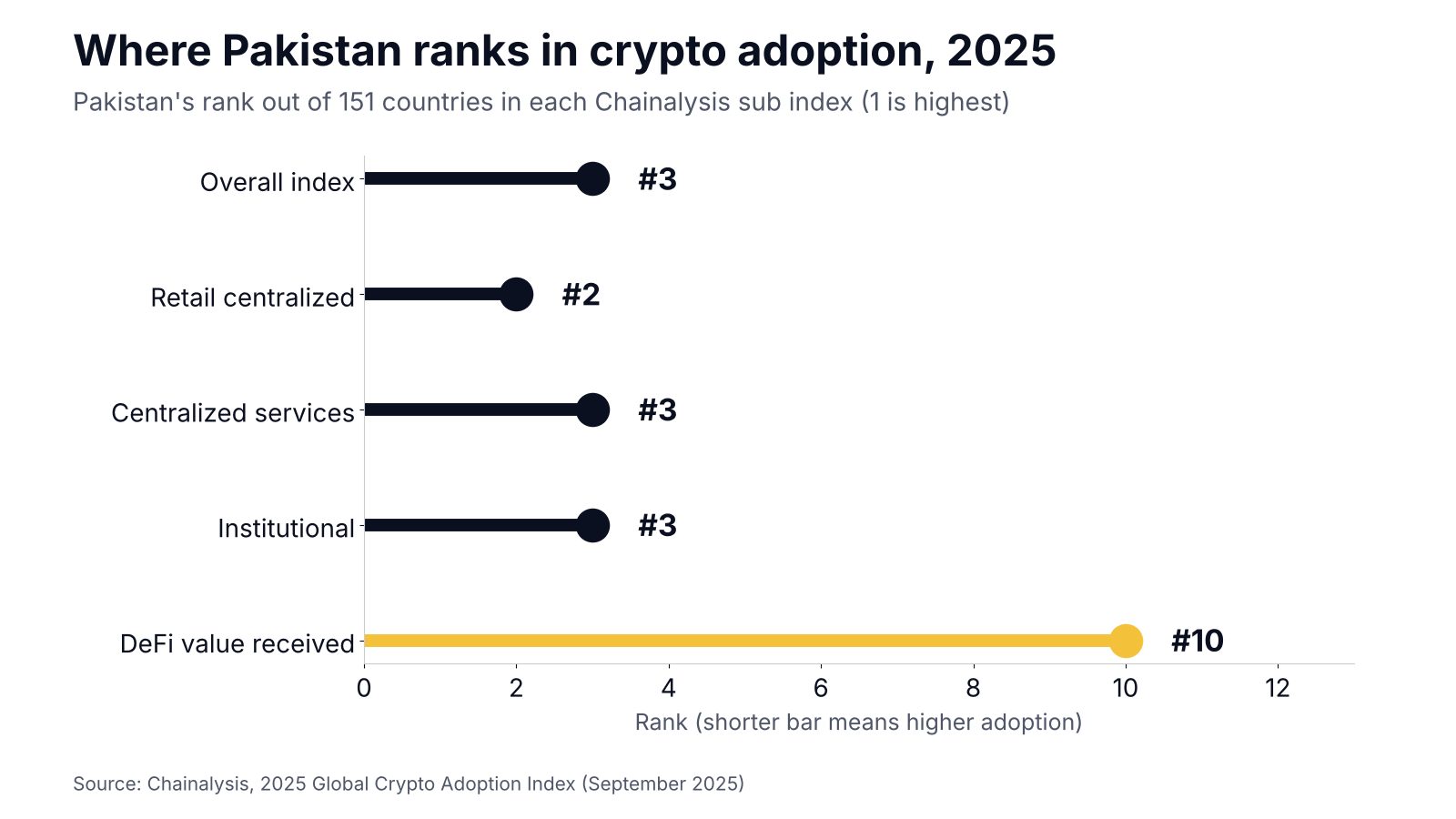
Pakistanis use crypto heavily, but mostly through centralized platforms. In the Chainalysis 2025 Global Crypto Adoption Index, published in September 2025 and covering 151 countries, Pakistan ranked 3rd overall, 2nd for retail centralized services and 10th for DeFi value received.
Scams that borrow DeFi words: the Pakistan edition
The scams I see in Pakistani WhatsApp and Telegram groups are rarely real DeFi. They borrow DeFi words to look modern.
- “Guaranteed halal monthly profit” schemes. In August 2025, the SECP warned the public not to invest with MAG Ventures, which promised “guaranteed halal monthly profits ranging from 5% to 12%” and collected deposits partly through crypto wallets, as reported by Business Recorder. Any fixed monthly return is a Ponzi warning sign.
- Fake support agents. No real exchange or wallet will ever ask for your seed phrase. Anyone who asks is a scammer, no exceptions.
- Fake tokens and airdrops. A token with a famous name and a tiny price is often a copy. Free tokens that appear in your wallet can lead you to a draining website when you try to sell them.
- “Mining” and “staking” apps with referral levels. If income depends on recruiting people, it is MLM wearing a crypto costume.
- Binary options platforms dressed as crypto. “Up or down in 60 seconds” apps are not DeFi and not investing. Stay away.
If you have already sent money, my scam complaint help page lists where to report, and PVARA has its own complaints page.
How to learn DeFi safely without money
You do not need to buy anything to understand DeFi. This is the order I recommend, and it costs nothing.
- Read before you click. Start with the Ethereum.org DeFi page linked above and the official documentation of one large protocol. If you cannot explain in two sentences where an app’s yield comes from, you are not ready to use it.
- Create a practice wallet. Install one well known self custody wallet from its official website only, and make a fresh wallet that will never hold real funds. Write the seed phrase on paper anyway, to build the habit: never in a screenshot, WhatsApp or Google Drive.
- Switch to a test network. Ethereum.org calls Sepolia “the recommended default testnet for application development”, and ETH on a testnet is “supposed to have no real value” (Ethereum.org networks page). Test tokens come free from a faucet, a website where you paste your public address. A faucet never needs your seed phrase, and you should never pay anyone for test tokens.
- Practise the real actions. Send a test transfer, make a swap, then supply and withdraw on the test version of a lending app. Aave, for example, lists a Sepolia test deployment (Aave help). Read every wallet pop up before you sign it.
- Practise cleaning up. Look up your practice address on a block explorer, then view and revoke the approvals you gave. The Ethereum.org guide in the risk table lists the tools, Revoke.cash among them.
- Keep a learning log. Write down each action, the fee it showed and what confused you. Only after that decide whether DeFi deserves any of your money at all.
What about real money? As of November 9, 2026, I could not find a fully licensed platform for buying crypto with rupees, so I am not giving a real money plan here. Do not try to get in early through P2P sellers, informal dealers or someone else’s account. If a legal route opens later, the same habits apply: a small wallet for experiments, a separate one you never connect to apps, a test transaction before any larger one, and nothing you cannot afford to lose.
Can you earn money from DeFi?
Not reliably, and never safely. Lending rates change with demand, liquidity fees come with impermanent loss, and reward tokens can fall in price faster than they are paid out. None of it is fixed, none of it is guaranteed, and none of it is a salary.
If your goal is income, a skill pays far more reliably than yield on a small balance. My guide to online earning in Pakistan covers that side. For trading specifically, start with the crypto trading in Pakistan guide.
Frequently asked questions about DeFi
Is DeFi halal?
Scholars differ on interest based lending, so many Muslim users avoid lending and borrowing for interest and only hold, swap or use stablecoins for payments. If this matters to you, ask a qualified Islamic finance scholar about the specific product.
Do I pay tax on DeFi in Pakistan?
I found no tax rule written specifically for DeFi. An FBR official told Arab News in June 2026 that crypto gains are already taxable as capital gains under existing law. If you ever use real funds, keep dated records of every transaction in rupees and ask a tax adviser.
What is the difference between DeFi and Web3?
Web3 is the wider idea of internet apps built on blockchains, including tokens, digital ownership and communities. DeFi is the financial part of it. My Web3 vs Web2 guide covers the rest, including where the skills turn into a career.
What is the best DeFi app for beginners?
There is no single best app, and I do not recommend one. Large, long running protocols such as Uniswap for swaps and Aave for lending are commonly used, but “large” reduces risk, it does not remove it. While you are learning, the best app is the test version of a well documented one.
Written by Muhammad Ismail (Ismail Blogger), founder of Ismailblogger in Islamabad, earning online since 2010, Binance Top KOL Pakistan and crypto educator to a combined audience of about 1M.
Free playbook
The Crypto Safety Playbook 2026
Wallet setup, Pakistan rules, the eight scams to avoid and simple risk rules for DeFi beginners. Free PDF, opens instantly.
Get it free →Keep reading