
Short answer: You can get a virtual card in Pakistan legally from SBP licensed apps and banks: SadaPay (Mastercard, free), NayaPay (Visa), JazzCash, Zindigi, UBL and Allied Bank. All of them hold rupees. On a foreign currency payment you pay the card’s own fee plus an advance tax of 0.5% for filers and 1% for non filers.
Key takeaways
- The tax is small in 2026. Section 236Y advance tax on card payments abroad is 0.5% for filers and 1% for non filers (Finance Act 2026). It was 5% and 10% before.
- The card fee is the real cost. SadaPay lists 6% on international payments, UBL 4.5% (minimum Rs 150), Allied Bank 4% (minimum Rs 100), and NayaPay a flat USD 0.25 per international card transaction.
- A 20 USD subscription costs about Rs 5,630 to Rs 5,920 at Rs 276.71 per dollar, depending on the card and your tax status. The filer saves only about Rs 28 on it.
- One yearly limit covers all your cards: USD 30,000 per person for international card payments, and it resets on 1 November.
- Never buy a “USA virtual card” from a Facebook or Telegram seller. You get no bank protection and the seller keeps control of the card.
Every fee here was read on the provider’s own schedule of charges on 15 November 2026. Schedules change every quarter or half year, so open the linked schedule before you order a card. Where a provider does not publish a figure, this guide says “not published, check in app”.
Want to see what being a non filer costs you across cards, banking, cars and property? Run your numbers in the filer vs non filer calculator. For card payments the gap is small. For most other things it is not.
What is a virtual card in Pakistan?
A virtual card is a debit card that lives inside an app. It has a card number, an expiry date and a CVV, like a plastic card, but nothing is printed or delivered.
In Pakistan these are virtual debit cards, not credit cards. They spend the rupees already in your wallet or bank account, and the issuer converts a dollar charge into rupees. For foreign sites you need Visa or Mastercard. PayPak is a domestic scheme.
Which bank or app gives a virtual debit card in Pakistan?
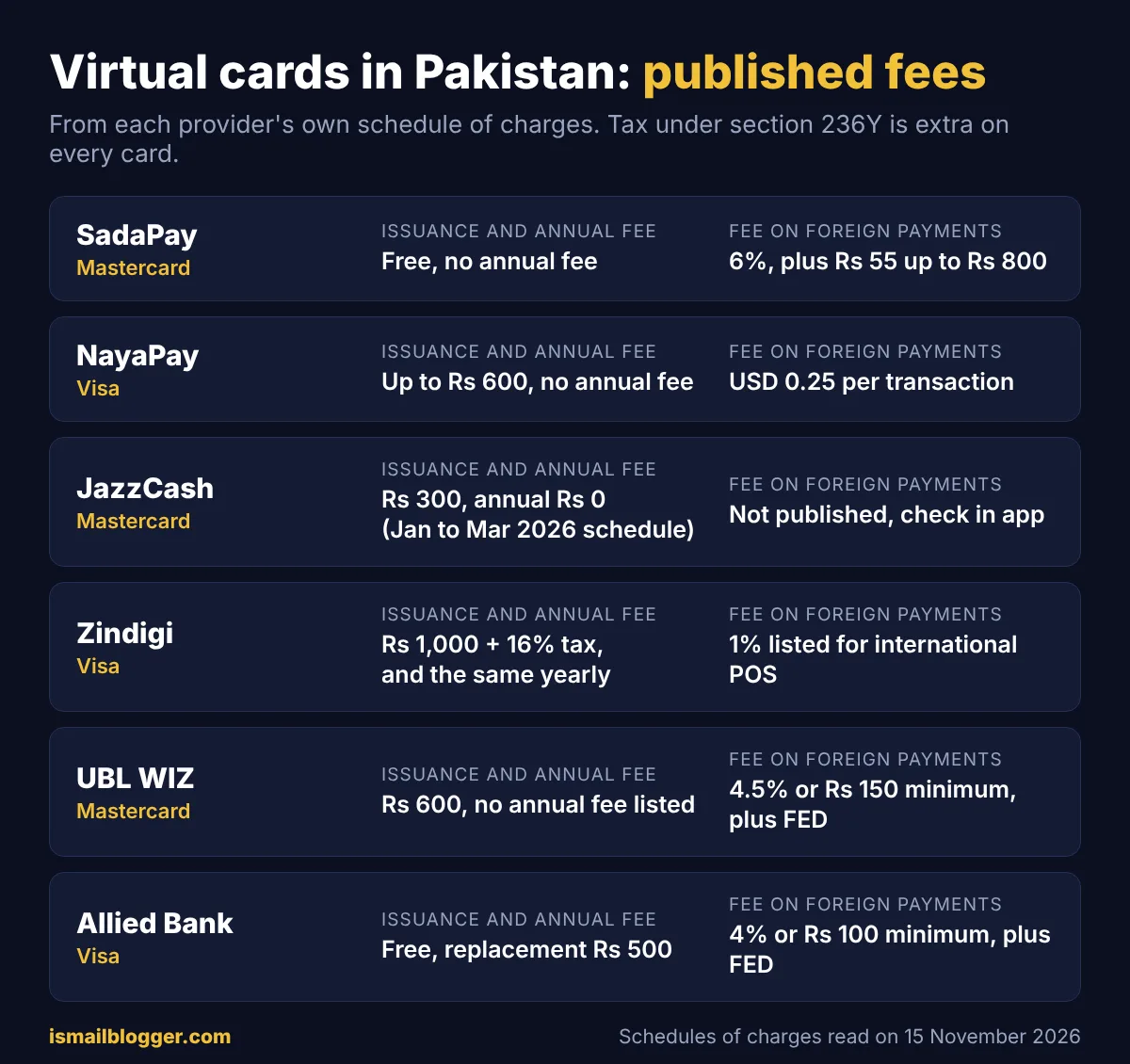
We opened the current schedule of charges of each provider on 15 November 2026. This is what they publish.
| Card | Network | Issuance and annual fee | Fee on foreign payments |
|---|---|---|---|
| SadaPay virtual card | Mastercard | Free, no annual fee | 6%, plus Rs 55 if the payment is up to Rs 800 |
| NayaPay virtual card | Visa | Rs 600 listed as the maximum, help centre says free; no annual fee | USD 0.25 per international card transaction; conversion markup not published, check in app |
| JazzCash virtual card | Mastercard | Rs 300, annual fee Rs 0 (January to March 2026 schedule) | Not published, check in app |
| Zindigi virtual card | Visa | Rs 1,000 plus 16% tax to issue, and the same every year | 1% listed for international POS; online not listed separately |
| UBL WIZ virtual card | Mastercard | Rs 600 to issue, no annual fee listed | 4.5% or Rs 150, whichever is higher, plus FED |
| Allied Bank virtual card | Visa | Free; replacement Rs 500 | 4% or Rs 100, whichever is higher, plus FED |
| Bank Alfalah virtual card | Not stated in schedule | Rs 250 plus tax | 4.5% listed for its debit cards |
The figures come from the July to December 2026 schedules of SadaPay, NayaPay, UBL, Allied Bank and Bank Alfalah, and the October to December 2026 schedule of Zindigi.
What we could not confirm
- Easypaisa. Its schedule of charges files did not open for us on 15 November 2026, so no Easypaisa figure appears here. Check the card section in the app.
- JazzCash. The newest schedule we could open is the Mobilink Bank notice for January to March 2026. Confirm the Rs 300 in the app.
- HBL and Meezan Bank. HBL’s July to December 2026 schedule has no virtual debit card line, and Meezan’s schedule page did not open.
- NayaPay’s issuance fee. The schedule lists Rs 600 as the most it may charge, while the help centre still says the virtual card is free. The app shows the real figure.
For one or two small dollar subscriptions, the two wallet cards are the easiest start: no branch visit, no annual fee. A flat fee suits bigger payments and a percentage suits tiny ones.
What extra charges apply on a foreign currency card payment?
A foreign payment on a rupee card has up to four parts. Here is each one, so you can see where the money goes.
1. The exchange rate
The issuer converts dollars to rupees at its own or its partner bank’s rate on the settlement date, not at the rate you saw on Google.
2. The card’s international fee
This is the fee in the table above. Bank schedules are written “exclusive of FED”, so Federal Excise Duty or provincial sales tax is added on the fee itself. Zindigi’s schedule shows that tax as 16%.
3. Advance tax under section 236Y
Section 236Y of the Income Tax Ordinance tells every bank to collect advance tax when it sends money abroad for your card payment. Division XXVII of Part IV of the First Schedule sets the rate at 0.5% of the gross amount. The Finance Act 2026 cut it from 5%.
If your name is not on the Active Taxpayers List, rule 1 of the Tenth Schedule doubles it to 1%. Zindigi’s current schedule prints the same two rates.
Some bank documents still print the old rates. Bank Alfalah’s July to December 2026 schedule shows “Filer: 5%, Non-Filer: 10%” for its virtual card, and an old block on SadaPay’s page says the same. If your statement shows 5% or 10% tax on a payment made after 1 July 2026, ask the bank which rate it applied.
The tax is adjustable. A filer can claim it against the year’s tax bill in the return. A non filer cannot, which is one more reason to become a filer and to check your ATL status once a year.
How much does a 20 USD subscription cost in PKR?
Here is a worked example. The rate is Rs 276.71 per dollar, the State Bank’s mark to market rate of 3 November 2026 as reported by ARY News. Your card’s rate on the day will differ.
Base amount: 20 x 276.71 = Rs 5,534.
This table uses a bank card with a 4.5% fee (UBL WIZ) and 16% FED on that fee.
| Item | Filer | Non filer |
|---|---|---|
| Price converted to rupees | Rs 5,534 | Rs 5,534 |
| Card fee, 4.5% | Rs 249 | Rs 249 |
| FED on the fee, 16% | Rs 40 | Rs 40 |
| Advance tax, section 236Y | Rs 28 (0.5%) | Rs 55 (1%) |
| Total deducted | Rs 5,851 | Rs 5,878 |
Now the same 20 USD payment on four cards, using each card’s published fee.
| Card | Card fee | Filer pays | Non filer pays |
|---|---|---|---|
| NayaPay (USD 0.25 flat) | Rs 69 | Rs 5,631 | Rs 5,659 |
| Allied Bank (4% plus FED) | Rs 257 | Rs 5,819 | Rs 5,846 |
| UBL WIZ (4.5% plus FED) | Rs 289 | Rs 5,851 | Rs 5,878 |
| SadaPay (6%) | Rs 332 | Rs 5,894 | Rs 5,922 |
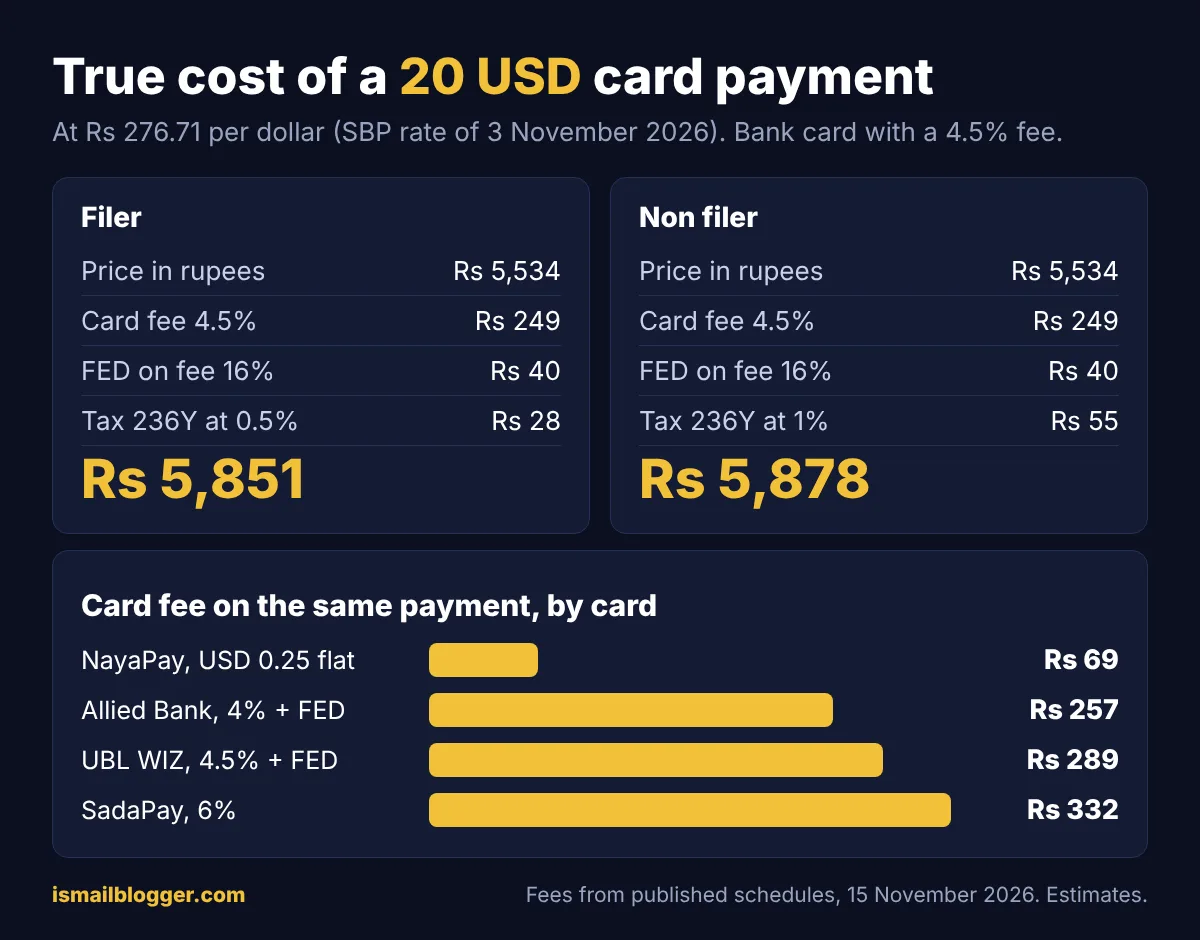
Two cautions. NayaPay does not publish its conversion markup, so its real total can be higher. And SadaPay’s schedule marks the 6% as tax inclusive, while an example in its help centre works out to 6.96%, about Rs 53 more.
On a 20 dollar payment the filer saves about Rs 28 in tax, but the choice of card can change the bill by more than Rs 250.
Over a year of that subscription, the tax is about Rs 332 for a filer and Rs 664 for a non filer. The bigger filer benefits are elsewhere, and the filer vs non filer guide lists them rate by rate.
Can I use a Pakistani virtual card for ChatGPT, Canva, Netflix and Facebook ads?
Yes, if the card is Visa or Mastercard, has balance and has international use switched on. The merchant decides whether to accept a card, so no issuer can promise that every site will work. These cards were not tested for this guide; what follows comes from the published rules.
- ChatGPT, Canva, Google Workspace and other software. Look at the currency on the checkout page before you pay. If it shows dollars, all three charges above apply. If the service offers rupee pricing, choose it and compare.
- Netflix. Netflix publishes rupee plans for Pakistan, from Rs 250 to Rs 1,100 a month (checked 15 November 2026). A rupee price is not always a local payment: SadaPay’s help centre treats rupee payments to merchants like Netflix as international, so a Rs 500 payment draws 6% plus the Rs 55 fee.
- Facebook and Instagram ads. Ad platforms charge several times a month as your spend builds up. Each charge is a separate transaction, so a per transaction fee repeats and an empty wallet can fail several times in a row.
Pay yearly instead of monthly when you are sure you will use the service. One transaction means one flat fee and one chance of a decline, not twelve.
Which card suits freelancers, creators and online sellers?
Most people who earn online need a card for the same few things: design and AI tools, hosting and domains, and ad spend.
- One or two small tool subscriptions. A wallet card with no annual fee is enough. Compare the fee on your exact amount using the table above.
- Ad spend that is charged many times a month. A percentage fee and a flat per transaction fee behave very differently here, so work out both on your real monthly budget before you load the card.
- Keep the statement entries. Tools, hosting and ads are business expenses, and the 236Y tax on them is adjustable, so download the statement each month for your tax return.
- Mind the yearly limit. The USD 30,000 limit covers personal payments. If your business spends more than that abroad, talk to your bank about a business account.
If you are still choosing how to earn, start with my guide to online earning in Pakistan. For a website, the hosting options are compared in best web hosting in Pakistan.
How do I get a virtual card and turn on international payments?
- Install the official app from the Play Store or App Store and open an account with your own CNIC and your own SIM.
- Complete biometric verification if the app asks.
- Open the Cards section and create the virtual card. Read the fee shown on the confirmation screen.
- Add money by Raast or bank transfer. Keep a little more than the price, because the fee and tax come on top.
- In the card settings, switch on online and international payments if they are off. UBL’s schedule even lists a Rs 100 charge when a payment fails because the channel is disabled.
- Enter the card number, expiry and CVV on the merchant’s site, and approve the OTP.
- Freeze the card when you are not using it, and unfreeze it before a renewal date.
Why do virtual card payments get declined?
- Not enough balance. The wallet needs the price plus fee plus tax. A wallet holding exactly Rs 5,534 will fail a 20 USD charge.
- Card frozen or international use off. Check the card status before you pay.
- Old renewals. A service you stopped using keeps trying the saved card. Remove the card from that site.
- Yearly limit reached. The State Bank allows USD 30,000 of international card payments per person per year across all cards, as the NayaPay help page explains. International use is suspended until the limit resets on 1 November.
- Business use. The same rule keeps personal cards for personal payments only.
Repeated declines carry a price. NayaPay charges its USD 0.25 fee on failed international transactions too, allows 5 failures, then charges to restore the card and blocks it after more. SadaPay lists Rs 500 to replace a virtual card blocked for declines.

Roman Urdu mein: virtual card kaun sa lein?
Pakistan mein virtual card SadaPay, NayaPay, JazzCash, Zindigi, UBL aur Allied Bank se mil jata hai. Yeh sab State Bank ke licence wale idaray hain. Dollar wali payment par card ki fee ke sath 236Y ka advance tax katta hai: filer ke liye 0.5%, non filer ke liye 1%. Choti payment ke liye fee ka column zaroor dekhein, kyun ke asal farq tax ka nahin, card ki fee ka hai. Facebook ya Telegram se “USA virtual card” kabhi na khareedein.
Mistakes and scams to avoid
Most problems with virtual cards come from where the card was bought and how its details were shared. Watch for these.

Buying “USA virtual cards” from Facebook or Telegram sellers
Pages and groups sell “USA virtual cards”, “trial cards” and “VCC for ads”. Avoid them.
- The card is in the seller’s name or someone else’s. The seller can see the balance, empty it or close it.
- You pay by wallet transfer to a stranger, with no refund route and no bank to complain to.
- An account opened with someone else’s card details can be closed by the service, with your work inside it.
If the seller is also pushing an earning offer, score it with the earning app checker first.
Sharing your card details
Never send your card number, expiry, CVV or OTP to anyone, including a caller claiming to be from the bank’s helpline.
Searches also show dollar cards loaded with crypto. Those are not issued by State Bank licensed banks or wallets, so they are outside this guide. Read how crypto is regulated under PVARA first.
What should you do next?
- Note the price and currency of what you want to pay for.
- Compare the fee of two cards from the table on that exact amount.
- Create the card in the official app, load the price plus about 10%, and make one payment.
- Check the statement entry: converted amount, fee and tax. If the tax line is more than 1%, ask the issuer why.
FAQ
Which is the best virtual card for international payments in Pakistan?
There is no single best card. On published fees checked on 15 November 2026, NayaPay’s flat USD 0.25 per international transaction is the lowest for payments of a few dollars or more, while SadaPay charges 6% and bank cards from UBL and Allied Bank charge 4.5% and 4%. NayaPay’s conversion markup is not published, so check the final amount in the app.
Is a virtual card free in Pakistan?
Some are. SadaPay’s schedule lists its virtual Mastercard as free and Allied Bank lists its virtual debit card as free. UBL charges Rs 600, JazzCash Rs 300 and Zindigi Rs 1,000 plus tax every year. Free issuance does not mean free use: international fees and tax still apply.
How much tax is deducted on international card payments in Pakistan?
Banks collect advance tax under section 236Y of the Income Tax Ordinance: 0.5% of the amount for filers and 1% for people not on the Active Taxpayers List, after the Finance Act 2026. On a 20 USD payment at Rs 276.71 that is about Rs 28 or Rs 55. The tax is adjustable in your income tax return.
Can I get a virtual credit card in Pakistan?
The virtual cards from wallets and banks in Pakistan are debit cards that spend your own balance, and sites that ask for a “credit or debit card” generally take them. A real credit card needs a bank’s approval, and the same 236Y tax and USD 30,000 yearly limit apply to it.
Is it safe to use a virtual card for online payments?
A virtual card from a licensed bank or wallet lets you keep a small balance on it and freeze it between payments, which limits what a leaked number can cost you. The risk comes from sharing the details or OTP, and from buying cards from unlicensed sellers.
Keep reading
Related articles
 Online Earning · 12 min readTikTok Monetization in Pakistan (2026): What Is Open and How Creators Really EarnRead article →
 Online Earning · 8 min readDropshipping in Pakistan 2026: How COD Works, Real Costs and the New TaxRead article →
 Online Earning · 27 min readOnline Earning for Students in Pakistan: 24 Real Options and a 30 Day PlanRead article →















0 comments
No comments yet. Start the conversation!