
Short answer: To become a filer in Pakistan, register yourself on FBR’s IRIS portal with your CNIC, a SIM in your own name, your own email and a bank account certificate, then file your income tax return for the last tax year. Your name joins the Active Taxpayers List (ATL) on FBR’s next Monday update, and from then on you pay the lower filer rates on bank profit, property and cars. Filing is free on IRIS; the only real cost of starting late is the late surcharge.
Key takeaways
- Two steps: register on IRIS (get your NTN), then file your return and wealth statement.
- Have these ready: CNIC, SIM registered on your CNIC, personal email, scanned bank account maintenance certificate in your name.
- Tax year 2026 means 1 July 2025 to 30 June 2026. Its deadline was extended to 31 October 2026, so filing now counts as late.
- Late for 2026? To get on the ATL, an individual pays a Rs 25,000 surcharge or gives a six month no property purchase undertaking.
- Students and people with low income can file too, and become filers even if no tax is due.
Why become a filer at all?
Because a non filer pays roughly double on most taxes cut at source. On a Rs 1 crore plot, the purchase tax is Rs 125,000 for a filer and Rs 1,050,000 for a non filer. On Rs 2 lakh of bank profit, the tax is Rs 40,000 against Rs 80,000. I worked through every rate for this year, from the Income Tax Ordinance itself, in filer vs non filer in Pakistan 2026-27, and you can put in your own numbers with our free filer vs non filer calculator.
Becoming a filer is not about paying more tax. For most people it is the cheapest way to stop paying double.
What you need before you start
FBR’s registration page says online registration on IRIS is for individuals only (an AOP or company registers at a tax office). Before you start, keep these ready:
- Your CNIC.
- A mobile SIM registered against your own CNIC (codes are sent to it).
- A personal email address that belongs to you.
- A scanned PDF of a certificate of maintenance of a personal bank account in your own name. Ask your bank for it; many banks also issue it through their app.
- If you run a business from a shop or office: proof of tenancy or ownership, and a paid utility bill not older than three months, both scanned as PDF.
- A computer or phone with internet, and a way to scan documents.
The bank certificate is the step most guides skip, and it is where many students get stuck. If you do not have a bank account in your own name yet, open one first. A digital account opened through a bank’s app is usually enough.
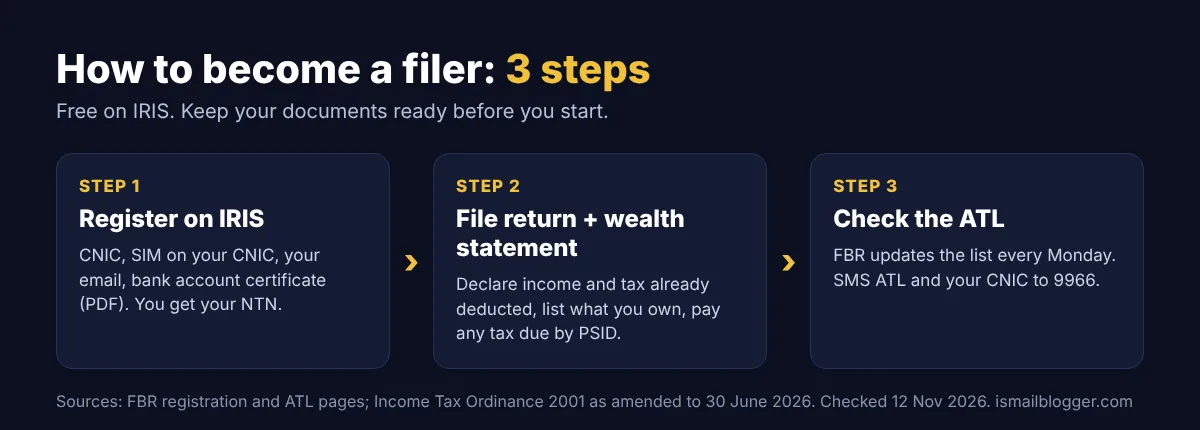
Step 1: Register on IRIS and get your NTN
- Open IRIS and choose the option for registration of an unregistered person.
- Enter your CNIC, mobile number and email. FBR sends verification codes to both; enter them to continue.
- Fill in the registration form: your name, address, source of income (salary, business, freelancing, property, or none), and your bank account details.
- Attach the scanned bank certificate (and business documents if they apply) and submit.
- FBR sends your login details. Your CNIC becomes your registration number (your NTN for an individual).
If you prefer help in person, FBR also registers individuals at the facilitation counter of any tax house. Take your original CNIC, your phone with the SIM on your CNIC, your email, and the original bank certificate.
Step 2: File your income tax return
Log in to IRIS with the password FBR sent, then:
- Open the return of income form for the right tax year. For a return filed now, that is usually tax year 2026 (income from 1 July 2025 to 30 June 2026).
- Enter your income under the right head: salary, business (freelancing usually falls here), property, or other sources.
- Enter the tax already deducted from you, for example by your employer, your bank, or on your phone and electricity bills. IRIS often pre-fills some of this; check it against your bank and salary slips.
- Fill in the wealth statement: what you own (bank balances, cash, gold, car, property) and what you owe at the end of the tax year. It must reconcile with your income and spending.
- Pay any tax that is still due through a payment slip (PSID) at your bank or in your banking app, then add the payment to the return.
- Submit. Save the acknowledgement.
The wealth statement is where most mistakes happen. Keep your bank statements open while you fill it, and do not leave out a car, plot or gold just because it is in your house. Next year’s statement starts from this one.
Step 3: Check that you are on the ATL
The ATL is updated every Monday, according to FBR. After that, send ATL, a space and your CNIC to 9966. If you filed on time you should show as active. My full guide on how to check your ATL status explains every result and what to do if you are not on the list.
Deadlines, and what happens if you are late
For individuals, section 118 of the Ordinance sets the due date as 30 September after the tax year ends. For tax year 2026, FBR extended it twice, to 15 October and then to 31 October 2026 (Tribune, 15 October 2026). No further extension had been announced when I checked on 12 November 2026.
If you file after the due date:
| Consequence | What the law says (as amended to 30 June 2026) |
|---|---|
| ATL for that year | You stay off it unless you pay a surcharge (section 182A) |
| Surcharge for an individual | Rs 25,000 (raised from Rs 1,000 by the Finance Act 2026) |
| Way to avoid the surcharge | An undertaking to the Commissioner not to buy any property for six months (section 182A(3)) |
| Late filing penalty | May apply under section 182: minimum Rs 10,000 if 75% or more of your income is salary, Rs 50,000 in other cases, reduced if you file within three months, capped at 200% of the tax payable |
The message is simple: late is still much better than never, and next year file before the deadline.
Your path, by situation
| You are | What to declare | Watch out for |
|---|---|---|
| Salaried | Salary from your employer’s certificate, plus any bank profit | Your employer already deducts tax monthly; the return just reports it. Every return is filed online on IRIS, as section 114(2A) requires. |
| Freelancer (Fiverr, Upwork, clients abroad) | Foreign income received through banks | Tax on IT export income is 0.25% if you are registered with PSEB, 1% if not (tax years 2024 to 2029). Keep your proceeds realization certificates. |
| YouTuber or creator | Platform income | Banks deduct 5% from social media platform income under section 154B since 1 July 2026, and 10% if you are not on the ATL. |
| Student, housewife, no income | Nil or small income, and what you own | You can still file and become a filer. Your wealth statement must explain any assets in your name. |
| Property or rental income | Rent received, sale gains | Property tax at sale and purchase depends on your ATL status at that time. |
New to earning online? Start with my guide to freelancing in Pakistan. For the freelancer and creator tax details, read my guides on tax for freelancers in Pakistan, PSEB registration for freelancers and YouTube income tax in Pakistan.
To estimate what you owe before you file, use our free income tax calculator, the salary tax calculator if you are salaried, or the freelancer tax calculator for export income.
Common mistakes that cause trouble later
- Leaving the wealth statement incomplete. Assets you leave out today become hard to explain later.
- Using someone else’s SIM or email. Registration codes and FBR notices go there.
- Filing for the wrong tax year. The tax year is named after the year it ends in.
- Forgetting tax already deducted. Bank, phone and electricity deductions can reduce your bill.
- Paying a “filer agent” for something you can do free. IRIS registration and filing cost nothing. Get help if your case is complex, but never hand your IRIS password to strangers.
How to become a filer: FAQ
Can a student become a filer?
Yes. A student can register and file a return showing nil or small income. You need a bank account in your own name for the registration certificate, and the wealth statement must show what you own.
Do I need an NTN to become a filer?
You need to be registered with FBR, which gives you an NTN (for individuals, your CNIC number). But the NTN alone does not make you a filer. You become a filer when your return is filed and your name appears on the ATL.
How much does it cost to become a filer?
Registering and filing on IRIS is free. You pay only the tax you owe, plus the late surcharge or penalty if you file after the due date.
Can overseas Pakistanis become filers?
Yes. Non residents can register and file online too, and the ATL rules apply to them for transactions in Pakistan. Some of the newer restrictions in section 114C do not apply to non residents, but the higher withholding rates for people off the ATL still do.
This article is general education, not tax or legal advice. Checked against FBR’s registration and ATL pages and the Income Tax Ordinance 2001 as amended up to 30 June 2026 on 12 November 2026. Deadlines and surcharges change with each Finance Act.
Keep reading