
Short answer: Being a filer in Pakistan means your name is on FBR’s Active Taxpayers List (ATL). A non filer is anyone who is not on it, and the law makes them pay roughly double on most taxes cut at source: 0.8% on daily cash withdrawals above Rs 50,000, 40% instead of 20% on bank profit, and up to 18.5% instead of 1.25% when buying property. The fix costs far less than the penalty, because filing one return puts you on the list.
Key takeaways
- Filer = on the ATL. The list is published every 1 March and updated every Monday by FBR.
- Non filers pay double on most withholding taxes. For car registration it is triple.
- Property is where it hurts most: 1.25% for a filer on a purchase, 10.5% to 18.5% for a non filer.
- Late filing became expensive in 2026: the surcharge to get on the ATL after the deadline is now Rs 25,000 for an individual.
- The “non filers cannot buy cars or property” rule is in the law but not switched on yet (as of November 2026).
Enter what you earned, bought or paid in the year to see what a non filer pays extra.
What is a filer and what is a non filer?
In daily talk, a “filer” is someone who files an income tax return. In law, the word that matters is the Active Taxpayers List. Section 181A of the Income Tax Ordinance lets FBR keep this list, and almost every rate in this article depends on one question: is your name on it on the day the tax is cut?
To be on the ATL you must file your return for the previous tax year. FBR publishes the list on 1 March each year, it stays valid until the end of February of the next year, and it is updated every Monday. So if you file today, you usually show up as a filer on the next Monday update, not instantly.
If you want to check your own status first, I have written a separate guide on how to check your ATL status by SMS, online and in the Tax Asaan app.
I read the Income Tax Ordinance as amended up to 30 June 2026, the version FBR publishes, for every rate below. Where a rate changed in the Finance Act 2026, I say so. Check the date at the end of this article before you rely on it.
Filer vs non filer tax rates in Pakistan 2026-27
This is the table most people are searching for. The filer column is the normal rate in the First Schedule. The non filer column comes from the Tenth Schedule, which sets the rule for people not on the ATL.
| Transaction | Filer (on ATL) | Non filer (not on ATL) | Section |
|---|---|---|---|
| Cash withdrawal from bank | No tax | 0.8% of the day’s total, if it is above Rs 50,000 | 231AB |
| Profit on bank deposits and savings | 20% | 40% | 151 |
| National Savings profit (DSC, RIC, SSC and similar) | 15% | 30% | 151 |
| Dividend from listed shares (general case) | 15% | 30% | 150 |
| Prize bond prize | 15% | 30% | 156 |
| Card payments abroad (foreign websites, subscriptions) | 0.5% | 1% | 236Y |
| YouTube, TikTok and other social media income | 5% | 10% | 154B |
| Buying property | 1.25% of fair market value | 10.5% up to Rs 50 million, 14.5% up to Rs 100 million, 18.5% above | 236K |
| Selling property | 2.75% of sale price | 11.5% of sale price | 236C |
| Registering a new car | 0.5% to 12% of value, by engine size | 3 times the filer rate | 231B |
| Transfer of a used car | Nil up to 850cc, then Rs 5,000 to Rs 62,500 by engine size, 10% less for each year since first registration | 3 times the filer amount | 231B(2) |
| Most other taxes cut at source | Normal rate | Normal rate plus 100% | Tenth Schedule, rule 1 |
| Salary, phone and internet bills | Same for both | Same for both | Excluded from the doubling |
Three rates changed in the Finance Act 2026: property purchase for filers is now a flat 1.25%, property sale for filers is now a flat 2.75%, and tax on card payments abroad fell from 5% to 0.5%. Older articles that still show property slab rates of 3% to 4% are out of date. The doubling does not touch salary tax or the tax on phone and internet bills, which are the same for everyone.
Most non filers do not pay more because they earn more. They pay more because they never filed one simple return.
What it costs in real rupees
Percentages hide the real damage. Here are worked examples using the rates above. These are my own calculations for illustration, not quotes for your case.
| Example | As a filer | As a non filer | You lose |
|---|---|---|---|
| Buying a Rs 1 crore plot (fair market value) | Rs 125,000 | Rs 1,050,000 | Rs 925,000 |
| Selling that plot for Rs 1 crore | Rs 275,000 | Rs 1,150,000 | Rs 875,000 |
| Registering a new 1300cc car worth Rs 45 lakh | Rs 67,500 | Rs 202,500 | Rs 135,000 |
| Rs 2 lakh profit on a savings account in a year | Rs 40,000 | Rs 80,000 | Rs 40,000 |
| Withdrawing Rs 2 lakh cash in one day | Rs 0 | Rs 1,600 | Rs 1,600 every such day |
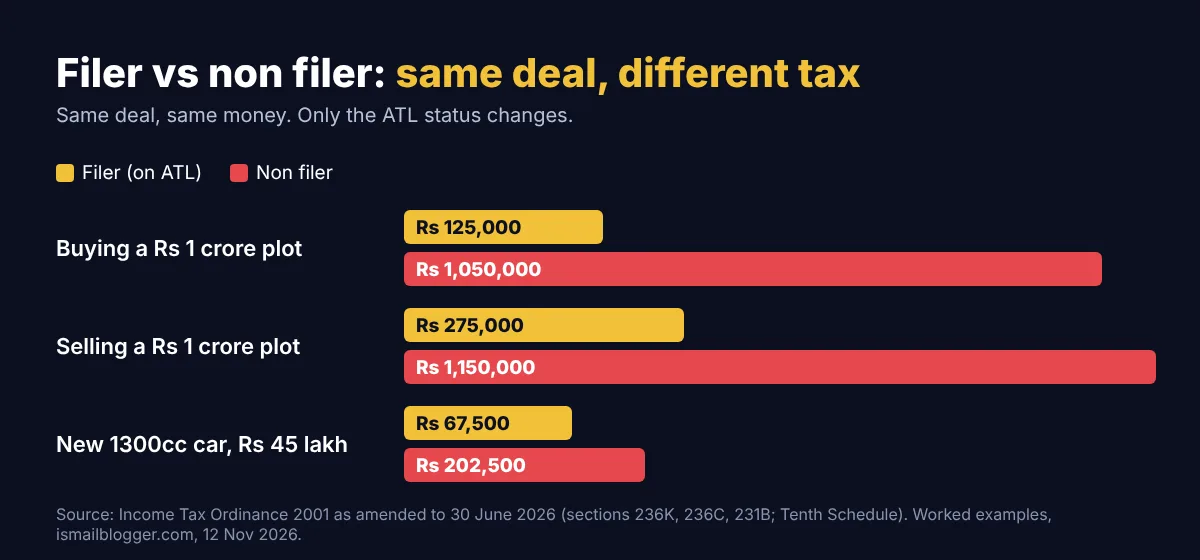
For property, the tax is worked out on the FBR valuation (fair market value), not only the price you agree. Our free property tax calculator for buyers and sellers works out the full bill, including provincial stamp duty.
Does a filer get any of this back?
Several of these are advance taxes. A filer can adjust them against the tax due in the return, and claim a refund if too much was taken. The law also lets a non filer adjust the higher tax if they later file a return for that year, but section 182A says no refund is issued while you are off the ATL. If you never file, the money simply stays with FBR, and FBR can even treat the tax it collected as a sign of hidden income and assess you on it. That is the hidden part of the cost that most comparison tables leave out.
The car rule: why non filers pay three times
For most taxes, the Tenth Schedule doubles the rate. Cars are the exception. The law says tax under section 231B is increased by 200% for people not on the ATL, which means three times the filer rate. Here is the filer rate on new registration by engine size, from Division VII of the First Schedule:
| Engine size | Filer rate (of value) | Non filer rate |
|---|---|---|
| Up to 850cc | 0.5% | 1.5% |
| 851cc to 1000cc | 1% | 3% |
| 1001cc to 1300cc | 1.5% | 4.5% |
| 1301cc to 1600cc | 2% | 6% |
| 1601cc to 1800cc | 3% | 9% |
| 1801cc to 2000cc | 5% | 15% |
| 2001cc to 2500cc | 7% | 21% |
| 2501cc to 3000cc | 9% | 27% |
| Above 3000cc | 12% | 36% |
This is income tax at registration. Your province’s token tax is a separate yearly charge; you can estimate it with our vehicle token tax calculator.
Can a non filer buy a car or property at all?
Yes, for now. The Finance Act 2025 added section 114C, which would stop an “ineligible person” from buying a car worth more than Rs 7 million, property worth more than Rs 100 million, investing more than Rs 50 million in securities, or withdrawing more than Rs 100 million in cash in a year. An eligible person is someone who filed last year’s return and declared enough resources in the wealth statement (130% of the cash and liquid assets needed for the deal), and the term covers their parents, spouse and dependent children.
But section 114C(5) says these limits start only on a date the federal government notifies. The cabinet turned down a proposal to switch them on from 1 July 2026, as Profit reported on 31 July 2026. Some websites describe the restrictions as already active. When I checked again on 12 November 2026, I found no Gazette notification, so they are law on paper but not in force.
You may also have seen June 2025 headlines saying the budget “ended” the filer and non filer distinction. Those stories were about section 114C. The higher non filer rates in the Tenth Schedule are still in the Ordinance as amended to 30 June 2026, so the table above still applies.
If you plan a big purchase in the next year, do not wait for the notification. File your return and keep your wealth statement honest and complete now, because eligibility depends on what you declared last year.
Filed late? The 2026 surcharge rule
If you miss the return deadline, section 182A keeps you off the ATL for that year. You can still get on the list by paying a surcharge. The Finance Act 2026 raised it sharply:
| Person | Old surcharge | From Finance Act 2026 |
|---|---|---|
| Individual | Rs 1,000 | Rs 25,000 |
| Association of persons | Rs 10,000 | Rs 50,000 |
| Company | Rs 20,000 | Rs 100,000 |
FBR’s own ATL help page still showed the old Rs 1,000 figure when I checked on 12 November 2026, so go by the Ordinance, not that page.
There is one new way out for individuals. Under section 182A(3), you do not have to pay the surcharge if you give the Commissioner an undertaking that you will not buy any property for six months from the date of the undertaking. If you have no property deal coming up, that option can save you Rs 25,000.
Who else is treated as a filer?
A few details from FBR’s ATL rules surprise people:
- Joint bank accounts: the account is treated as on the ATL if any one of the holders is on it.
- Minor’s account: treated as on the ATL if a parent or guardian, or whoever deposits the money, is on it.
- People not required to file: if your income is below the taxable limit and the law does not require you to file, the bank or other withholding agent can notify the Commissioner instead of charging the higher rate. In practice, filing a simple return is usually faster than relying on this.
Filer vs non filer: should you become a filer?
If you earn anything at all, own a bank account with savings, or plan to buy or sell property or a car, the answer is yes. A student or a housewife with no income can usually file a nil or low income return too. The money you save on one property deal or one year of bank profit is larger than any cost of filing.
The steps are simple: get registered on IRIS, file the return for last tax year, then check your status on the next Monday. I walk through each step, with separate paths for students, salaried people and freelancers, in how to become a filer in Pakistan.
If you earn from Fiverr, Upwork or YouTube, read my guides on tax for freelancers in Pakistan and YouTube income tax in Pakistan, and estimate your yearly tax with the income tax calculator or, if you are salaried, the salary tax calculator.
Filer vs non filer FAQ
Is a person with an NTN automatically a filer?
No. An NTN only means you are registered. You become a filer (on the ATL) only after you file your return for the relevant tax year. Many people have an NTN and are still non filers.
How soon after filing do I become a filer?
FBR updates the ATL every Monday, so your name normally appears on the first Monday update after a return filed on time is processed. If you filed after the due date, you also need to pay the surcharge or give the undertaking described above.
Does it cost money to become a filer?
FBR charges no fee to register on IRIS or to file your return online. You only pay the tax you actually owe, plus the late surcharge if you file after the deadline. A tax consultant is optional; for a simple salary or freelance return, many people file it themselves.
Does being a filer mean FBR will check my bank account?
Filing does not trigger anything on its own. FBR already receives data from banks, property registrars and excise departments about both filers and non filers. Filing honestly simply means your declared income and assets explain your spending.
This article is general education, not tax or legal advice. Rates checked against the Income Tax Ordinance 2001 as amended up to 30 June 2026 (Ordinance) on 12 November 2026. Rates change every June with the budget, so check again after the next Finance Act.
Keep reading